
How to Build a Full-Funnel Digital Marketing Strategy
On this page
Most marketing budgets bleed money at one specific point: the gap between awareness and conversion. Brands pour spend into Meta ads or Google Search, collect clicks, and then wonder why their pipeline looks thin. A full funnel marketing strategy fixes exactly that. It treats the customer journey as a connected system, not a collection of isolated campaigns. When every stage works together, your cost per acquisition drops and your return on ad spend climbs. If you want to understand what good ROAS looks like before you build your funnel, read our guide on what is ROAS and how to improve it for your business.
What Is a Full-Funnel Marketing Strategy
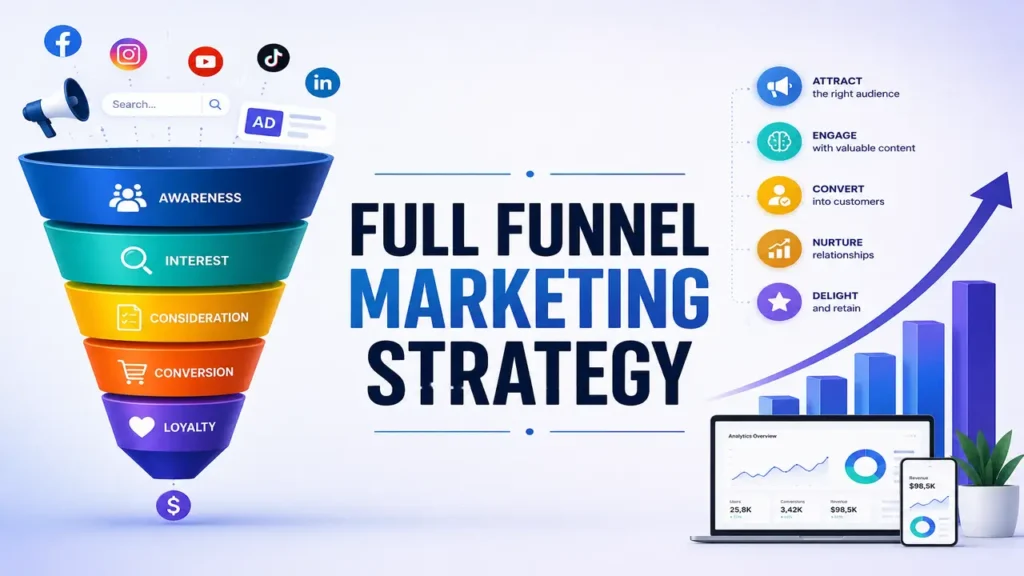
A full funnel marketing strategy is a structured approach to digital marketing that aligns content, ads, and messaging to every stage of the customer journey, from initial awareness through active consideration to final conversion. It maps TOFU (top of funnel), MOFU (middle of funnel), and BOFU (bottom of funnel) tactics to specific buyer behaviours, ensuring no stage of the marketing funnel is left unaddressed and that each touchpoint builds on the last.
Why a Full-Funnel Marketing Strategy Matters in 2026
Buyers do not move in a straight line. A prospect might discover your brand through a YouTube pre-roll, read a comparison blog three days later, and finally convert after seeing a retargeting ad on Instagram. If your strategy only covers one or two of those touchpoints, you are handing the sale to a competitor who shows up everywhere.
According to HubSpot’s 2024 State of Marketing Report, marketers who use three or more channels in their campaigns see a 287% higher purchase rate than those using a single channel. Multi-channel marketing is not optional at this point. It is the baseline expectation for any brand operating at scale. Our performance marketing services are built around exactly this principle.
In the Indian market specifically, this matters even more. Indian buyers, especially in B2B and high-ticket D2C segments, often move through longer consideration cycles. A prospect might engage with a brand on LinkedIn, shift to WhatsApp for queries, and convert through a Google Search ad. A full funnel marketing strategy that accounts for this cross-platform behaviour is the only way to stay present throughout that cycle. Tools like Google Analytics 4 allow you to track assisted conversions across channels, giving you a verified view of how each stage of your marketing funnel is contributing to revenue. For a closer look at how Indian businesses can approach this, our guide on digital marketing for small businesses in India covers the platform-specific behaviour patterns that shape the Indian buyer journey.
Building the TOFU, MOFU, BOFU Framework for Your Full-Funnel Marketing Strategy
The first step in any full funnel marketing strategy is accepting that not everyone who sees your brand is ready to buy. The marketing funnel exists precisely to accommodate that reality. Each stage, awareness, consideration, and conversion, requires different content, different channels, and different success metrics.
Top of Funnel (TOFU): Awareness
At the awareness stage, your job is reach and relevance. You are not selling yet. You are introducing. TOFU content should educate, entertain, or address a broad problem your target audience already has.
Channels that work well here include YouTube pre-roll ads, Meta awareness campaigns, programmatic display, Instagram Reels, and SEO-driven blog content targeting informational keywords. For Indian brands running Meta campaigns, a daily budget of even Rs. 500 to Rs. 1,000 can generate meaningful reach in Tier 1 cities when targeting is tight. Understanding how programmatic display fits into your TOFU mix is worth the effort; our breakdown of what is programmatic advertising and how does it work explains exactly where it sits in a full funnel marketing strategy.
The metric to track at TOFU is not conversions. It is reach, video view rate, and branded search lift.
Middle of Funnel (MOFU): Consideration
This is where most full funnel marketing strategies fall apart. Brands generate awareness, then go silent while the buyer is actively comparing options.
At the MOFU stage, your content needs to build trust and answer specific questions. This is where case studies, product comparison pages, webinars, email nurture sequences, and retargeting ads earn their money. A buyer who has already visited your site once is five times more likely to convert if you re-engage them with specific, relevant content. Setting up retargeting properly is one of the highest-leverage moves in any full funnel marketing strategy; our guide on how to set up a Facebook retargeting campaign that actually works walks through the full setup for the Meta environment.
Key MOFU tactics to build into your full funnel marketing strategy:
Retargeting ads on Meta and Google Display targeted at site visitors who did not convert
Email sequences triggered by content downloads or free trial sign-ups
Comparison landing pages that address common objections directly
LinkedIn thought leadership content for B2B buyers still in research mode
Case studies segmented by industry or use case, not generic testimonials
Webinars or live Q and A sessions that let prospects self-qualify
Bottom of Funnel (BOFU): Conversion
At BOFU, the buyer is close. They just need the right push. This is where high-intent Google Search ads, personalised email offers, and direct sales outreach do the heaviest lifting.
Your BOFU assets should be built to remove friction, not to introduce more information. Pricing pages, free trials, demo requests, and limited-time offers all belong here. Your landing pages at this stage deserve special attention: CRO services and landing page optimisation are often the fastest wins available at the bottom of the funnel. Every piece of your full funnel marketing strategy should be pulling prospects toward this stage with less resistance each time they return.
How to Build a Full-Funnel Marketing Strategy Step by Step
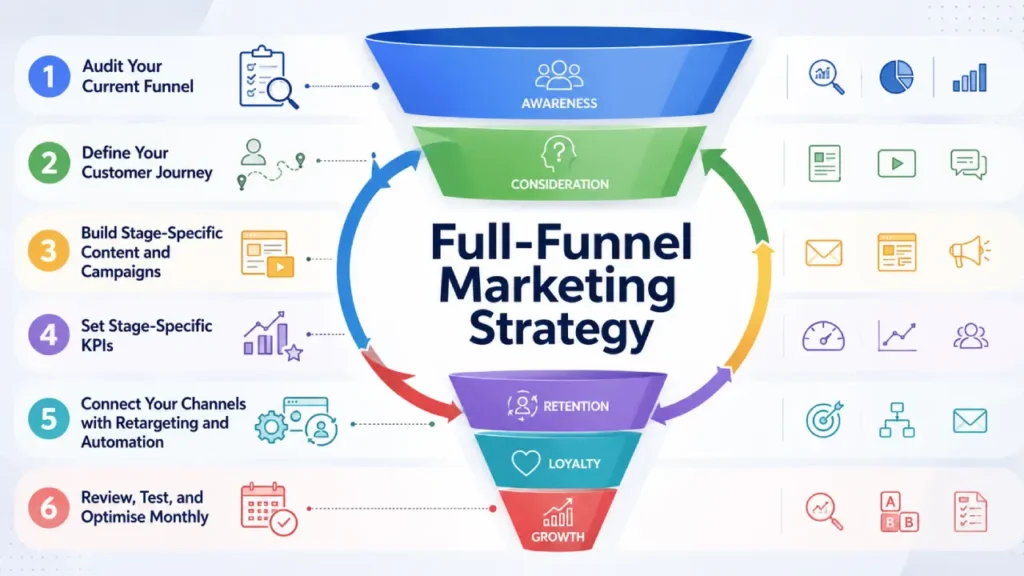
Building a full funnel marketing strategy from scratch does not require a massive budget. It requires a clear process. Here is the approach I use with clients, broken down into six stages.
Step 1: Audit Your Current Funnel
Before building anything new, map what you already have. List every active channel, every content asset, and every paid campaign. Tag each one as TOFU, MOFU, or BOFU. Most brands discover they are heavily weighted toward one stage, usually the bottom, and have almost nothing at awareness or consideration. A free SEO audit is a useful starting point for spotting gaps in organic coverage across funnel stages.
Step 2: Define Your Customer Journey
Interview real customers or review your CRM data to understand how buyers actually move through your marketing funnel. How many touchpoints did they have before converting? Which channels appeared most frequently in the path? In Google Analytics 4, the Path Exploration report gives you a verified view of this journey. One of the most instructive exercises at this stage is mapping the SEO vs PPC split in your attribution data; our comparison of SEO vs PPC and which your business should invest in first helps clarify how each channel contributes at different funnel stages.
Step 3: Build Stage-Specific Content and Campaigns
With your customer journey mapped, build content and campaign assets for each stage. Do not repurpose a bottom-of-funnel offer for a cold audience. The messaging, format, and call to action must match where the buyer is in their decision-making process. Our content marketing services cover the full range of content types needed at each stage, from informational blog posts to high-converting landing page copy.
Step 4: Set Stage-Specific KPIs
A full funnel marketing strategy only works if you are measuring the right things at the right stage. At TOFU, measure reach and engagement rate. At MOFU, measure email open rates, return visitor rate, and content downloads. At BOFU, measure conversion rate, cost per lead, and revenue. If you are running paid campaigns at multiple stages, understanding the relationship between ROAS and cost per lead is essential; our article on how to reduce cost per lead without sacrificing lead quality addresses this directly.
Step 5: Connect Your Channels with Retargeting and Automation
This is what turns a collection of campaigns into a genuine full funnel marketing strategy. Use pixel-based retargeting to follow TOFU visitors into MOFU campaigns. Use email automation services to move MOFU leads toward BOFU offers. Connect your CRM to your ad platforms so sales and marketing are working from the same data. For B2B funnels specifically, LinkedIn Ads are often the most effective MOFU channel; our guide on how to use LinkedIn Ads to generate B2B leads in 2026 covers the setup and targeting approach in detail.
Step 6: Review, Test, and Optimise Monthly
A full funnel marketing strategy is not a set-and-forget exercise. Review performance at each funnel stage monthly. Identify where prospects are dropping off and test new content or messaging to address it. The brands that win are the ones that treat their marketing funnel as a living system, not a static plan. Whamply’s approach to campaign management follows this same principle; you can read more about our process and how we build and optimise full funnel strategies for clients across industries.
Common Mistakes to Avoid in a Full-Funnel Marketing Strategy
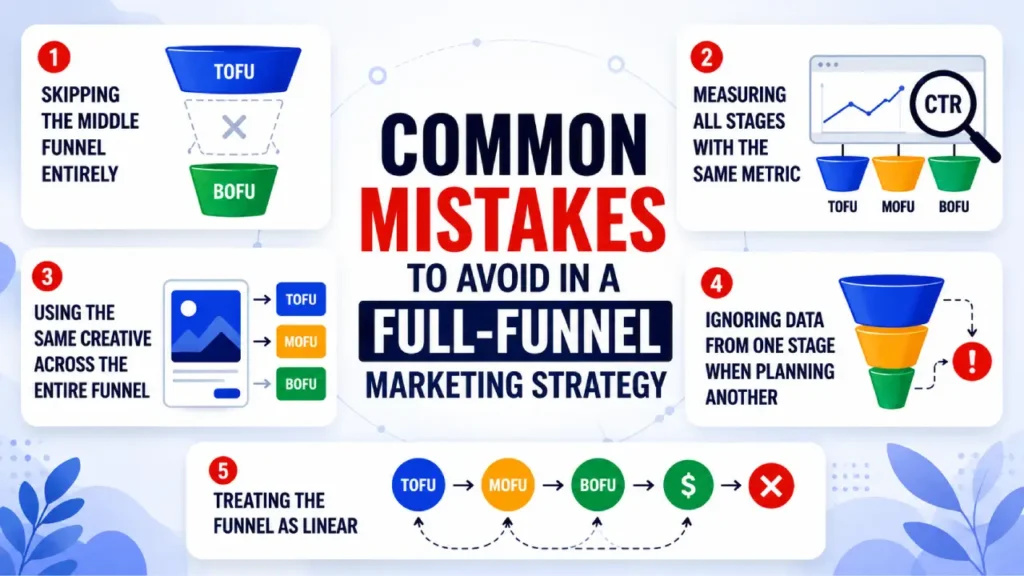
Skipping the Middle Funnel Entirely
Most brands have a TOFU campaign running and a BOFU offer ready, but nothing in between. The consideration stage is where buyers spend the most time. Leaving it unaddressed means you are generating awareness for competitors who do have MOFU content. Build at least two MOFU assets, a case study and a comparison page, before you scale any awareness spend.
Measuring All Stages With the Same Metric
If you are judging your YouTube awareness campaign by cost per conversion, you will always kill it before it has a chance to work. Each stage of the marketing funnel needs its own success metric. Applying BOFU logic to TOFU campaigns is one of the most common and most costly mistakes in a full funnel marketing strategy.
Using the Same Creative Across the Entire Funnel
A cold audience does not need a demo offer. A retargeted visitor does not need to be introduced to your brand again. When creative does not match funnel stage, your click-through rates drop and your cost per result rises. Build a creative matrix that maps specific ad formats, messaging angles, and calls to action to each funnel stage. The distinction between Google Ads and Meta Ads in terms of audience intent is particularly relevant here; our guide on Google Ads vs Meta Ads and which drives better ROI in 2026 explains how to allocate creative and budget across both platforms within a full funnel marketing strategy.
Ignoring Data From One Stage When Planning Another
Your TOFU data tells you which audiences are engaging. Your MOFU data tells you which objections are coming up. Your BOFU data tells you what finally drives the decision. If your campaign teams are not sharing this data with each other, your full funnel marketing strategy is running on guesswork. Lead generation services that are properly integrated with your CRM and ad accounts solve this problem at the operational level.
Treating the Funnel as Linear
Real buyers loop back. A prospect might convert, churn, and re-enter the funnel at the consideration stage. Build your full funnel marketing strategy to accommodate re-entry, especially through post-purchase email flows and win-back campaigns. The customer journey is not a one-way street.
Conclusion
The single most actionable move any brand or agency can make right now is to audit their existing campaigns by funnel stage and identify where prospects are going silent. In most cases, it is the consideration stage. The second step is building even one strong MOFU asset, a case study, a comparison page, or a retargeting sequence, and connecting it to what is already running at the top and bottom. Those two actions alone will improve performance before you change a single budget line.
If you want a professional review of your current marketing funnel and a clear view of where budget and effort should be focused, book a free audit services with the Whamply strategy team. We will map your customer journey, identify the gaps, and give you a prioritised action plan built for your specific market and budget.
Frequently Asked Questions
What is a full-funnel marketing strategy?
A full funnel marketing strategy is a coordinated approach to digital marketing that covers every stage of the customer journey, from brand awareness at the top of the funnel, through consideration in the middle, to conversion at the bottom. It ensures that marketing activity is present and relevant at every point where a buyer might interact with your brand.
What does TOFU MOFU BOFU mean in marketing?
TOFU stands for top of funnel, MOFU for middle of funnel, and BOFU for bottom of funnel. These three stages represent the awareness, consideration, and conversion phases of the marketing funnel. Each stage requires different content, different channels, and different performance metrics.
Why is a full-funnel marketing strategy better than running isolated campaigns?
A full funnel marketing strategy connects every touchpoint in the customer journey, meaning prospects are never left without a relevant next step. Isolated campaigns typically generate either awareness without follow-through or conversions without sufficient audience volume, both of which inflate your cost per acquisition over time.
How many channels should a full-funnel marketing strategy include?
There is no fixed number, but HubSpot data shows that three or more channels produce significantly higher purchase rates than single-channel approaches. A practical full funnel marketing strategy typically uses two to three TOFU channels, one to two MOFU channels, and one to two BOFU channels, depending on budget and audience size.
What is the difference between multi-channel marketing and a full-funnel marketing strategy?
Multi-channel marketing refers to being present on multiple platforms. A full funnel marketing strategy goes further by connecting those platforms to specific stages of the customer journey and ensuring the messaging, content, and calls to action are appropriate for where a buyer is in their decision process.
How long does it take to build a full-funnel marketing strategy?
A basic full funnel marketing strategy can be built in four to six weeks. This includes auditing existing assets, mapping the customer journey, building stage-specific content, setting up retargeting audiences, and connecting ad platforms to a CRM. Ongoing optimisation is continuous.
What metrics should I track at each stage of the marketing funnel?
At TOFU, track reach, impressions, and video view rate. At MOFU, track return visitor rate, email open rate, and content downloads. At BOFU, track conversion rate, cost per lead, and return on ad spend. Using the same metric across all stages gives you a distorted view of what is actually working.
Can a small business run a full-funnel marketing strategy on a limited budget?
Yes, In India, for example, a brand can run a functional full funnel marketing strategy with a monthly budget of Rs. 30,000 to Rs. 50,000 by prioritising Meta for TOFU awareness, email for MOFU nurturing, and Google Search for BOFU capture. The key is allocating budget proportionally across stages rather than concentrating it all at conversion.
What content works best at the consideration stage of the marketing funnel?
Case studies, product comparison pages, how-to guides, webinars, and retargeting ads addressing specific objections all perform well at the MOFU stage. The goal is to give a prospect enough information and trust to move toward a buying decision without pushing them too hard toward conversion before they are ready.
How do I know if my marketing funnel has a leak?
A funnel leak is typically visible in your analytics as a sharp drop-off between two stages. If you have strong TOFU traffic but weak MOFU engagement, your awareness audience is not being re-engaged. If you have strong MOFU engagement but low BOFU conversion, your offer, pricing, or friction point at the conversion stage needs attention. Google Analytics 4’s funnel exploration tool can pinpoint this precisely.
What is the role of retargeting in a full-funnel marketing strategy?
Retargeting is the mechanism that moves prospects from one stage of the marketing funnel to the next. Without retargeting, a TOFU visitor who does not convert immediately is lost. With retargeting, that same visitor sees MOFU content designed specifically for someone who already knows your brand, dramatically increasing the likelihood of eventual conversion.
How does a full-funnel marketing strategy apply to B2B companies?
In B2B, the customer journey is longer and involves more stakeholders. A full funnel marketing strategy for a B2B brand typically uses LinkedIn and content marketing for TOFU, email sequences and case studies for MOFU, and direct outreach or demo campaigns for BOFU. The consideration stage in B2B can last weeks or months, making MOFU investment especially important.
Is SEO part of a full-funnel marketing strategy?
Yes, SEO contributes to all three stages of the marketing funnel. Informational blog posts drive TOFU awareness through organic search. Comparison and review content captures MOFU intent. High-intent transactional pages target BOFU searches. A full funnel marketing strategy that includes SEO reduces dependence on paid channels over time. Whamply’s SEO services are structured specifically to support all three funnel stages through organic search.
What tools are used to manage a full-funnel marketing strategy?
Google Analytics 4 for tracking the customer journey across channels, a CRM platform for lead nurturing, Meta Ads Manager and Google Ads for paid campaigns across all funnel stages, and an email automation platform for MOFU sequences. These tools, used together, give you a connected view of your full funnel marketing strategy performance. Whamply’s AI-powered marketing services layer automation and AI-driven optimisation across all of these tools simultaneously.
How often should a full-funnel marketing strategy be reviewed?
Monthly reviews are the minimum for an active full funnel marketing strategy. At each review, check drop-off points between stages, test new creative or messaging at any stage showing weakness, and reassess budget allocation based on where the funnel is performing and where it is losing prospects.