
What is Programmatic Advertising and How Does It Work
On this page
Programmatic advertising now accounts for over 90% of all digital display advertising spend globally, yet most marketing teams still set up campaigns based on guesswork rather than system logic. If you have ever wondered why your display advertising costs keep rising without a proportional return, the answer is almost always in how your buying process is structured. Most brands running paid campaigns through a performance marketing agency are already operating inside programmatic ecosystems without fully understanding the infrastructure beneath them.
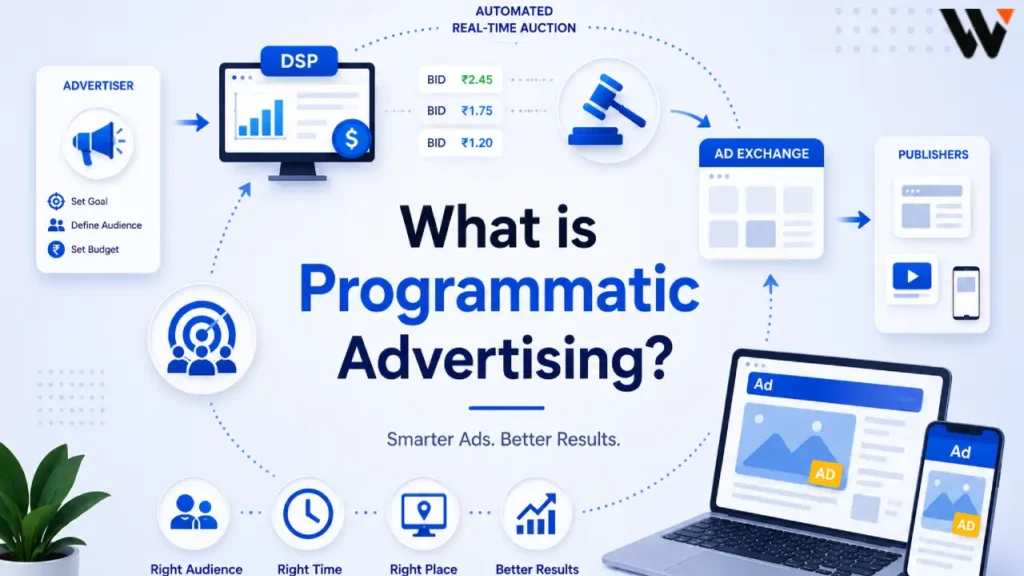
What is programmatic advertising? Programmatic advertising is the automated buying and selling of digital ad inventory in real time, using software platforms called DSPs (Demand-Side Platforms) and SSPs (Supply-Side Platforms), connected through ad exchanges. Instead of negotiating placements manually, advertisers set targeting rules and bid parameters, and the system uses data about users, context, and price signals to buy the right impression at the right moment, often within milliseconds.
Why Programmatic Advertising Matters in 2026
The scale of programmatic advertising has made manual media buying largely obsolete for anything beyond premium sponsorships. According to Statista programmatic digital display ad spend is projected to exceed $725 billion globally by 2026. That is not a niche channel. It is the default operating system of digital media.
For Indian markets specifically, the shift has been fast and uneven. Platforms like Google Display Network, DV360, and The Trade Desk are now widely used by agencies across Mumbai, Bengaluru, and Delhi NCR, but CPM benchmarks in India remain significantly lower than Western markets, often ranging from INR 20 to INR 120 per thousand impressions depending on audience segment quality and placement type. That gap represents opportunity, not a limitation.
Brands running Google Ads Services alongside programmatic buys increasingly need to understand how these two environments interact. Budget allocated between search ads and programmatic display should be driven by where in the funnel your audience sits, not habit.
How the Programmatic Advertising Ecosystem Actually Works
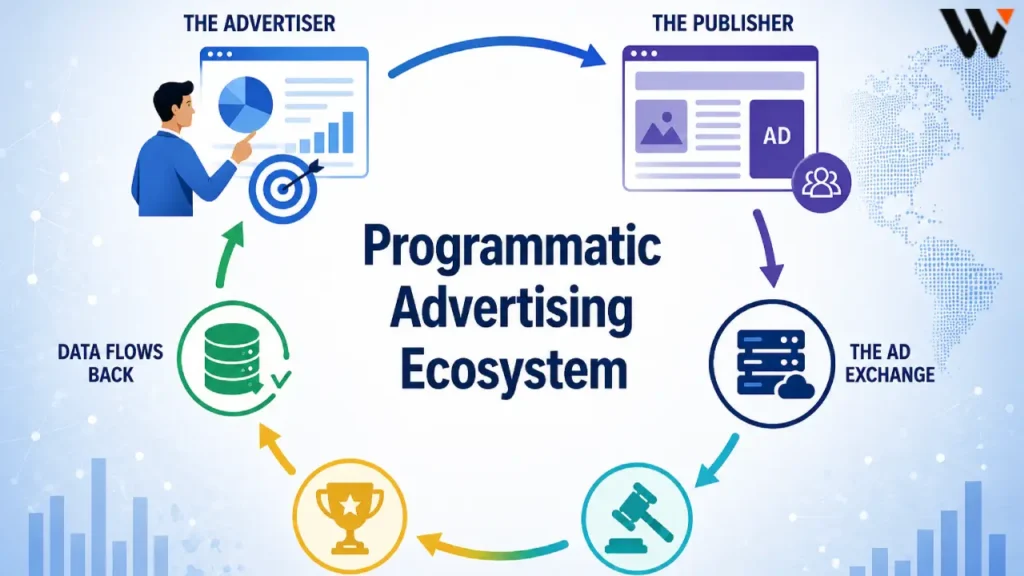
The ecosystem behind programmatic advertising involves several layers of technology working simultaneously. Most advertisers see only the campaign dashboard. What happens underneath is a structured auction that takes place every time a webpage loads.
Here is what the supply and demand chain looks like in practice:
- The advertiser sets a campaign in a DSP like Google’s DV360, The Trade Desk, or MediaMath, defining target audience segments, CPM bids, creative assets, and frequency caps.
- The publisher connects their available ad inventory to an SSP like Magnite, PubMatic, or Google Ad Manager, which makes that inventory available to multiple ad exchanges simultaneously.
- The ad exchange sits between the DSP and SSP, running a real-time auction. When a user loads a page, the exchange sends a bid request to connected DSPs in milliseconds.
- The DSP evaluates the bid request, checking whether the user matches the advertiser’s audience segments and what the impression is worth. If it is a match, the DSP submits a CPM bid.
- The winning bid gets the impression. The advertiser’s ad appears on the publisher’s page. The entire process takes roughly 100 milliseconds.
- Data flows back into the DSP as the campaign runs, allowing the system to optimise bids, shift budget toward better-performing placements, and refine audience segments based on performance signals.
The reason programmatic advertising outperforms manual buying is not magic. It is that this system evaluates millions of impression-level variables simultaneously, things no human media buyer could process at speed, including device type, time of day, browsing history signals, content context, and historical conversion data from similar users.
Programmatic advertising works best when it is paired with strong conversion infrastructure. Sending programmatic traffic to a generic homepage wastes the precision of the buying system. Landing page optimisation is one of the highest-leverage improvements any programmatic advertiser can make. The ad system can find the right user, but only a well-structured page can convert them.
What is programmatic advertising without real-time bidding? Technically, private marketplace deals (PMPs) and programmatic guaranteed deals also fall under programmatic advertising. These skip the open auction and involve direct agreements between a single advertiser and publisher, but still use the same DSP and SSP infrastructure for delivery and reporting. It is a common misconception that programmatic advertising only means open auction RTB.
Types of Programmatic Advertising Deals and Formats
Not all programmatic advertising campaigns run on the same buying model. The deal type you choose determines how much control you have over placement, pricing, and audience reach.
Step 1: Open Auction (RTB)
This is the most common entry point. Your DSP bids against all other advertisers in a real-time auction for available impressions. CPMs are dynamic and usually lower, but inventory quality varies. For most display advertising campaigns at scale, this is where the majority of budget runs. Whamply’s display ads service manages open auction campaigns for brands across India and the UK, with specific attention to inventory quality and brand safety controls from day one.
Step 2: Private Marketplace (PMP)
A publisher invites a select group of buyers to bid on their premium inventory before it goes to open auction. You still compete in a real-time bidding environment, but the pool is smaller and the inventory is higher quality. PMPs are common for brand-safe news environments and vertical publishers.
Step 3: Preferred Deals
One advertiser, one publisher, one fixed CPM. You get first right of refusal on specific inventory, but the publisher is not obligated to fill your order. Good for testing premium placements without a long-term commitment.
Step 4: Programmatic Guaranteed
A reserved deal with a fixed price and a guaranteed number of impressions. This resembles traditional direct buying but uses DSP and SSP infrastructure for targeting and reporting. Used most often for brand campaigns where reach certainty matters more than CPM efficiency.
Step 5: Choose Your Format
Programmatic advertising supports display advertising (banner and rich media), video (pre-roll, mid-roll, outstream), connected TV (CTV), audio, and native. The format should match the user’s context and your campaign objective. Running video programmatic advertising on mobile in India, for example, requires attention to load speeds and data constraints that many mid-range device users still face. YouTube Ads sit at the intersection of programmatic video and owned-platform inventory, and are often the most cost-efficient video entry point for Indian advertisers before graduating to broader DSP video buys.
Step 6: Set Audience Segments and Exclusions
Audience segments in programmatic advertising come from three sources: first-party data (your CRM, pixel, or app data), second-party data (shared by a partner directly), and third-party data (purchased from data providers via the DSP). Exclusions are as important as inclusions. Dynamic remarketing campaigns benefit from tightly defined audience exclusions in particular, as retargeting pools without proper segmentation often re-expose converted users unnecessarily, which wastes budget and skews attribution data.
Common Mistakes to Avoid in Programmatic Advertising
Running on open auction with no brand safety controls
Open RTB inventory includes long-tail sites that most brands would never choose manually. Without content category exclusions and domain blocklists, ads for established businesses end up appearing next to low-quality or inappropriate content. Every DSP offers brand safety layers. Use them from day one. An SEO audit services of your own site’s referral traffic can also reveal patterns that indicate where your programmatic ads may have been running, which is a useful secondary check on your DSP’s brand safety reporting.
Setting and forgetting frequency caps
Without proper frequency controls, the same user sees your ad 30 times in a week. This is not reach, it is annoyance. CPM models in programmatic advertising make it easy to burn budget on a narrow audience at high frequency. Set impression caps per user per day and per campaign window. If bounce rates from display advertising traffic are high and session durations are very short, frequency is usually a contributing factor, and CRO services work hand in hand with programmatic optimisation to address what happens after the click.
Ignoring CPM floors and bid shading nuances
Many advertisers focus only on what they bid, not on what they actually pay. Bid shading, available in most modern DSPs, reduces what you pay in second-price auctions. But if your CPM bids are too low, you win only low-value inventory. If they are too high without floors, you overpay consistently. Audit your bid landscape monthly.
Not separating prospecting and retargeting audience segments
Mixing new audience segments with retargeting audiences in the same programmatic advertising campaign produces misleading performance data and competing bid logic. Separate them. Prospecting campaigns need different CPM benchmarks, creative, and success metrics compared to retargeting. B2B lead generation campaigns that rely on programmatic prospecting need particularly clean audience separation, because cost per lead benchmarks for cold audiences are structurally different from re-engagement costs.
Treating all display advertising formats the same
A 300×250 banner, an outstream video unit, and a native ad require entirely different creative approaches, different CPM benchmarks, and different optimisation windows. Running the same creative across all formats inside one programmatic advertising campaign makes it impossible to understand what is driving performance. SEO content writing and landing page copy play a direct role here too: the quality of the page that programmatic traffic reaches determines post-click performance, not just the ad creative itself.
Conclusion
The single most important thing to take away from understanding what is programmatic advertising is that the technology is only as effective as the strategy behind it. Audience segment quality, deal structure, creative relevance, and bid logic determine outcomes far more than which DSP you use.
If your programmatic advertising campaigns are not performing to CPM, viewability, or conversion benchmarks, a structured audit is the right starting point. Book a free audit at or get in touch directly to discuss your programmatic advertising setup with the Whamply team.
Frequently Asked Questions
What is programmatic advertising in simple terms?
Programmatic advertising is automated digital ad buying. Software replaces manual negotiation, using real-time bidding and audience data to purchase ad impressions automatically across websites, apps, and other digital channels.
How is programmatic advertising different from Google Ads?
Google Ads runs within Google’s own properties and search network. Programmatic advertising, run through platforms like DV360 or The Trade Desk, accesses inventory across thousands of third-party publishers and ad exchanges outside Google’s walled garden. Many advertisers run both, with search ads covering high-intent queries and programmatic handling upper-funnel reach and retargeting.
What is a DSP in programmatic advertising?
A DSP (Demand-Side Platform) is the software an advertiser uses to buy ad inventory programmatically. It connects to multiple ad exchanges and SSPs, allowing centralised campaign management, audience targeting, and real-time bidding from a single interface.
What is an SSP in programmatic advertising?
An SSP (Supply-Side Platform) is the technology publishers use to sell their ad inventory to multiple buyers simultaneously. It maximises the publisher’s revenue by exposing inventory to competing DSPs in real-time auctions.
What is real-time bidding (RTB)?
Real-time bidding is the auction mechanism that runs within programmatic advertising. When a user loads a page, an auction takes place in milliseconds. The DSP with the highest qualifying bid wins the impression and serves the ad.
What CPM rates should I expect in programmatic advertising?
CPM rates vary significantly by market, format, and audience quality. In India, open auction display CPMs typically range from INR 20 to INR 120. In the UK and US, equivalent placements run between $1 and $8 CPM on open exchanges, with premium PMP inventory running higher.
Is programmatic advertising suitable for small businesses?
Yes, with realistic expectations. Programmatic advertising has a minimum effective budget threshold. Spending below INR 50,000 to 80,000 per month makes it difficult to gather enough data for meaningful optimisation. Below that level, Facebook Ads or Instagram Ads may offer better efficiency for smaller budgets, as their auction systems require less data volume to optimise effectively.
What audience segments can I use in programmatic advertising?
Audience segments in programmatic advertising include demographics, interest-based segments, in-market audiences, retargeting lists, contextual categories, and lookalike audiences built from your first-party data. The quality of your first-party data increasingly determines how well campaigns perform.
How does programmatic advertising use data after cookie deprecation?
Modern programmatic advertising relies on contextual targeting, first-party data clean rooms, and identity frameworks like UID2.0 and Google’s Privacy Sandbox. AI SEO strategies are increasingly relevant here, as first-party data collected through organic search channels becomes the foundation for programmatic audience building in a cookieless environment.
What is the difference between a PMP and open RTB in programmatic advertising?
Open RTB is a public auction open to all buyers. A PMP (Private Marketplace) is an invitation-only auction where a publisher offers premium inventory to a select group of advertisers at a negotiated floor price, still using real-time bidding infrastructure.
Which platforms are used for programmatic advertising in India?
The most widely used programmatic advertising platforms in India include Google’s DV360, The Trade Desk, MediaMath, InMobi (for mobile-first campaigns), and Xandr. Most Indian agencies run display advertising through DV360 or directly via Google Ad Manager for mid-size budgets.
What is viewability in programmatic advertising?
Viewability measures whether an ad was actually seen. The MRC standard requires at least 50% of a display ad to be visible for at least one second. Programmatic advertising campaigns should optimise for viewable CPM (vCPM) rather than raw CPM to ensure budget is spent on seen impressions.
Can programmatic advertising run on connected TV (CTV)?
Yes, CTV is one of the fastest-growing programmatic advertising channels. Advertisers can buy inventory on streaming platforms programmatically through DSPs, with similar audience segment targeting available as in digital display.
What is brand safety in programmatic advertising?
Brand safety refers to ensuring your ads do not appear next to harmful, offensive, or low-quality content. DSPs offer built-in brand safety controls using category exclusions, site blocklists, and third-party verification tools like IAS (Integral Ad Science) or Double Verify.
How long does it take to see results from programmatic advertising?
Display advertising campaigns through programmatic channels typically need 4 to 6 weeks of data before meaningful optimisation is possible. Campaigns with smaller audiences or niche audience segments may take longer. Performance in week one is rarely representative of the campaign’s true potential.