
How to Do Keyword Research for Paid Search Campaigns
On this page
Poor keyword research for PPC is the single most common reason paid search campaigns waste budget from day one. Google processes over 8.5 billion searches daily, and the advertisers winning the auction are not necessarily spending more. They are bidding on the right terms with the right match types against a tightly managed negative keyword list. Get the keyword strategy wrong and no amount of creative testing or bid optimisation will fix the damage. If you are running Google Ads and your cost per lead keeps climbing despite budget increases, the keyword layer is almost always where the problem starts.
What Is Keyword Research for PPC?
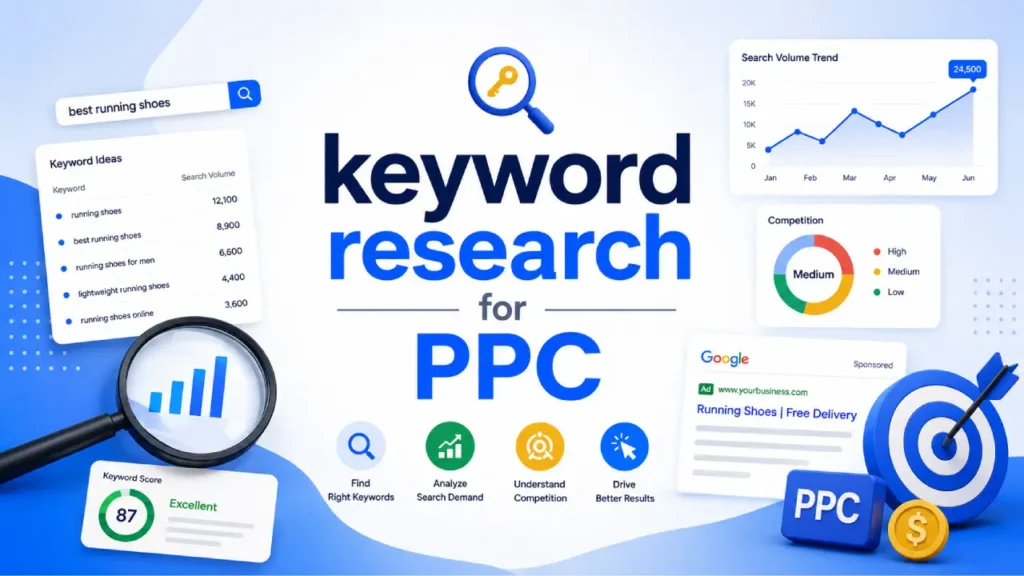
Keyword research for PPC is the process of identifying, evaluating, and organising the search terms that trigger your paid ads, so your budget reaches users who are most likely to convert. It involves analysing search intent, estimating search volume and competition using tools like Google Keyword Planner, selecting appropriate match types, building structured ad groups, and adding negative keywords to filter out irrelevant traffic before the campaign goes live.
Why Keyword Research for PPC Matters in 2026
Google Ads has become significantly more automated since Performance Max and broad match expansion took hold, but automation does not replace keyword strategy. It amplifies whatever foundation you give it. If your keyword research for PPC is shallow, Google’s smart bidding system will optimise toward the wrong traffic and your cost per conversion will reflect that within days. This is true whether you are running standard Search campaigns or a full Performance Max setup.
In India specifically, keyword research for PPC requires extra attention to language variation and buying intent signals. A search for “digital marketing agency” in Mumbai can mean anything from a student researching careers to a business owner ready to spend Rs 2 lakh per month. Without intent-qualified keyword lists, you are paying the same CPC for both. According to WordStream, the average click-through rate for Google Search Ads across industries is 6.42%, but accounts with tightly themed ad groups and intent-matched keywords consistently outperform that benchmark.
AI-powered search is also changing how queries are formed. Users are typing longer, more conversational searches, which makes long-tail keywords more valuable than ever in 2026. A keyword research for PPC strategy that ignores long-tail terms is leaving the highest-intent, lowest-competition traffic untapped. The same logic that makes long-tail keywords powerful in SEO applies here, except in paid search the reward is lower CPC rather than easier ranking.
How to Build Your Keyword List for PPC the Right Way
The starting point for any keyword research for PPC process is understanding what the user actually wants when they type a query. Search intent sits above everything else. A keyword with 10,000 monthly searches is worth nothing if the people searching it are not buyers.
Start with seed keywords, which are the broad, category-level terms that describe your product or service: From there you build outward using tools, competitor data, and search term reports from your own account history. Here is what a thorough keyword research for PPC process covers at the list-building stage:
Seed keywords based on core product or service categories: These become the framework for your ad groups. One theme per ad group is the standard that holds up across account sizes. For agencies running B2B lead generation campaigns, seed keywords should map directly to each service line or buyer persona rather than being pulled from a generic category list.
Keyword Planner data for search volume, competition level, and suggested bid ranges: In India, Google Keyword Planner shows bid ranges in INR and separates mobile and desktop volume, which is useful given the difference in conversion behaviour between the two.
Competitor keyword intelligence using tools like SEMrush, Ahrefs, or SpyFu: Entering a competitor’s domain shows which paid terms they are consistently bidding on, which is a reliable proxy for what converts in your category. Whamply’s AI competitor analysis service automates this process at scale for accounts where manual competitor tracking is too slow to keep pace with the market.
Long-tail keywords that signal specific intent. “Best CRM software for small business India under 5000” converts at a significantly higher rate than “CRM software,” even though the search volume is lower. Long-tail keywords also tend to have lower CPCs, which improves return on ad spend at the same budget level. For SaaS lead generation campaigns specifically, long-tail intent terms are often the only way to compete against category leaders with five-figure monthly budgets.
Search term reports from existing campaigns. If you are adding to an active account, the Search Terms report in Google Ads is the highest-quality source of keyword data you have. It shows actual queries that triggered your ads and their conversion outcomes.
Seasonal and trend-based terms. Google Trends shows how search volume for your keywords shifts across months and regions. In India, categories like education, real estate, and e-commerce have sharp seasonal spikes that should inform both keyword strategy and bid adjustments.
The goal at this stage is a list of 50 to 200 keywords per campaign, segmented by theme and intent, before any match type decisions are made.
Match Types, Negative Keywords, and Ad Group Structure
Getting keyword research for PPC right does not stop at the list. How you apply those keywords, through match types and ad group structure, determines whether your list performs or overspends. This structural layer is what separates accounts that reduce cost per lead over time from those that plateau.
Match types control how closely a user’s search query must match your keyword before your ad is eligible to show. The three active match types in Google Ads are Broad Match, Phrase Match, and Exact Match. Each has a distinct role in a well-built campaign.
- Start with Exact Match for your highest-value, highest-intent terms: Exact Match gives you the most control. Your ad only shows for queries that closely match your keyword, which means your budget goes to verified, intent-specific traffic. Use this for branded terms, competitor terms, and your core conversion keywords. Pair this with Search Ads campaigns structured around one theme per ad group for maximum Quality Score impact.
- Layer in Phrase Match for medium-intent terms where you want coverage without losing context: Phrase Match triggers your ad when the user’s query contains the meaning of your keyword, with words before or after allowed. This is where most of the volume sits in a healthy PPC keyword strategy.
- Use Broad Match only with Smart Bidding and strong audience signals: In 2026, Broad Match has become more accurate when paired with Target CPA or Target ROAS bidding and a Customer Match list. Without those constraints, Broad Match will expand into irrelevant territory and increase wasted spend significantly. If you are considering Broad Match, read Whamply’s breakdown of Performance Max campaigns first, since the two share similar AI-driven expansion behaviour and the same guardrails apply.
- Build your negative keyword list before the campaign launches: Negative keywords are the most underused element of keyword research for PPC. A well-maintained negative list prevents your ads from showing on searches that will never convert. Standard exclusions for most campaigns include terms like “free,” “jobs,” “courses,” “DIY,” and “Wikipedia.” Add negatives at the campaign level for broad exclusions and at the ad group level for theme-specific ones.
- Structure ad groups around single themes, not keyword dumps: Each ad group should contain keywords that share the same intent and could all be served by the same ad copy. Mixing “affordable accountant for startups” with “accounting software free trial” into one ad group produces poor Quality Scores and weak ad relevance. Tight ad group structure improves your Quality Score, which lowers your CPC and improves ad position. Better Quality Scores also feed directly into CRO performance by ensuring the user who clicks arrives at the most relevant landing page.
- Review the Search Terms report weekly and mine it for both additions and negatives: After your campaign goes live, the search terms your keywords actually trigger will tell you more than any keyword planning tool. Queries that convert should be added as exact or phrase match keywords. Queries that spend without converting should be added to your negative keyword list immediately. If this process reveals your landing pages are getting irrelevant traffic, that is a keyword structure problem, not a page problem.
Common Mistakes to Avoid in Keyword Research for PPC
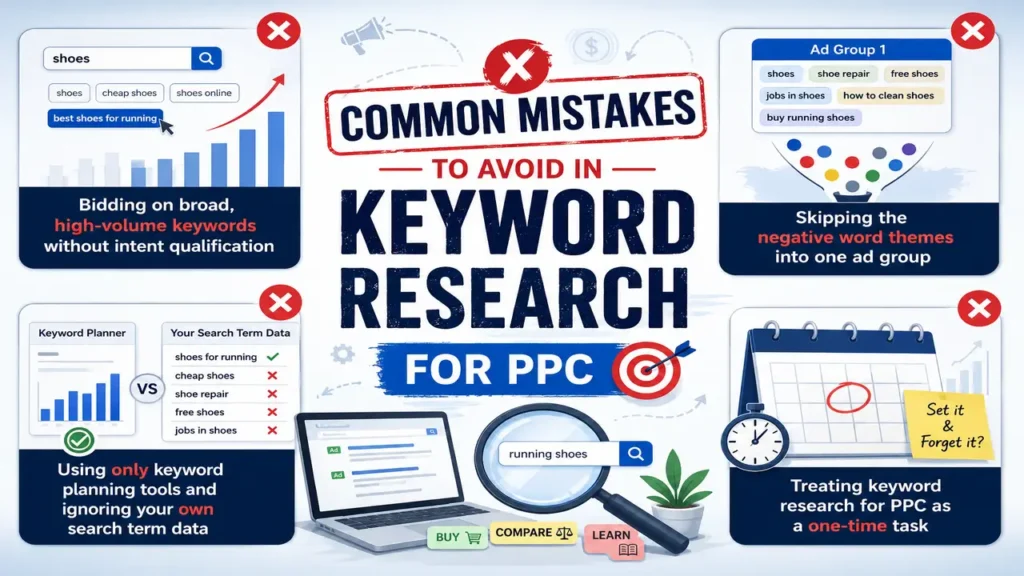
Bidding on broad, high-volume keywords without intent qualification
“Marketing agency” gets thousands of searches per month, but the people typing it include competitors, students, journalists, and job seekers alongside actual buyers. Bidding on it with Broad Match and no negatives is how accounts burn through Rs 50,000 in a week with two leads to show for it. Every high-volume keyword in your list needs an intent filter, either through match type, negative keywords, or both. This mistake alone accounts for the majority of wasted spend identified during Whamply’s free Google Ads audits.
Skipping the negativeword themes into one ad group
When ten different keyword themes share one ad group, the ad copy cannot speak precisely to any of them. Quality Score suffers, ad relevance drops, and CPC climbs. One theme per ad group, even if that means more ad groups to manage, produces better results at lower cost. This is the single structural change that most consistently improves account performance during audits.
Using only keyword planning tools and ignoring your own search term data
Google Keyword Planner and third-party tools give you estimates based on historical data. The Search Terms report from your live campaigns gives you actual buyer behaviour in your specific market. Accounts that rely entirely on planning tools and never mine their search term reports are leaving their most valuable keyword intelligence unread. Pairing live search term data with AI keyword research tools gives you both historical pattern recognition and real-time intent signals in one workflow.
Treating keyword research for PPC as a one-time task
Keyword research is not a campaign setup step, it is an ongoing process. Search behaviour shifts with seasonality, competitor activity, and product changes. A keyword list built in January may be missing significant opportunity or carrying costly waste by April. Scheduling a monthly keyword review as part of your PPC management routine prevents performance decay and keeps your bid strategy aligned with actual demand. Teams that struggle to keep this up consistently benefit from workflow automation that flags keyword performance drops and search term anomalies without requiring manual report pulls every week.
Conclusion
The two moves that will have the biggest immediate impact on your paid search performance are building a thorough negative keyword list before your next campaign launches and restructuring your ad groups around single keyword themes. Both are keyword research for PPC decisions, not bid decisions, and both are fully in your control before a single rupee is spent.
If you want a paid search specialist to audit your current keyword structure and identify where budget is leaking, Whamply offers a free Google Ads audit for accounts spending Rs 50,000 or more per month. Book yours at whamply.com and receive a prioritised keyword and ad group action plan within 48 hours.
Frequently Asked Questions
What is keyword research for PPC?
Keyword research for PPC is the process of identifying which search terms to bid on in paid search campaigns so your ads reach users with genuine intent to buy or enquire. It involves analysing search volume, competition, match types, and search intent, then organising keywords into structured ad groups with a supporting negative keyword list.
How is PPC keyword research different from SEO keyword research?
PPC keyword research prioritises conversion intent, cost per click, and match type control, whereas SEO keyword research focuses on search volume, ranking difficulty, and topical coverage. In PPC you pay for every click, so commercial intent is the primary filter. Long-tail keywords with lower volume but higher purchase intent are often more valuable in PPC than in SEO.
What tools are best for keyword research for PPC?
Google Keyword Planner is the most reliable starting point because it uses live Google data and shows bid estimates in your target market’s currency. SEMrush and Ahrefs add competitor keyword intelligence. SpyFu is useful for seeing which keywords competitors have been bidding on consistently over time. For Indian market research, Keyword Planner’s geo-filter set to India gives INR bid estimates and region-specific volume data.
What are negative keywords and why do they matter in PPC?
Negative keywords are terms you add to your campaign or ad group to prevent your ads from showing on irrelevant searches. They directly reduce wasted spend by filtering out traffic that will not convert. For example, a B2B software company might add “free,” “student,” and “tutorial” as negatives to avoid clicks from users who are not potential buyers.
What match types should I use for PPC keyword research?
Use Exact Match for high-intent, high-value terms where you want precise control. Use Phrase Match for medium-intent terms where some query variation is acceptable. Use Broad Match only when paired with Smart Bidding and strong audience signals, because without those constraints it expands into irrelevant traffic. Most campaigns perform best with a mix of Exact and Phrase Match as the primary foundation.
How many keywords should I have in a PPC campaign?
A typical campaign should have 50 to 200 keywords across all ad groups, with no more than 10 to 20 tightly themed keywords per ad group. More is not better. Tightly organised, intent-matched keyword lists consistently outperform large, loosely structured ones because they produce higher Quality Scores, better ad relevance, and lower CPCs.
What is search intent in keyword research for PPC?
Search intent is the underlying reason behind a user’s query: whether they are researching, comparing, or ready to buy. In PPC, matching your keywords to transactional or commercial intent (terms like “buy,” “pricing,” “near me,” “best”) reduces wasted spend and improves conversion rate. Informational queries rarely convert well in paid search and should typically be excluded using negative keywords.
How do I find long-tail keywords for PPC?
Long-tail keywords for PPC can be found using Google Keyword Planner’s “expand by keyword” feature, the Search Terms report from active campaigns, autocomplete suggestions in Google Search, and competitor analysis tools like SEMrush. Queries of three words or more with specific modifiers (location, price range, use case) are the most reliable signals of high purchase intent.
How often should I update my PPC keyword list?
PPC keyword lists should be reviewed monthly at minimum. The Search Terms report should be checked weekly to add converting queries as keywords and exclude irrelevant ones as negatives. Campaign launches, seasonal changes, and competitor activity are all triggers for a more thorough keyword research for PPC review outside the standard monthly cycle.
What is a good bid strategy to pair with keyword research for PPC?
For campaigns with 30 or more conversions per month, Target CPA or Target ROAS smart bidding works well and allows Google to adjust bids in real time based on conversion signals. For newer campaigns without conversion history, start with Maximise Clicks or Maximise Conversions to build data, then transition to a Target CPA or ROAS constraint once enough conversion data exists. Bid strategy and keyword research for PPC are interdependent: smart bidding performs better with tightly themed, intent-qualified keyword lists.
What is Quality Score and how does keyword research affect it?
Quality Score is Google’s rating of your keyword’s expected click-through rate, ad relevance, and landing page experience. Better keyword research for PPC directly improves Quality Score by ensuring your keywords, ad copy, and landing page all speak to the same intent. Higher Quality Scores reduce your CPC and improve your ad position, which is why keyword organisation into tight ad groups is worth the extra setup time.
Should I bid on competitor keywords in PPC?
Bidding on competitor brand names is a common PPC tactic and is generally permitted by Google, though you cannot use a competitor’s trademark in your ad copy. Competitor keywords tend to have lower conversion rates than branded or category terms because users are already looking for something specific, but they can be effective for capturing consideration-stage traffic and comparing your offer against established alternatives.
How do I do keyword research for PPC in the Indian market?
For Indian PPC keyword research, set Google Keyword Planner’s location to India and select INR as the currency to see locally accurate bid estimates. Layer in regional and language variations where relevant, since bilingual search behaviour is common across Hindi-English speakers in tier-1 and tier-2 cities. Also account for India-specific intent signals: searches including “near me,” “in Delhi,” “best in Mumbai,” or price qualifiers like “under 10000” carry strong local buying intent and deserve dedicated ad groups.
What is the difference between ad groups and campaigns in PPC keyword structure?
A campaign sets the budget, location targeting, network settings, and bid strategy. Ad groups sit inside campaigns and contain the keywords and ads for a specific theme. Keyword research for PPC determines how you divide themes across ad groups: one theme, one intent, one ad group. Multiple ad groups live within one campaign when they share the same budget and targeting but cover different sub-topics or product variations.
How does Google’s AI affect keyword research for PPC in 2026?
Google’s AI, particularly through Performance Max and Smart Bidding, uses the keywords in your Search campaigns as signals to guide automation across other channels. Tighter keyword research for PPC means better signals for the AI. In 2026, broad match expansion means Google will show your ads beyond your exact keyword list, which makes negative keywords and audience signals even more important as guardrails to keep the AI focused on converting traffic rather than volume.