
Email Marketing vs WhatsApp Marketing: Which Converts Better in India
On this page
WhatsApp messages in India get opened within 3 minutes on average, while the average email open rate across Indian industries sits at 15 to 20 percent. That single data point tells you a lot about where the email marketing vs WhatsApp marketing debate stands in 2026. But open rates are not the whole story, and the channel that wins for your business depends on what you are trying to achieve, who you are talking to, and how much you are willing to spend. This article breaks down the full picture so you can make the right call. For a broader look at how these channels fit into a larger plan, see our guide on how to build a full-funnel digital marketing strategy.
What Is the Difference Between Email Marketing and WhatsApp Marketing
Email marketing vs WhatsApp marketing is a comparison of two direct communication channels used by businesses to reach, nurture, and convert customers. Email marketing uses inbox-based campaigns, drip campaigns, and newsletters to engage audiences over time, while WhatsApp marketing uses the WhatsApp Business API or WhatsApp Business app to send transactional messages, promotional content, and conversational updates directly to a customer’s phone. Both are retention marketing tools, but they differ significantly in open rates, audience behaviour, compliance requirements, and cost structures.
Why This Comparison Matters for Indian Businesses in 2026
India has over 500 million active WhatsApp users, making it the largest WhatsApp market in the world. For most Indian consumers, WhatsApp is not just a messaging app. It is their primary communication layer for everything from family groups to business queries. This fundamentally changes how WhatsApp marketing performs in India compared to any other country.
At the same time, email marketing remains the backbone of B2B communication and high-ticket D2C retention in India. According to Statista, the email marketing market in India is projected to grow at a compound annual growth rate of 14.4% through 2027. The channel is not going anywhere, especially for brands targeting professionals, SaaS customers, and enterprise buyers. Whamply’s email marketing services are built specifically to serve these use cases at scale.
The reason the email marketing vs WhatsApp marketing debate has intensified in 2026 is the introduction of Meta’s WhatsApp Business API at scale, alongside more affordable third-party platforms that bring WhatsApp automation within reach of small and mid-sized Indian businesses spending as little as Rs. 2,000 to Rs. 5,000 per month. If you want to understand how both channels fit into a performance-driven plan for the Indian market, our guide on digital marketing for small businesses in India is a useful starting point.
Email Marketing vs WhatsApp Marketing: How Each Channel Actually Performs
Before choosing between email marketing and WhatsApp marketing, you need to understand the performance baselines for each channel in the Indian market. The numbers are quite different, and they should directly inform your decision.
Email Marketing Performance in India
Average open rate: 15 to 25 percent depending on industry
Average click-through rate: 2 to 5 percent
Best use cases: drip campaigns, newsletters, lead nurturing, post-purchase sequences, B2B outreach
Delivery: inbox, subject line dependent, affected by spam filters
Automation: highly mature, tools like Mailchimp, Klaviyo, HubSpot handle complex branching sequences
Cost: low per send, typically Rs. 1 to Rs. 3 per email at scale
Email marketing shines when you need to communicate complex information, send long-form content, attach documents, or run multi-step drip campaigns over weeks or months. For SaaS onboarding, EdTech course nurturing, or B2B sales sequences, email remains the most cost-effective and feature-rich retention marketing channel available. Our email automation services handle exactly this kind of multi-step sequence building, including triggered flows based on user behaviour.
The downside is inbox competition. An average Indian professional receives 80 to 120 emails per day. Standing out requires strong subject lines, proper segmentation, and consistent sender reputation management. Our email segmentation service addresses this directly by ensuring the right message reaches the right contact at the right time. Email marketing rewards patience and technical rigour.
WhatsApp Marketing Performance in India
Average open rate: 85 to 98 percent
Average click-through rate: 15 to 35 percent (campaign dependent)
Best use cases: order updates, abandoned cart recovery, flash sale alerts, appointment reminders, customer support follow-ups
Delivery: push notification directly to phone, near-instant
Automation: available via WhatsApp Business API through platforms like Wati, Interakt, AiSensy
Cost: Rs. 0.30 to Rs. 0.80 per conversation under Meta’s conversation-based pricing
WhatsApp marketing wins on attention. When a message lands in a WhatsApp inbox in India, it almost always gets read. For time-sensitive campaigns, flash offers, or high-urgency transactional updates, nothing else comes close in terms of open rates and response speed.
The limitation is content format. WhatsApp messages are short by nature. You cannot replicate a five-email drip campaign on WhatsApp without risking being reported as spam and getting your number flagged by Meta. Consent and compliance requirements are also stricter, especially under WhatsApp Business API rules. Both email marketing and WhatsApp marketing produce their best results when they are part of a connected lead generation strategy rather than standalone sends.
How to Decide Between Email Marketing vs WhatsApp Marketing for Your Business
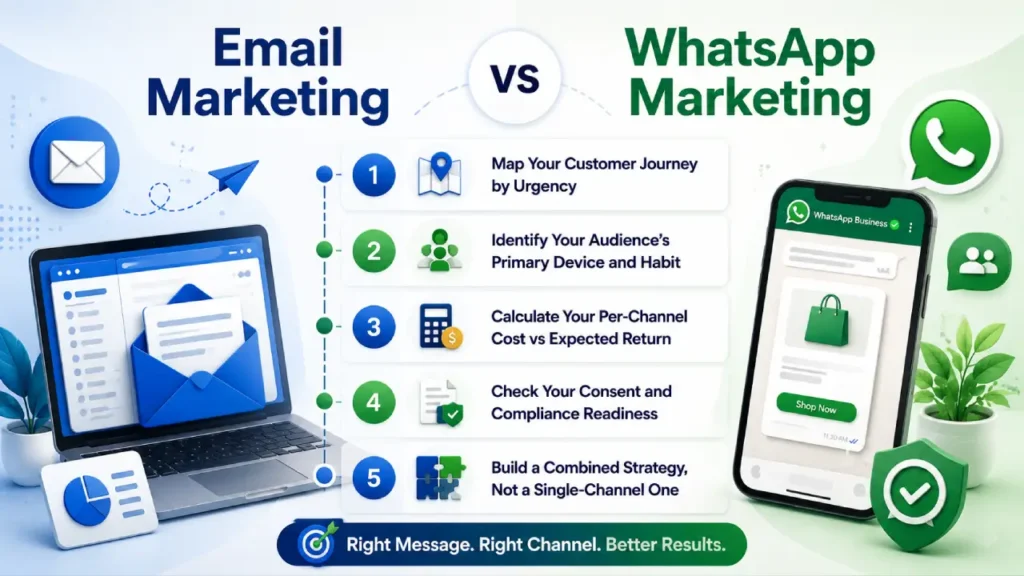
Choosing between email marketing vs WhatsApp marketing is not a binary decision for most Indian businesses. The smarter question is: which channel handles which part of your customer journey?
Here is a practical decision framework broken into five steps.
Step 1: Map Your Customer Journey by Urgency
If a touchpoint is time-sensitive, such as an abandoned cart, a payment confirmation, or a same-day sale, WhatsApp marketing wins. If the touchpoint is part of a longer nurture sequence, such as onboarding emails or a lead magnet follow-up series, email marketing is more appropriate. Start by sorting your existing communications into urgent versus non-urgent buckets. Our piece on how to reduce cost per lead without sacrificing lead quality explains how urgency mapping affects campaign economics across both channels.
Step 2: Identify Your Audience’s Primary Device and Habit
In Tier 2 and Tier 3 Indian cities, WhatsApp penetration is significantly higher than email usage. Many consumers in these markets check WhatsApp dozens of times per day but rarely open a branded email. For brands targeting these audiences, WhatsApp marketing should be the primary channel. For professionals, SaaS users, or enterprise buyers, email marketing typically outperforms. B2B brands targeting decision-makers often find that LinkedIn Ads combined with email marketing outperforms WhatsApp marketing at the top of the funnel; our guide on how to use LinkedIn Ads to generate B2B leads in 2026 covers this combination in detail.
Step 3: Calculate Your Per-Channel Cost vs Expected Return
Run a quick unit economics check. For email marketing, factor in your platform cost, list size, and average order value per campaign. For WhatsApp marketing, factor in the per-conversation cost under Meta’s API pricing, your opt-in list size, and your average conversion rate per blast. Indian D2C brands typically find WhatsApp marketing delivers 3 to 4 times higher revenue per message sent compared to email for promotional campaigns, but email marketing wins on total campaign volume and automation depth. For a clear framework on measuring what actually matters, our breakdown of what is ROAS and how to improve it applies directly to both email and WhatsApp campaign planning.
Step 4: Check Your Consent and Compliance Readiness
Email marketing in India operates under relatively straightforward consent rules. WhatsApp Business API requires explicit opt-in, and Meta actively reviews accounts for abuse. Before investing in WhatsApp marketing at scale, ensure your opt-in flow is clean and your message templates are approved. A flagged WhatsApp Business number can set your marketing back by weeks. Our AI-powered marketing services include workflow automation that handles opt-in management and compliance checks across both channels automatically.
Step 5: Build a Combined Strategy, Not a Single-Channel One
The brands that get the most from email marketing vs WhatsApp marketing are the ones that use both, deliberately. A common pattern that works well in India: use WhatsApp marketing for top-of-funnel lead capture and urgent conversion pushes, and use email marketing for mid-funnel nurturing and post-purchase retention. Our drip campaign service is built to sit alongside WhatsApp automation flows, creating a joined-up retention marketing system rather than two siloed channels.
Common Mistakes to Avoid When Running Email Marketing vs WhatsApp Marketing in India
Sending Promotional WhatsApp Blasts Without Verified Opt-Ins
The most common and costly mistake in WhatsApp marketing is sending bulk promotional messages to contacts who never explicitly opted in through a WhatsApp channel. Meta’s algorithm detects unusual sending patterns and high block rates, which leads to account suspension. Always use a verified opt-in flow before adding anyone to a WhatsApp marketing list. Our lead automation services include compliant opt-in flow setup for WhatsApp Business API campaigns.
Treating Email Marketing as a Set-and-Forget Channel
Many Indian businesses set up a welcome email sequence, then stop. Email marketing requires regular list cleaning, subject line testing, and segment-level performance reviews. An unmanaged email list with high bounce rates will eventually damage your sender reputation, reducing deliverability for every campaign you send. Our email campaign management service handles ongoing optimisation so deliverability and click-through rate stay healthy over time.
Using WhatsApp for Long-Form Content That Belongs in Email
WhatsApp messages that run longer than three to four short paragraphs almost always see sharp drop-offs in read completion. Sending a five-hundred-word product explainer via WhatsApp is the wrong channel choice. That content belongs in an email, ideally linked to a well-built landing page. For advice on what makes a landing page convert once the email click happens, see our article on landing page optimisation.
Ignoring Click-Through Rate as a Metric
Open rate alone is a vanity metric in both channels. A 90 percent WhatsApp open rate means nothing if your click-through rate is under 1 percent. Track click-through rate per campaign, per segment, and per message type in both email marketing and WhatsApp marketing. This is the data that tells you whether your message is actually moving people to act.
Running Both Channels in Silos
The biggest strategic mistake is treating email marketing and WhatsApp marketing as separate functions with separate teams, separate lists, and no shared data. If a customer clicks a WhatsApp link but does not convert, that signal should feed into your email marketing sequence. Our CRM automation service connects both channels to a single customer data layer so behavioural signals from WhatsApp automatically trigger the right email marketing response and vice versa.
Conclusion
The clearest takeaway from the email marketing vs WhatsApp marketing debate is this: WhatsApp wins on attention, email wins on depth. For Indian businesses in 2026, the highest-performing brands are not choosing between the two. They are using WhatsApp marketing for urgent, high-intent touchpoints and email marketing for nurturing, education, and long-term retention. Running both well, with integrated data and clear channel logic, is what separates the brands growing their customer lifetime value from the ones chasing open rates.
If you want to audit your current email marketing and WhatsApp marketing setup and identify exactly where revenue is leaking, book a free channel strategy review with the Whamply team. We will map your customer journey, review your retention marketing stack, and give you a clear action plan for both channels built around your specific audience and budget.
Frequently Asked Questions
What is the difference between email marketing and WhatsApp marketing?
Email marketing uses inbox-based communication for longer-form content, drip campaigns, and B2B nurturing. WhatsApp marketing uses the WhatsApp Business app or API for short, high-urgency messages with near-instant open rates. Both are direct marketing channels, but they serve different stages of the customer journey and attract very different engagement behaviours.
Which has better open rates email marketing or WhatsApp marketing?
WhatsApp marketing has significantly higher open rates, typically between 85 and 98 percent in India. Email marketing open rates in India average 15 to 25 percent. However, open rate alone does not determine which channel converts better. Click-through rate and cost per conversion are more meaningful performance indicators.
Is WhatsApp marketing legal in India?
Yes, WhatsApp marketing is legal in India when conducted through the official WhatsApp Business app or the WhatsApp Business API with verified opt-ins from recipients. Sending bulk promotional messages to contacts who have not opted in violates Meta’s terms of service and can result in account suspension.
Which channel is better for B2B marketing in India: email or WhatsApp?
Email marketing is generally more effective for B2B marketing in India. Professionals and enterprise buyers are more accustomed to receiving business communication via email, and email marketing supports longer-form content, document attachments, and complex drip sequences that B2B sales cycles require. WhatsApp can complement B2B strategy for reminders and follow-ups but rarely replaces email as the primary B2B channel.
What is the WhatsApp Business API and how does it differ from the WhatsApp Business app?
The WhatsApp Business API is a developer-level integration that allows businesses to send automated, high-volume messages at scale, manage multiple agents, and build chatbot flows. The WhatsApp Business app is a simpler free tool for small businesses managing conversations manually. For any serious WhatsApp marketing programme in India, the API is the correct tool.
How much does WhatsApp marketing cost in India?
WhatsApp marketing costs in India vary by platform and conversation volume. Under Meta’s current pricing model, conversations are billed per 24-hour window. Using third-party platforms like Wati, Interakt, or AiSensy, Indian businesses typically spend between Rs. 2,000 and Rs. 15,000 per month depending on conversation volume and features required.
What is a good click-through rate for email marketing in India?
A good click-through rate for email marketing in India is between 2 and 5 percent across most industries. E-commerce and D2C brands often see higher rates, between 4 and 8 percent, when campaigns are well-segmented and offer clear value. Anything below 1 percent consistently suggests a mismatch between content, audience, or sending frequency.
Can I run drip campaigns on WhatsApp?
Yes, drip campaigns are possible on WhatsApp via the WhatsApp Business API, using platforms like Wati or AiSensy to build automated message sequences. However, WhatsApp drip campaigns must use pre-approved message templates, must not exceed certain frequency thresholds, and require active opt-in from recipients. They are best suited for short sequences of three to five messages rather than the extended multi-week flows that email marketing supports.
Which is more cost-effective for a small business in India: email or WhatsApp marketing?
For very small lists under five thousand contacts, email marketing is typically more cost-effective because tools like Mailchimp offer free tiers and low-cost plans. For businesses with strong WhatsApp opt-in lists and a high-urgency product such as e-commerce, food delivery, or real estate, WhatsApp marketing delivers better revenue per message sent. The right answer depends entirely on list size, industry, and customer communication preference.
What types of messages work best on WhatsApp marketing in India?
The message types that consistently perform well in WhatsApp marketing in India include abandoned cart recovery messages, flash sale alerts with a countdown, order confirmation and shipping updates, appointment reminders for healthcare and education brands, and personalised re-engagement messages for lapsed customers. Messages that are direct, short, and include a single clear call to action consistently outperform longer, multi-point messages.
Does email marketing still work in India in 2026?
Yes, email marketing remains highly effective in India in 2026, particularly for B2B brands, SaaS companies, EdTech platforms, and high-ticket D2C products. The channel supports automation depth, content complexity, and cost-per-send economics that WhatsApp cannot match at scale. Businesses that dismiss email marketing in favour of WhatsApp marketing often find gaps in their mid-funnel nurturing that are difficult to fill with WhatsApp alone.
How do I grow an opt-in list for WhatsApp marketing in India?
The most effective methods for growing a WhatsApp opt-in list in India include adding a WhatsApp opt-in checkbox to checkout flows, running Click-to-WhatsApp ads on Meta platforms, using lead magnets such as free resources or discount codes that are delivered via WhatsApp, and adding a WhatsApp opt-in option to existing email sign-up forms. Quality of opt-in matters more than list size for WhatsApp marketing compliance.
Should I use email marketing or WhatsApp marketing for customer retention?
Both channels contribute to retention marketing but in different ways. Email marketing is better suited to long-term loyalty programmes, newsletters, and re-engagement campaigns that build brand familiarity over time. WhatsApp marketing is better for immediate reactivation, personalised one-to-one outreach, and time-sensitive offers. The best retention marketing programmes in India use both channels together, triggered by customer behaviour across the journey.
What platforms support WhatsApp marketing automation in India?
The leading platforms for WhatsApp marketing automation used by Indian businesses in 2026 include Wati, Interakt, AiSensy, DelightChat, and Gallabox. All of these operate on the WhatsApp Business API and provide campaign management, automated flows, contact segmentation, and analytics dashboards. Pricing ranges from approximately Rs. 2,000 to Rs. 10,000 per month depending on feature requirements and conversation volume.