
Landing Page Optimisation: 12 Proven Ways to Boost Conversions
On this page
Most landing pages convert at under 3%. The global average conversion rate across industries sits at around 2.35%, according to WordStream, but the top 25% of pages convert at 5.31% or higher. That gap is not about budget or traffic volume. It comes down to landing page optimisation, and most businesses are leaving serious money on the table by skipping it.
What Is Landing Page Optimisation?
Landing page optimisation is the process of systematically improving the elements of a landing page, including its copy, layout, CTA buttons, page load speed, and design, to increase the percentage of visitors who take a desired action. It combines data analysis, user behaviour research, A/B testing, and conversion rate principles to reduce friction and align the page experience with what the visitor actually expects to find.
Why Landing Page Optimisation Matters in 2026
Paid traffic costs more than it ever has. In India, the average cost-per-click on Google Ads has climbed steadily, with competitive categories like finance, EdTech, and real estate now running CPCs between Rs 80 and Rs 300 per click. If your page converts at 1%, you are burning through budget for almost nothing. Better landing page optimisation directly reduces your cost per acquisition without requiring more spend. Businesses running Google Ads campaigns feel this most acutely, since every rupee wasted on a poor landing page compounds across the entire campaign.
Search intent has also shifted. Users arrive with higher expectations and less patience. A page that loads slowly, buries its offer, or uses vague CTA buttons will lose the visitor in seconds. According to Google, a one-second delay in mobile page load speed can reduce conversions by up to 20%.
AI-powered answer engines like Perplexity and ChatGPT are now part of how buyers research before clicking. Pages that are clear, structured, and specific perform better not just in traditional SEO but in how they get cited and recommended. Landing page optimisation now serves both human visitors and AI crawlers at once. For agencies running performance marketing services, this shift means optimising for conversion and content quality simultaneously.
The 12 Landing Page Optimisation Strategies That Actually Work
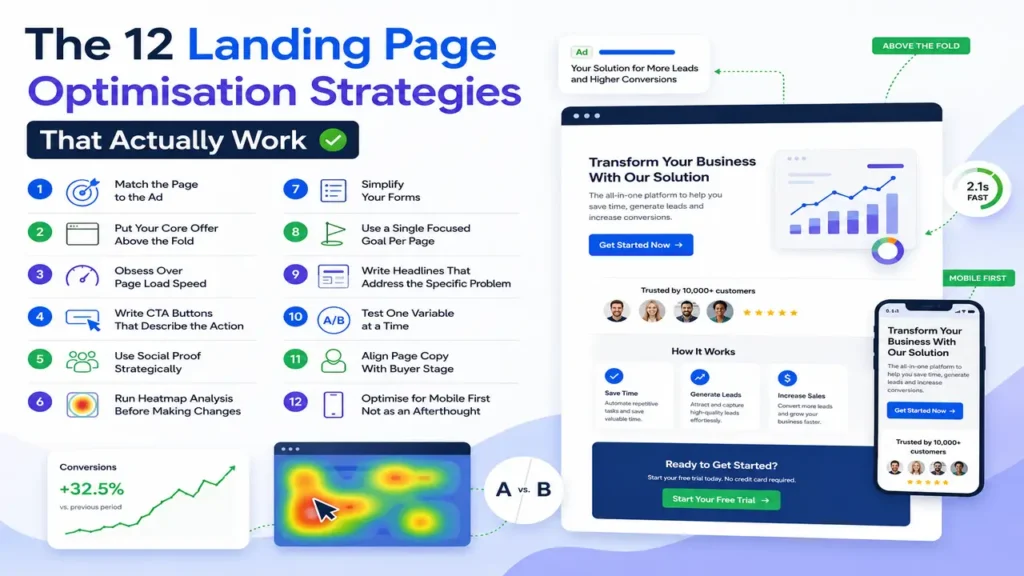
Match the Page to the Ad
Message match is the single most overlooked element in landing page optimisation. When someone clicks an ad about “affordable solar panels in Delhi,” they expect that exact phrase or close to it on the page. A mismatch in language, offer, or visual tone causes immediate bounce.
Check every active ad group and confirm the landing page headline mirrors the ad copy. This is especially critical for Search Ads, where user intent is highest and expectations are most specific. Getting message match right alone can lift conversion rate by double digits.
Put Your Core Offer Above the Fold
Above the fold means the portion of the page visible without scrolling. Most visitors decide within 5 seconds whether to stay or leave. If your headline, sub-headline, and primary CTA button are buried below the fold, you are making them work for information they should receive immediately.
Keep the above the fold section clean. One clear headline, one supporting line, one CTA button. Nothing else competing for attention. If you need professional help structuring this, Whamply’s landing page design services build conversion-first layouts from the ground up.
Obsess Over Page Load Speed
Page load speed is a conversion lever, not just a technical metric. Google’s own research confirms that pages loading in under 2 seconds see significantly higher engagement and lower bounce rates. Run your page through Google PageSpeed Insights and target a score above 80 on mobile.
In the Indian market, where a significant portion of users still access the web on 4G connections in tier-2 and tier-3 cities, a slow page is a lost lead. Compress images, remove unused scripts, and use a CDN if you are running high-traffic campaigns. Whamply’s speed optimisation service specifically targets Core Web Vitals and mobile performance scores for pages running paid traffic.
Write CTA Buttons That Describe the Action
“Submit” is not a CTA button. It is a command that tells the visitor nothing about what they get. CTA buttons should describe the outcome: “Get My Free Audit,” “Book a 15-Minute Call,” “Download the Pricing Guide.”
Test button colour, size, and copy using A/B testing. Button colour is often overhyped, but button copy and placement are consistently high-impact variables in any CRO programme. Our CRO services run systematic button and copy tests across client landing pages every week.
Use Social Proof Strategically
Testimonials, client logos, case study snippets, and review counts all reduce purchase anxiety. Place social proof near the CTA button, not buried at the bottom. A single specific testimonial (“We reduced our cost per lead by 43% in 8 weeks”) outperforms five generic five-star quotes.
Run Heatmap Analysis Before Making Changes
Heatmap analysis tools like Hotjar or Microsoft Clarity show you exactly where users click, scroll, and drop off. Before running any A/B test or redesign, spend two weeks collecting heatmap data on your current page.
Simplify Your Forms
Every extra form field reduces submission rate. Research by Unbounce found that reducing form fields from 11 to 4 increased conversions by 120%. Ask only for what you genuinely need at this stage of the funnel. Name and email is enough for a top-of-funnel offer. Phone number should be optional unless the business model requires a call. This principle applies across lead generation services regardless of industry or platform.
Use a Single, Focused Goal Per Page
Landing pages that try to do too many things convert poorly. One page, one offer, one CTA. If you are running campaigns across multiple audience segments or products, build separate landing pages for each. This is a core principle of CRO and one that dramatically improves relevance scores in Google Ads as well. If you are running Facebook Ads or Instagram Ads, dedicated per-audience landing pages can significantly lower your cost per lead.
Write Headlines That Address the Specific Problem
Generic headlines like “Welcome to Our Services” convert at a fraction of the rate of specific, problem-aware headlines. “Cut Your Google Ads Spend by 30% Without Losing Leads” speaks directly to a felt pain. It also qualifies the visitor, meaning the people who stay are genuinely interested.
Strong headline writing falls squarely within landing page copy services, and it is one of the highest-leverage skills in any CRO stack.
Test One Variable at a Time
A/B testing works when you isolate variables. Testing a new headline and a new image and a new CTA button in the same test tells you nothing useful. The test cannot identify which change drove the result.
Run clean, single-variable A/B tests. Give each test enough traffic to reach statistical significance, typically 1,000 visitors per variant as a minimum, before drawing conclusions.
Align Page Copy With Buyer Stage
A visitor who found your page through a branded search is much closer to converting than someone who clicked a broad awareness ad. Landing page optimisation means building pages that speak to the right buyer stage.
Awareness stage pages need to educate. Consideration stage pages need to compare and reassure. Decision stage pages need to reduce risk and make the next step obvious. Using one generic page for all three stages is one of the most common and costly mistakes in CRO. This is why businesses investing in B2B lead generation need funnel-specific landing pages for each outreach channel.
Optimise for Mobile First, Not as an Afterthought
Mobile traffic accounts for over 60% of web sessions globally. In India, that figure is consistently above 75% across most industries. If your landing page optimisation process starts on desktop, you are optimising for the minority of your audience.
Build and test on mobile first. Check touch target sizes, font readability at small screen sizes, and whether the above the fold section still communicates the offer without scrolling on a 375px screen. All pages Whamply builds through its web design services are tested on live mobile devices before launch, not just resized in a browser preview.
How to Build a Landing Page Optimisation Process That Sticks
One-off changes rarely produce lasting results. Landing page optimisation works best as a repeatable cycle. Here is the process I recommend to any team starting out:
- Audit your existing pages: Use Google Analytics 4 and heatmap analysis to identify your highest-traffic, lowest-converting pages. These are your highest-leverage opportunities. You can also request a free SEO audit that includes landing page performance signals alongside technical SEO findings.
- Define a single hypothesis: Before any A/B test, write a clear hypothesis: “If we change the CTA button copy from ‘Submit’ to ‘Get My Free Report,’ we expect conversion rate to increase because visitors will understand the value exchange.”
- Build the variant and run the test: Use tools like VWO or Optimizely. Ensure both variants run simultaneously to account for time-of-day and day-of-week variation.
- Wait for statistical significance: Do not call tests early. Most A/B testing tools will show you significance levels. Aim for 95% confidence before declaring a winner.
- Implement and document: Apply the winning variant and document what you tested, what you found, and why it worked. This builds institutional knowledge your team can use across every future campaign.
- Repeat the cycle: Landing page optimisation is not a one-time project. The best-performing teams run continuous testing, moving through the page systematically. Businesses running dynamic remarketing campaigns benefit especially from this, since returning visitors behave differently from cold traffic.
Common Mistakes to Avoid in Landing Page Optimisation
Sending all ad traffic to your homepage
Your homepage serves too many purposes to convert well for a specific campaign. It has navigation menus, multiple CTAs, and messages aimed at every possible visitor type. A dedicated landing page with one goal and one CTA will almost always outperform it. Every campaign Whamply manages through its performance marketing services uses dedicated, campaign-specific pages rather than the client’s main website.
Calling a test early because it looks promising
Statistical significance takes time and sufficient traffic. Ending an A/B test at 300 visitors because one variant is “winning” by 2% is how you make bad decisions with false confidence. Wait for the data to be reliable.
Ignoring the quality of traffic before blaming the page
If your conversion rate is low, check traffic quality first. Are the visitors from the right audience? Are they coming from keywords that match the offer? Landing page optimisation cannot fix a targeting problem. Garbage traffic into a perfect page still produces poor results. This is why proper on-page SEO and audience targeting need to work together with page optimisation.
Using stock images of people looking at laptops
Generic stock photography actively undermines trust. Visitors can spot it instantly. Real product photos, screenshots of actual results, or illustrations specific to your offer consistently outperform stock imagery in A/B testing across categories.
Treating mobile optimisation as a checkbox
Mobile optimisation is not “make it responsive.” It means reviewing the page on an actual device and asking whether a visitor using their thumb, in natural light, with a slow connection, can understand the offer and complete the action without frustration. Whamply’s technical SEO services include mobile usability audits as a standard deliverable for any site running paid campaigns.
Conclusion
The two highest-leverage changes you can make right now are fixing your above the fold section and running your first clean A/B test on your primary CTA button. Most landing pages fail at both. Everything else, heatmap analysis, form simplification, mobile optimisation, builds on getting those two right first.
If you are running paid campaigns and want an honest assessment of where your landing pages are losing conversions, Whamply offers a free landing page audit for businesses spending Rs 50,000 or more per month on Google or Meta Ads. Book yours at whamply and get a prioritised CRO action plan within 48 hours.
Frequently Asked Questions
What is landing page optimisation?
Landing page optimisation is the practice of improving a page’s design, copy, speed, and structure to increase the percentage of visitors who complete a desired action, such as filling a form, booking a call, or making a purchase. It uses data, testing, and user behaviour research to reduce friction and improve conversion rate.
How long does landing page optimisation take to show results?
Results depend on your traffic volume. With 1,000 or more visitors per week per variant, meaningful A/B testing data can emerge within 2 to 4 weeks. For lower-traffic pages, a reliable test may take 6 to 8 weeks.
What is a good conversion rate for a landing page?
The average landing page conversion rate is around 2.35%, according to WordStream. A well-optimised page in most industries should target 5% or above. Top-performing pages in some niches reach 10 to 15%.
What tools are used for landing page optimisation?
Commonly used tools include Google PageSpeed Insights for page load speed, Hotjar or Microsoft Clarity for heatmap analysis, Google Analytics 4 for traffic and behaviour data, and VWO or Optimizely for A/B testing. Google Ads landing page experience scores also provide useful signal.
What is A/B testing in the context of landing pages?
A/B testing means showing two versions of a page to different segments of your traffic simultaneously to determine which version produces a higher conversion rate. You test one element at a time, such as headline copy, CTA button text, or form length, to isolate what drives the change.
How does page load speed affect conversions?
Google’s research shows that a one-second delay in mobile page load speed can reduce conversions by up to 20%. Slower pages increase bounce rate, reduce ad quality scores, and create a poor user experience. Targeting a load time under 2 seconds is the standard benchmark in CRO.
What should be above the fold on a landing page?
Above the fold should include a benefit-driven headline, a supporting subheadline that clarifies the offer, and a clear CTA button. Optionally, a trust signal such as a client logo strip or a single testimonial can appear here if space allows on desktop.
How many CTA buttons should a landing page have?
A focused landing page should have one primary CTA repeated at logical scroll points, typically above the fold, after the key benefits section, and above the footer. Multiple competing CTAs reduce decision clarity and typically lower conversion rate.
What is heatmap analysis and why does it matter for CRO?
Heatmap analysis visually maps where users click, move their cursor, and scroll on a page. It reveals which elements attract attention and where users drop off, helping you prioritise which changes to test first. Tools like Hotjar and Microsoft Clarity offer free versions suitable for most small to mid-size businesses.
Is landing page optimisation different from SEO?
Yes, though they overlap. SEO focuses on driving organic traffic through keyword relevance, backlinks, and technical signals. Landing page optimisation focuses on what happens after the visitor arrives. Both disciplines share an interest in page speed and structured content, but their primary goals differ. Whamply’s SEO services and CRO work run in parallel for clients running both organic and paid traffic.
Can landing page optimisation improve Google Ads performance?
Yes, Google Ads assigns a landing page experience score that directly affects your Quality Score and cost-per-click. A well-optimised landing page that matches ad intent, loads quickly, and provides clear information will receive a higher score, which lowers your CPC and improves ad placement.
What is message match in landing page optimisation?
Message match is the degree of consistency between your ad copy and the landing page headline and content. A high message match means the visitor lands on a page that immediately reflects what the ad promised. Poor message match causes confusion and increases bounce rate.
How do I know which element to test first on my landing page?
Start with heatmap analysis and scroll depth data to identify where users are dropping off or ignoring key sections. The headline and CTA button are almost always worth testing first because they have the highest potential impact on conversion rate with the simplest changes.
Does social proof actually improve landing page conversion rates?
Yes, Specific, credible social proof, such as named testimonials with measurable outcomes, verified review counts, or recognisable client logos, consistently improves conversion rates by reducing risk perception. Generic five-star reviews with no context have minimal effect.
How many pages should I build for a single campaign?
Build a dedicated landing page for each distinct ad group or audience segment. If you are targeting three different buyer personas or three different products, you need three separate pages. Using one generic page for multiple ad groups is one of the most common causes of poor CRO performance.
[…] all belong here. Your landing pages at this stage deserve special attention: CRO services and landing page optimisation are often the fastest wins available at the bottom of the funnel. Every piece of your full funnel […]
[…] rate and Google’s Quality Score signals. For deeper guidance on post-click conversion, the landing page optimisation guide covers the 12 most impactful improvements to run in parallel with any PMAX […]
[…] on conversion rate optimisation before scaling traffic is often the higher-ROI first step. The landing page optimisation guide on the Whamply blog covers the specific on-page changes that move conversion rates most reliably […]