
What is Conversion Rate Optimisation (CRO) and Why Does It Matter
On this page
A 1% improvement in conversion rate sounds small until you realise it can mean the difference between a marketing budget that pays for itself and one that does not. Most businesses spend heavily on traffic and almost nothing on what happens after the click. Conversion rate optimisation is the discipline that fixes that imbalance, and the businesses doing it well are converting two to three times more of their existing traffic into customers without spending another rupee on ads.
What Is Conversion Rate Optimisation?
Conversion rate optimisation (CRO) is the systematic process of increasing the percentage of website visitors who complete a desired action, such as making a purchase, filling out a form, or signing up for a trial. It combines data analysis, user experience research, and structured A/B testing to identify friction points on a website and test changes that improve conversion outcomes. Conversion rate optimisation focuses on extracting more value from existing traffic rather than acquiring new visitors.
Why Conversion Rate Optimisation Matters in 2026
The cost of paid traffic has risen across nearly every channel over the past three years. Google Ads CPCs are up, Meta Ads costs have climbed, and LinkedIn remains expensive for B2B categories. When traffic costs more, the return on every visitor matters more, which is exactly what conversion rate optimisation is designed to improve.
According to WordStream’s conversion benchmark data, the average website conversion rate sits around 2.35%, while the top 25% of websites convert at 5.31% or higher. That gap represents a more than double improvement in output from the exact same traffic, achieved entirely through better conversion rate optimisation rather than additional spend.
In India, conversion rate optimisation has become a higher priority as digital ad costs in competitive sectors like fintech, ed-tech, and D2C e-commerce have risen sharply. Indian businesses spending ₹2 lakh to ₹15 lakh per month on performance marketing are increasingly allocating 10 to 15% of that budget toward dedicated CRO programmes and testing, recognising that a conversion rate improvement compounds across every future campaign rather than being a one-time gain.
The Core Components of Conversion Rate Optimisation
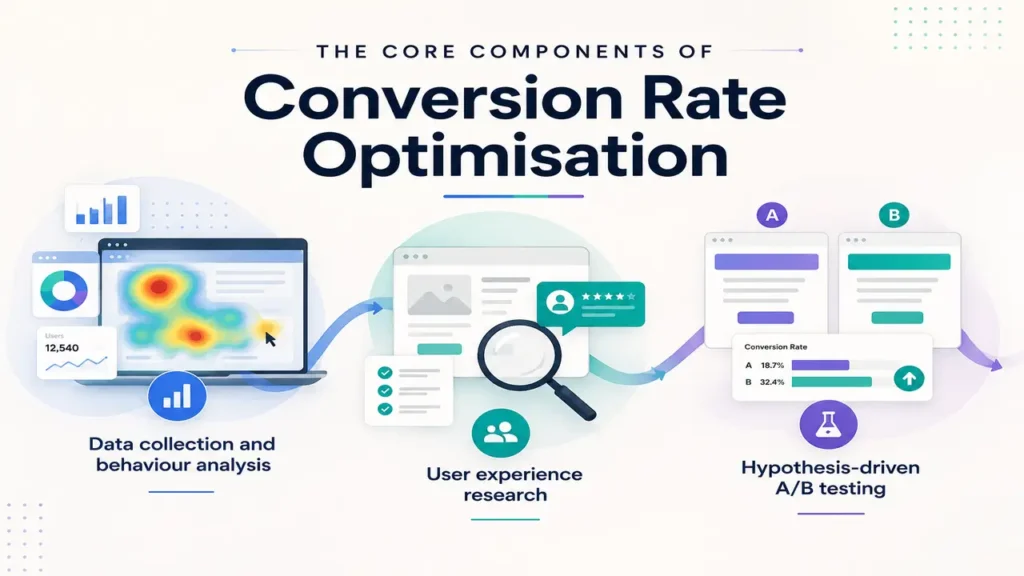
Conversion rate optimisation is not a single tactic. It is a structured discipline built on several connected components that work together to identify and fix conversion barriers.
Data collection and behaviour analysis
Before changing anything, effective conversion rate optimisation starts with understanding how visitors actually behave on your site. This means combining quantitative data (where do people drop off, what pages have the highest bounce rate) with qualitative data (why are they dropping off, what are they confused by).
User experience research
User experience directly determines conversion outcomes. A confusing navigation structure, an unclear value proposition, or a slow-loading page all create friction that reduces conversions regardless of how good the underlying offer is. Sites with unresolved technical SEO issues, like slow load times or broken mobile rendering, often see conversion rate optimisation efforts undermined before testing even begins. Conversion rate optimisation treats UX as a measurable, testable variable rather than a subjective design preference.
Hypothesis-driven A/B testing
Every change tested in a conversion rate optimisation programme should be based on a specific hypothesis grounded in data, not a guess or a personal preference. “We believe shortening the form from 5 fields to 3 will increase form completion because session recordings show 40% of users abandon at field 4” is a testable hypothesis. “Let’s try a different colour button” is not. Strong hypotheses are especially important for landing page optimisation work, where a single page often carries the full weight of a paid campaign’s conversion outcome.
The core CRO tools used across most conversion rate optimisation programmes include:
- Hotjar or Microsoft Clarity for heatmaps, scroll maps, and session recording to observe real user behaviour
- Google Analytics 4 for quantitative funnel and drop-off analysis across the full customer journey
- Optimizely or VWO for running structured A/B and multivariate tests with proper statistical confidence
- Google PageSpeed Insights for identifying technical performance issues that contribute to bounce rate
- Survey and feedback tools like Hotjar Surveys or Typeform to capture qualitative insight directly from visitors
- Crazy Egg or FullStory for deeper session-level behavioural analysis on complex conversion paths
Together, these components turn conversion rate optimisation from a guessing exercise into a measurable, repeatable system for improving website conversions.
How to Build a Conversion Rate Optimisation Programme Step by Step
A structured CRO programme produces compounding results over time. Random, ad hoc changes rarely do. Here is the process that works across most website types and industries.
Step 1: Audit your current funnel and identify the biggest drop-off points
Use Google Analytics 4 to map your full conversion funnel, from landing page to final conversion. Identify the steps with the highest percentage drop-off. A funnel that loses 60% of users between the homepage and the product page tells you exactly where to focus your conversion rate optimisation efforts first, rather than spreading testing thin across the entire site. For B2B lead generation websites, this often means mapping the journey from first visit through to demo request, not just to a single form fill.
Step 2: Install behavioural tracking tools to understand the why
Quantitative data tells you where users drop off. Heatmaps, scroll maps, and session recordings from Hotjar or Microsoft Clarity tell you why. Look for rage clicks (repeated frustrated clicking), dead clicks (clicking something that is not interactive), and abandoned form fields. These behavioural signals are the raw material for your testing hypotheses.
Step 3: Form specific, data-backed hypotheses
For each identified problem, write a clear hypothesis that states what you believe is causing the issue, what change you will test, and what outcome you expect. Prioritise hypotheses by potential impact and ease of implementation. High-impact, low-effort tests (changing CTA button copy, simplifying a form) should be run before complex structural redesigns.
Step 4: Run A/B tests with proper statistical rigour
Test one variable at a time wherever possible. Run each test until you reach a minimum sample size of 1,000 visitors per variant and at least 95% statistical confidence before declaring a winner. Stopping a test early because results look promising is one of the most common errors in conversion rate optimisation and frequently leads to false positives.
Step 5: Document and implement winning variations
When a test produces a statistically significant winner, implement the change permanently and document the result, including the hypothesis, the test duration, the sample size, and the percentage lift achieved. Connecting these results to CRM automation data also lets you confirm that conversion rate gains are translating into actual qualified leads and revenue, not just more form fills. This documentation becomes a valuable knowledge base that prevents repeated testing of ideas that have already been proven or disproven.
Step 6: Move to the next priority and repeat
Conversion rate optimisation is continuous, not a one-time project. Return to your funnel data, identify the next biggest opportunity, and repeat the process. For brands running parallel remarketing campaigns, CRO insights from your main funnel often reveal new audience segments worth retargeting separately. Mature CRO programmes typically run two to four tests simultaneously across different parts of the funnel, with a constant pipeline of hypotheses queued for testing.
Common Mistakes in Conversion Rate Optimisation
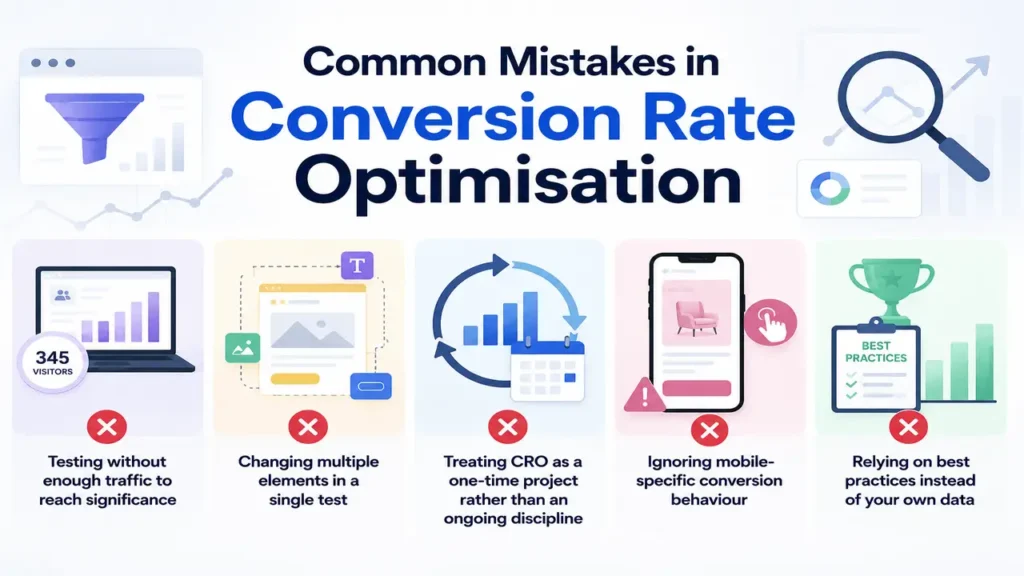
Testing without enough traffic to reach significance
Running an A/B test on a page that receives 300 visitors a month will rarely produce statistically reliable results within a reasonable timeframe. If your traffic volume is low, prioritise qualitative research methods like session recordings and user interviews over formal A/B testing, or focus testing efforts on your highest-traffic pages first.
Changing multiple elements in a single test
Testing a new headline, a new image, and a new CTA button simultaneously means that if the variant wins, you have no way of knowing which change actually drove the improvement. Isolate variables wherever possible so that each test produces a clear, actionable learning rather than an ambiguous result.
Treating CRO as a one-time project rather than an ongoing discipline
Many businesses run a single round of conversion rate optimisation testing, see an improvement, and then stop. Conversion rate optimisation produces the strongest results when it operates as a continuous programme, since user behaviour, competitive context, and traffic sources all shift over time, creating new opportunities and new friction points.
Ignoring mobile-specific conversion behaviour
Desktop and mobile users behave differently, yet many conversion rate optimisation programmes run tests only on desktop or apply desktop-derived insights to mobile without verification. Mobile traffic now represents the majority of sessions for most consumer websites, particularly in India, and testing should be run separately for each device category.
Relying on best practices instead of your own data
A button colour or form length that improved conversions on another company’s website may have no effect, or even a negative effect, on yours. Conversion rate optimisation should be grounded in your specific audience’s behaviour and your specific data, not generic best practice lists copied from blog posts, including this one. Use industry benchmarks as a starting point for hypotheses, not as a guarantee of results.
Conclusion
The fastest way to start with conversion rate optimisation is to install a heatmap and session recording tool on your highest-traffic page and watch real user behaviour for two weeks before changing anything. That single step usually surfaces two or three clear, testable hypotheses that more guesswork-based approaches would miss entirely.
If your website is generating traffic but converting at a rate that feels lower than it should, a structured CRO audit will identify exactly where visitors are dropping off and what to test first. Book a free conversion rate audit with Whamply Media’s CRO team and get a prioritised testing roadmap delivered within 48 hours.
Frequently Asked Questions
What is conversion rate optimisation?
Conversion rate optimisation (CRO) is the process of systematically increasing the percentage of website visitors who complete a desired action, such as a purchase or form submission. It uses data analysis, user experience research, and A/B testing to identify and remove friction points that prevent visitors from converting.
Why is conversion rate optimisation important?
Conversion rate optimisation is important because it increases the return on existing traffic without requiring additional ad spend. Improving conversion rate from 2% to 4% effectively doubles the output of your marketing budget, making CRO one of the highest-ROI activities available to most businesses.
What is a good conversion rate?
A good conversion rate varies by industry and traffic source, but the average website conversion rate across most sectors is around 2.35%, according to WordStream. The top 25% of websites convert at 5.31% or higher. B2B lead generation pages, e-commerce product pages, and SaaS trial sign-up pages all have different typical benchmarks.
What is A/B testing in conversion rate optimisation?
A/B testing is a method used in conversion rate optimisation that compares two versions of a page or element by showing each version to a portion of traffic simultaneously and measuring which performs better. The test continues until a statistically significant result is reached, at which point the winning variation can be implemented permanently.
What tools are used for conversion rate optimisation?
The most commonly used CRO tools include Hotjar and Microsoft Clarity for heatmaps and session recording, Google Analytics 4 for funnel analysis, Optimizely and VWO for A/B testing, and Google PageSpeed Insights for technical performance diagnostics. Most conversion rate optimisation programmes use a combination of these tools rather than relying on a single platform.
How long does it take to see results from conversion rate optimisation?
Individual A/B tests typically need two to four weeks to reach statistical significance, depending on traffic volume. A broader conversion rate optimisation programme that produces compounding improvements across multiple page elements usually shows measurable results within two to three months of consistent testing.
What is a heatmap and how is it used in CRO?
A heatmap is a visual representation of where users click, move their cursor, and scroll on a webpage, using colour intensity to show concentration of activity. In conversion rate optimisation, heatmaps reveal which page elements get attention and which are ignored, helping identify whether key content and CTAs are positioned where users actually look.
What is session recording and why does it matter for CRO?
Session recording captures anonymised video-like playback of individual user sessions on a website, showing mouse movement, clicks, scrolling, and form interactions. It matters for conversion rate optimisation because it reveals specific moments of confusion or frustration, such as repeated clicking on a non-clickable element, that aggregate data alone cannot show.
What is bounce rate and how does it relate to conversion rate optimisation?
Bounce rate measures the percentage of visitors who leave a website after viewing only one page without taking further action. A high bounce rate often signals a mismatch between visitor expectations and page content, or a poor user experience. Reducing bounce rate is frequently one of the first priorities in a conversion rate optimisation programme, particularly for landing pages receiving paid traffic.
What is the difference between CRO and SEO?
SEO focuses on attracting more traffic to a website through improved organic search visibility. Conversion rate optimisation focuses on converting more of the traffic a website already receives, regardless of its source. Both disciplines are complementary: SEO without CRO wastes potential traffic, and CRO without sufficient content marketing driven traffic has limited overall impact on revenue.
Can small businesses benefit from conversion rate optimisation?
Yes, though the approach differs from larger businesses with high traffic volumes. Small businesses with lower traffic should prioritise qualitative research methods, such as user interviews and session recordings, over formal A/B testing, which requires significant traffic volume to reach statistical significance. Even modest, well-reasoned changes based on qualitative insight can meaningfully improve conversion rate.
What is statistical significance in A/B testing?
Statistical significance in A/B testing indicates the likelihood that a difference in conversion rate between two variants is due to the actual change being tested rather than random chance. Most conversion rate optimisation programmes use a 95% confidence threshold, meaning there is only a 5% probability the observed result occurred by chance.
How does mobile conversion rate optimisation differ from desktop?
Mobile conversion rate optimisation requires attention to smaller screen real estate, touch-based interaction, slower average connection speeds, and shorter user attention spans compared to desktop. Tests and insights derived from desktop behaviour do not always transfer to mobile, so conversion rate optimisation programmes should analyse and test mobile experiences separately rather than assuming desktop wins apply universally.
What is multivariate testing and how does it differ from A/B testing?
Multivariate testing examines multiple variables simultaneously across several page elements to identify the best-performing combination, whereas A/B testing typically compares two complete versions of a page or a single isolated element. Multivariate testing requires significantly more traffic to reach statistical significance, making it more suitable for high-traffic websites running mature conversion rate optimisation programmes.
How do I prioritise what to test first in a CRO programme?
Prioritise tests based on a combination of potential impact and ease of implementation. Pages with the highest traffic and the largest funnel drop-off points should be addressed first, since improvements there compound across the largest visitor volume. Use a simple scoring framework that weighs estimated impact, confidence in the hypothesis, and effort required, then work through your testing queue in that order.