
What Is Search Engine Optimisation? Full Definition and Examples
On this page
Search engine optimisation drives 53 percent of all trackable website traffic, more than paid ads, social media, and email combined. Yet most business owners still think SEO means stuffing keywords into a page and hoping Google notices. It does not work that way, and it never really did. If you have ever typed a question into Google and clicked the first result without a second thought, you have already experienced what good search engine optimisation looks like from the outside.
What Is Search Engine Optimisation?
Search engine optimisation is the process of improving a website’s visibility in unpaid search results by aligning content, technical structure, and authority signals with what search engines and users are looking for. It involves keyword research, on-page content optimisation, technical fixes, and link building. The goal of search engine optimisation is to rank higher for relevant queries and earn consistent, cost-free organic traffic.
Why Search Engine Optimisation Matters in 2026
Search behaviour has changed more in the last three years than in the previous decade. People now ask Google full questions instead of typing short keyword fragments, and a growing share of searches never result in a click because AI-generated answers satisfy the query directly on the results page. This shift has made search engine optimisation more technical and more competitive, not less relevant.
According to Statista, global digital ad spend continues to rise year on year, but organic search still delivers the highest ROI of any channel because it does not require ongoing spend once a page ranks. A HubSpot study found that inbound leads from organic search close at a noticeably higher rate than outbound leads, largely because the visitor is already searching with intent rather than being interrupted.
For Indian businesses specifically, the shift matters even more. Google.co.in processes billions of queries monthly across Hindi, English, and regional languages, and voice search on mobile has pushed conversational, question-based queries to the front of the pack. A business that ignores search engine optimisation in 2026 is effectively invisible to the majority of its potential customers before they even reach a website. If you want to see where your own site stands, a free SEO audit is the fastest way to find out.
Core Components of Search Engine Optimisation
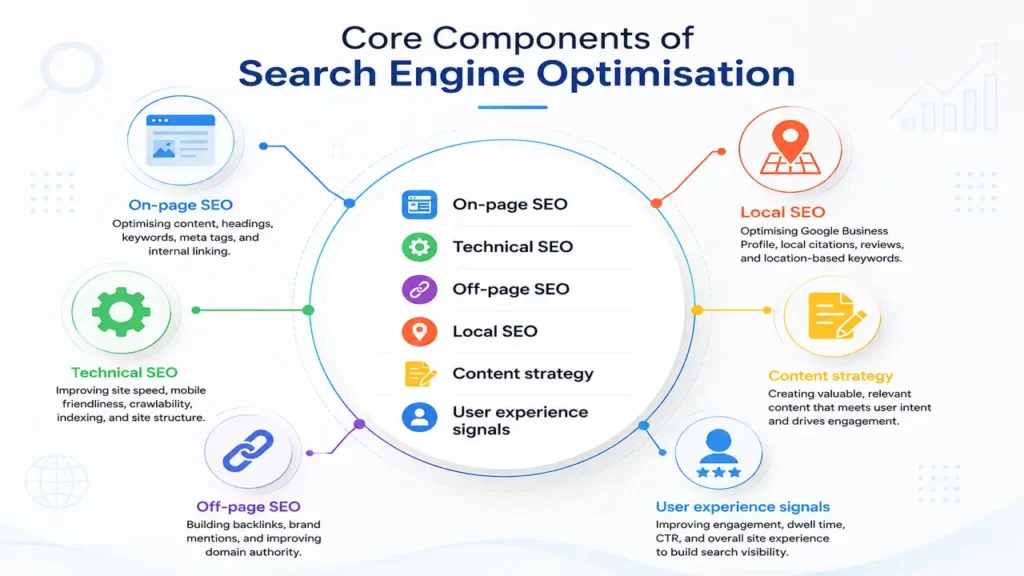
Search engine optimisation is not one activity. It is a combination of disciplines that work together, and skipping one weakens the rest.
- On-page SEO: Optimising titles, headers, content, and internal links on individual pages so both users and search engines understand what the page is about. Whamply’s on-page SEO services cover this end to end.
- Technical SEO: Fixing crawlability, site speed, mobile responsiveness, indexing errors, and structured data so search engines can access and understand a site properly, an area covered in detail by technical SEO services.
- Off-page SEO: Building backlinks and brand mentions from other credible websites, which signals authority and trust to search engines. This is where off-page SEO and link building services come in.
- Local SEO: Optimising Google Business Profile listings, local citations, and location-specific content, critical for service businesses targeting cities like Delhi, Mumbai, or Bengaluru. Explore local SEO services for city-specific strategy.
- Content strategy: Creating pages that genuinely answer what a searcher wants to know, not just what a keyword tool suggests, handled by dedicated SEO content writing services.
- User experience signals: Page speed, mobile usability, and dwell time increasingly influence how search engines rank a page.
A search engine optimisation strategy that ignores even one of these areas will underperform, no matter how strong the others are. I have seen technically flawless websites lose rankings simply because the content did not match search intent, and I have seen brilliant content get buried because the site took eight seconds to load.
How Search Engine Optimisation Actually Works: A Step-by-Step Breakdown
- Keyword and intent research: Identify what your audience is actually searching for, and more importantly, why. A keyword like “best CRM software” has different intent than “CRM software pricing India.”
- Content creation and on-page optimisation: Build pages around that intent, using the target keyword naturally in the title, headers, and body, along with related terms search engines expect to see.
- Technical audit and fixes: Resolve crawl errors, broken links, slow-loading pages, and missing schema markup so search engines can index the site properly.
- Authority building: Earn backlinks from relevant, credible sites through digital PR, guest content, or partnerships. Quality matters far more than quantity here.
- Measurement and iteration: Track rankings, organic traffic, and conversions using tools like Google Search Console and Google Analytics, then refine based on what the data shows.
- Ongoing maintenance: Search engine optimisation is not a one-time project. Algorithms update, competitors publish new content, and rankings shift, so the work continues indefinitely. For businesses without an in-house team, SEO consultation services can keep this moving.
Real Examples of Search Engine Optimisation
A clothing brand targeting “cotton kurtas for women” might optimise a category page with the keyword in the title tag, add a detailed buying guide, include size charts, and build internal links from related blog posts about fabric care. Within a few months, that page can start ranking above competitors who only listed products without context. This is the kind of work covered under ecommerce SEO services.
A local dentist in Gurgaon optimising for “dentist near Sector 45 Gurgaon” would focus on Google Business Profile optimisation, local citations, and a location page with genuine patient reviews, rather than trying to rank a generic homepage for that query.
A national B2B manufacturer chasing rankings across multiple cities and product categories needs a different scale of work entirely, closer to what enterprise SEO services are built for.
These examples show the same principle: search engine optimisation works best when it solves a specific, real search intent rather than chasing broad, vague keywords. You can see real ranking and traffic outcomes in Whamply’s SEO case studies.
Common Mistakes to Avoid
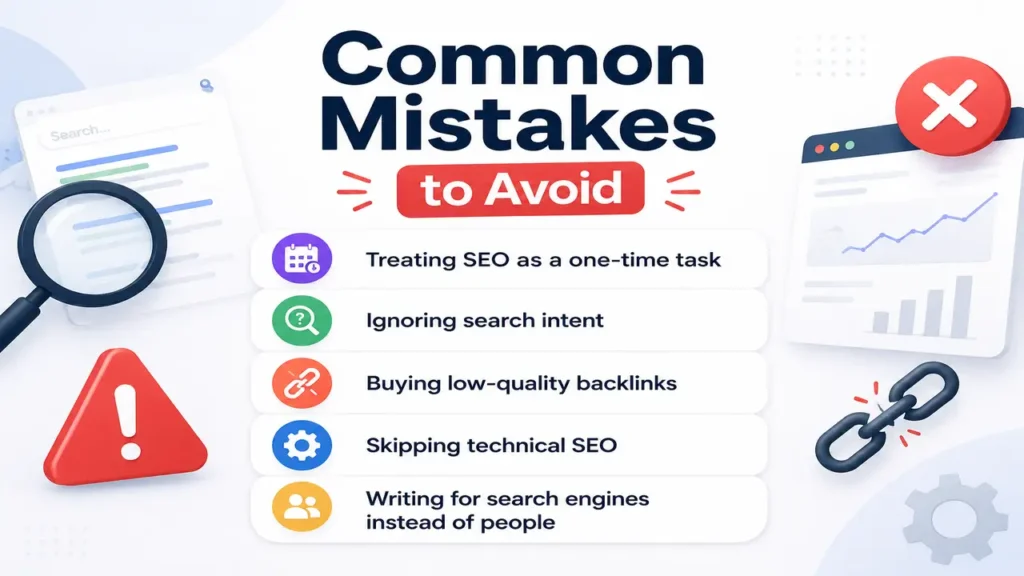
Treating SEO as a one-time task.
Search engine optimisation is ongoing. A page that ranks well today can drop within months if competitors publish better content or algorithms shift priorities.
Ignoring search intent
Ranking a product page for an informational keyword, or a blog post for a transactional one, almost never works because it does not match what the searcher actually wants.
Buying low-quality backlinks
Cheap link packages from unrelated, spammy sites can trigger penalties instead of boosting authority. Google’s algorithms have become very good at spotting manipulation.
Skipping technical SEO
A slow, unindexed, or mobile-unfriendly site can undo months of content work, because search engines simply cannot crawl or rank what they cannot properly access.
Writing for search engines instead of people
Keyword-stuffed content that reads awkwardly gets penalised, and even if it briefly ranks, it will not convert visitors into customers. If you want a longer primer on the basics, this beginner’s guide to SEO is a good next read.
Conclusion
Search engine optimisation is not a trick or a shortcut. It is a long-term investment that compounds over time, and businesses that treat it seriously consistently outperform those chasing quick wins through paid ads alone.
If your website is not getting the organic visibility it deserves, get a free SEO audit from Whamply and see exactly where your search engine optimisation strategy is losing traffic and how to fix it. You can also get in touch directly to talk through a custom plan.
Frequently Asked Questions
What is search engine optimisation in simple terms?
Search engine optimisation is the practice of improving a website so it ranks higher in unpaid search results. It involves optimising content, site structure, and credibility signals to match what people are searching for.
What are the three types of SEO?
The three main types are on-page SEO, off-page SEO, and technical SEO. On-page focuses on content and structure, off-page focuses on backlinks and authority, and technical SEO ensures search engines can crawl and index the site properly.
How long does search engine optimisation take to show results?
Most websites see measurable results within 4 to 6 months, though competitive keywords can take a year or longer. Timelines depend on domain authority, competition, and content quality.
Is search engine optimisation still relevant in 2026?
Yes, search engine optimisation remains highly relevant because organic search still drives the majority of website traffic. AI-driven search results have changed the format but not eliminated the need for strong SEO fundamentals, including newer areas like AI SEO.
What is the difference between SEO and SEM?
SEO focuses on earning free organic rankings, while SEM (search engine marketing) includes paid advertising like Google Ads. Many businesses use both together for faster and more sustainable visibility.
How much does search engine optimisation cost in India?
SEO services in India typically range from INR 15,000 to INR 1,00,000 or more per month, depending on the agency, competition level, and scope of work involved.
What is keyword research in SEO?
Keyword research is the process of finding the terms and phrases people actually search for, so content can be built around real demand instead of guesswork.
Can a website rank without backlinks?
It is possible for low-competition, niche keywords, but for most competitive terms, backlinks remain one of the strongest ranking signals search engines use.
What is local SEO?
Local SEO is the practice of optimising a business’s online presence to rank for location-based searches, primarily through Google Business Profile, local citations, and location-specific content.
Does site speed affect search engine optimisation rankings?
Yes, site speed is a confirmed ranking factor, and slow-loading pages often see higher bounce rates, which further hurts rankings indirectly.
What is technical SEO?
Technical SEO refers to backend improvements like crawlability, indexing, mobile responsiveness, and structured data that help search engines access and understand a website correctly.
How is SEO different from content marketing?
Content marketing focuses on creating valuable material to attract an audience, while search engine optimisation ensures that content is structured and optimised to actually be found through search engines.
What tools are used for search engine optimisation?
Common tools include Google Search Console, Google Analytics, Ahrefs, SEMrush, and Screaming Frog, each covering different parts of the SEO process from keyword research to technical audits.
Do small businesses need search engine optimisation?
Yes, small businesses often benefit the most from local SEO, since it helps them compete with larger brands for nearby, high-intent customers without a massive advertising budget.
What is an SEO audit?
An SEO audit is a comprehensive review of a website’s technical health, content quality, and backlink profile, used to identify what is holding back rankings and what needs fixing. You can request one through Whamply’s SEO services page.