
Google Ads vs Meta Ads: Which Platform Drives Better ROI in 2026
On this page
Businesses running paid ads in 2026 are spending more carefully than ever, and the question of Google Ads vs Meta Ads comes up in almost every strategy conversation. The average cost per click on Google Search has risen 17% year-on-year in competitive verticals, while Meta’s CPM rates fluctuated sharply across Q3 and Q4 of 2025. Getting this platform decision wrong means wasting budget, not just missing targets.
What is the Google Ads vs Meta Ads debate?
Google Ads vs Meta Ads is the comparison between two dominant paid advertising platforms: Google Ads, which shows ads to users based on active search intent through Google Search and Display networks, and Meta Ads, which delivers ads across Facebook and Instagram using interest-based and behavioural audience targeting. Marketers weigh both platforms on metrics like cost per click, audience targeting precision, conversion rates, and overall ad platform ROI to decide where their budget generates the most return.
Why This PPC Comparison Matters More in 2026
The paid advertising market has changed significantly. Apple’s ATT framework, third-party cookie deprecation across Chrome, and tighter data privacy regulations have reshaped how both Google Ads and Meta Ads operate. Audience targeting on Meta is less precise than it was in 2021, and Google has leaned harder into AI-powered Smart Bidding to compensate for signal loss.
In India specifically, Meta Ads still command strong engagement, particularly on Instagram Reels placements, where CPMs can be as low as INR 40 to INR 120 for broad consumer audiences. Google search ads in the same market often start at INR 5 to INR 25 per click for moderately competitive keywords, making both platforms genuinely accessible even for mid-sized budgets.
According to WordStream’s 2025 Google Ads Benchmark Report, the average conversion rate across industries on Google Search sits at around 4.8%, compared to approximately 1.2% on Meta for cold traffic. That gap tells you something important about intent.
Google Ads in 2026: Where Search Intent Still Wins
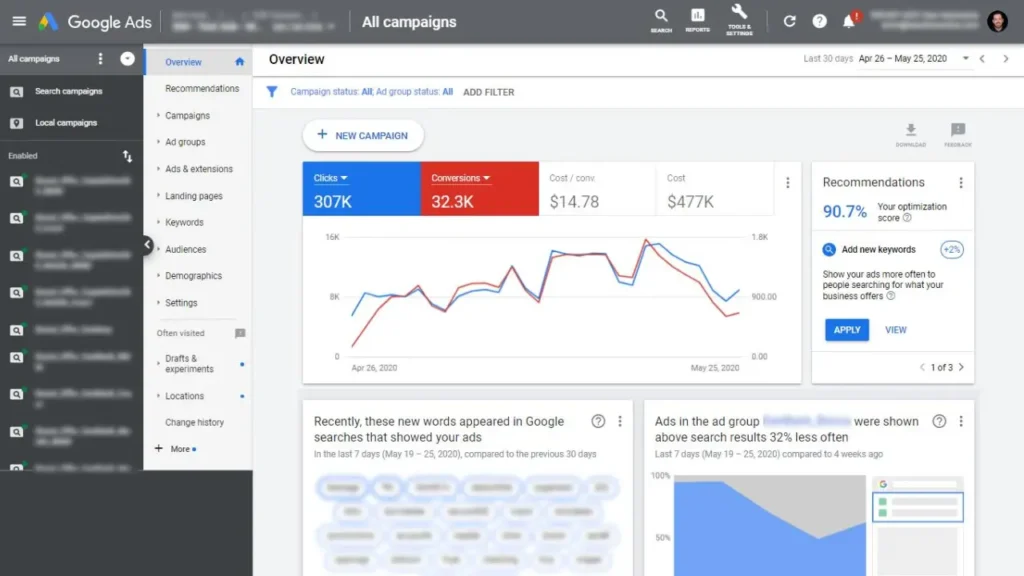
Google Ads remains the dominant platform when purchase intent is high. When someone searches “best CRM software for small business” or “emergency plumber in Bengaluru,” they are already in buying mode. That is the core advantage Google search ads hold over almost every other ad format.
The Google Ads platform in 2026 operates across several key formats:
- Search campaigns: Text ads triggered by keyword queries, still the highest-converting format for bottom-of-funnel traffic.
- Performance Max (PMax): Google’s AI-driven campaign type that spans Search, Display, YouTube, Gmail, and Maps. Effective for scale, but harder to control at a granular level. Whamply’s Performance Max management service handles this end-to-end.
- Demand Gen campaigns: Replaced Discovery ads in late 2024, designed to build awareness across YouTube and Gmail with more creative flexibility.
- Shopping campaigns: Essential for e-commerce, now integrated heavily with PMax. Pair this with Shopping Ads management for better product feed control.
- Display and YouTube: Better suited to retargeting and brand awareness rather than direct conversion.
From a pure ad platform ROI perspective, Google search ads consistently deliver lower cost-per-acquisition for high-intent keywords. The trade-off is volume. If you are in a niche B2B category or a local service business, search volume may be limited, and cost per click in competitive sectors like insurance or legal services can exceed INR 500 to INR 1,200 per click in India.
Google’s Smart Bidding has matured considerably. Target ROAS and Target CPA strategies now outperform manual bidding in most accounts once conversion data reaches statistical significance. The threshold most campaign managers work with is roughly 30 to 50 conversions per month before automated bidding becomes reliable.
For advertisers focused on measurable, intent-driven results, google ads services continues to be the stronger platform in this Google Ads vs Meta Ads comparison. The caveat is that it requires solid keyword strategy, negative keyword management, and consistent landing page optimisation to maintain efficiency as competition intensifies.
Meta Ads in 2026: Audience Targeting at Scale
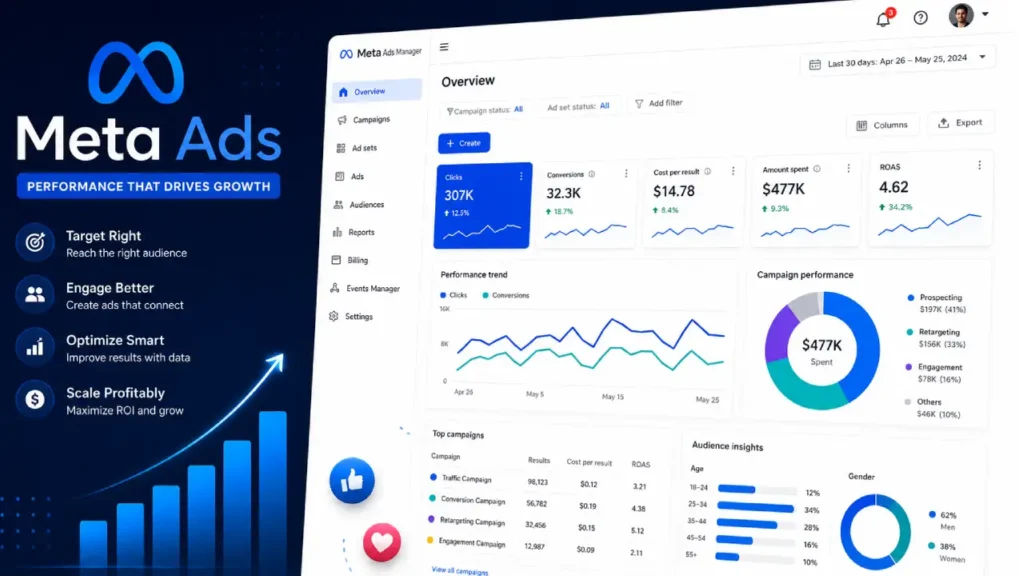
Meta Ads operate on a fundamentally different logic. Instead of capturing existing demand, Facebook advertising and Instagram advertising create demand by placing ads in front of people who match a defined audience profile. This makes Meta stronger for brand building, new product launches, and markets where search volume does not exist yet.
Here is how to approach Meta Ads strategically in 2026, step by step:
- Define your audience architecture first. Meta’s Advantage+ audience tools use AI to expand targeting beyond your manual inputs. Start with a core custom audience (existing customers or website visitors) and let Meta’s algorithm identify lookalikes and interest overlaps.
- Choose your campaign objective based on your funnel stage. Sales and leads objectives with Advantage+ Shopping are best for bottom-of-funnel. Awareness and engagement objectives work for top-of-funnel. Mixing objectives in one campaign dilutes the algorithm’s learning.
- Invest in creative above everything else. In 2026, Meta’s ad auction rewards high-engagement creative. A single strong video or UGC-style image can outperform an entire library of mediocre static ads. Creative is the primary targeting lever on Meta, not the audience.
- Structure your ad sets to avoid overlap. Too many ad sets targeting similar audiences splits the learning budget and slows down the algorithm. Most experienced account managers now consolidate to two or three broad ad sets per campaign.
- Monitor frequency and refresh creative regularly. On Meta, ad fatigue hits fast, especially on Instagram Ads placements. A frequency above 3.5 within a 7-day window usually signals it is time to test new creative.
- Layer in retargeting thoughtfully. Custom audiences based on video views, website visits, and engagement are still highly effective on Meta, even post-ATT. These warm audiences typically convert at 3 to 5 times the rate of cold traffic. A well-structured dynamic remarketing setup handles this automatically.
The cost per click on Meta varies widely by industry, creative quality, and audience size. In India, Facebook advertising CPCs for e-commerce audiences average between INR 4 and INR 20, making it one of the most cost-efficient markets globally for Meta placements.
Common Mistakes to Avoid in the Google Ads vs Meta Ads Decision
Treating both platforms as interchangeable. Google Ads and Meta Ads serve different stages of the buyer journey. Sending cold Meta traffic directly to a product page with no warming sequence almost always underperforms. Equally, running broad Google Display campaigns to build awareness wastes budget that search intent cannot recover.
Judging ROI by last-click attribution alone. Meta Ads often influence purchases that are later attributed to Google search, especially in research-heavy categories. If you only look at last-click data in Google Analytics, you will consistently undervalue Meta’s contribution. Use data-driven attribution models or run controlled geo-split tests to get a truer picture of ad platform ROI.
Setting and forgetting Smart Bidding without enough data. Both Google’s Target CPA and Meta’s Advantage+ need conversion volume to function properly. Launching a brand new campaign with automated bidding and only five conversions per week is a recipe for unstable delivery and inflated costs. Manual or enhanced CPC bidding works better until sufficient data is present.
Ignoring the India-specific competitive context. In Indian markets, the Google Ads vs Meta Ads calculus can look different from Western benchmarks. Search volumes for many B2B SaaS or high-consideration categories are still relatively low in regional languages, making Meta a stronger reach vehicle. Localised creative in Hindi or regional languages consistently outperforms English-only ads on Meta in Tier 2 and Tier 3 cities. A specialised B2B lead generation approach often works better here than standard ad setups.
Cutting budget too quickly after launch. Both Google and Meta campaigns go through a learning phase. Cutting budget during the first two to four weeks based on early CPA data is one of the most common and costly mistakes. Give campaigns at least 30 days and 50 conversions before making major bid or budget changes.
Conclusion
The honest answer to the Google Ads vs Meta Ads debate in 2026 is that the most effective paid media strategies do not choose one over the other. They use Google search ads to capture existing demand and Meta Ads to build it. The platform that drives better ROI depends on your product, your audience, and where your customers are in their buying journey.
If you are only on one platform right now, start by auditing where your conversions are actually coming from. A proper attribution audit often reveals that budget is either over-concentrated in one channel or split in a way that does not reflect actual influence on revenue.
Want a clear-eyed review of how your current Google Ads and Meta Ads budget is performing? Whamply Media offers a free audit services for businesses ready to scale. Book a call this week and the team will show you exactly where your ad spend is working and where it is not.
Which platform has a better ROI, Google Ads or Meta Ads?
It depends entirely on your product, funnel stage, and audience. Google Ads typically delivers higher ROI for high-intent searches and bottom-of-funnel conversions. Meta Ads performs better for brand awareness, new product launches, and audiences who are not yet searching for your solution.
What is the average cost per click on Google Ads vs Meta Ads?
Google Search ads average between INR 10 and INR 80 per click for most industries in India, with premium verticals like finance and legal going much higher. Meta Ads cost per click typically ranges from INR 3 to INR 25, though the relevant metric on Meta is usually CPM rather than CPC.
Should I run Google Ads and Meta Ads together?
Yes, in most cases. Running both platforms together creates a full-funnel strategy where Meta builds awareness and Google captures the resulting search demand. Many advertisers see better overall ROI from a combined performance marketing approach than from either platform in isolation.
Which platform is better for B2B marketing?
Google Ads generally wins for B2B because professional buyers search with specific intent. LinkedIn can outperform both for very precise job-title targeting, but Google Ads usually delivers better CPA at scale for B2B lead generation compared to Meta.
Which is better for e-commerce, Google Ads or Meta Ads?
Both are essential for e-commerce. Google Shopping captures purchase-ready buyers. Meta Ads is critical for product discovery, retargeting abandoned carts, and reaching new audiences who have not yet heard of your brand.
How does audience targeting differ between Google Ads and Meta Ads?
Google Ads targets based on search keywords, in-market segments, and user behaviour signals. Meta Ads targets based on interests, demographics, behaviours, and lookalike audiences derived from your existing customer data. Google captures intent; Meta builds it.
Is Meta Ads or Google Ads easier to manage?
Neither is genuinely easy, but Meta Ads has a lower barrier to entry for basic campaigns. Google Ads, especially Search campaigns, requires more upfront keyword research, match type strategy, and negative keyword management to run efficiently.
What budget should I start with on Google Ads vs Meta Ads in India?
A reasonable starting budget for testing is INR 15,000 to INR 30,000 per month per platform. Below that threshold, the data volume is too low to optimise effectively. Larger budgets accelerate the learning phase on both platforms.
How do I measure ROI accurately across both platforms?
Use a combination of platform-reported data, Google Analytics 4 with data-driven attribution, and where possible, a third-party attribution tool or regular conversion lift tests. Avoid comparing both platforms using last-click data alone.
Which platform is better for local service businesses?
Google Ads, specifically Local Services Ads and Search campaigns, almost always wins for local service businesses like plumbers, lawyers, and clinics. The intent is direct and immediate. Meta can support local brand recognition but rarely converts as efficiently for service queries.
How has the Google Ads vs Meta Ads comparison changed in 2026?
Privacy changes have affected Meta more than Google, with reduced signal from iOS devices limiting audience targeting precision. Google has responded to cookie deprecation with Privacy Sandbox tools. Both platforms have leaned heavily into AI automation, changing how campaign managers approach optimisation.
Can small businesses afford to run Google Ads vs Meta Ads simultaneously?
Yes, with focused targeting and small budgets. A combined spend of INR 25,000 to INR 50,000 per month can generate useful data from both platforms if campaigns are kept simple and audiences are kept tight.
What creative formats work best on Meta Ads in 2026?
Short-form video (15 to 30 seconds), UGC-style content, and carousel formats for e-commerce consistently outperform static image ads on Meta. Reels placements offer the widest organic-style reach at lower CPMs.
Which platform offers better analytics, Google Ads or Meta Ads?
Google Ads integrates directly with Google Analytics 4, offering deeper cross-channel attribution and a wider range of conversion tracking options. Meta’s Ads Manager is improving, but signal loss from iOS has made its attribution less reliable than it was before 2021.
Is Google Ads or Meta Ads better for retargeting?
Both are strong for retargeting. Google Display and YouTube retargeting keeps your brand visible as users browse across the web. Meta retargeting through custom audiences is highly effective for e-commerce, particularly for abandoned cart and post-visit sequences. A managed dynamic remarketing service handles this across both platforms simultaneously.