
What is ROAS and How to Improve It for Your Business
On this page
If you spent Rs 1,00,000 on ads last month and have no clear idea whether it made you money, ROAS is the metric you are missing. Businesses that track return on ad spend consistently outperform those optimising purely for clicks or impressions. Understanding what is ROAS, how to calculate it, and how to push it higher is one of the most practical skills any marketing team can develop. This guide walks you through all of it.
What is ROAS?
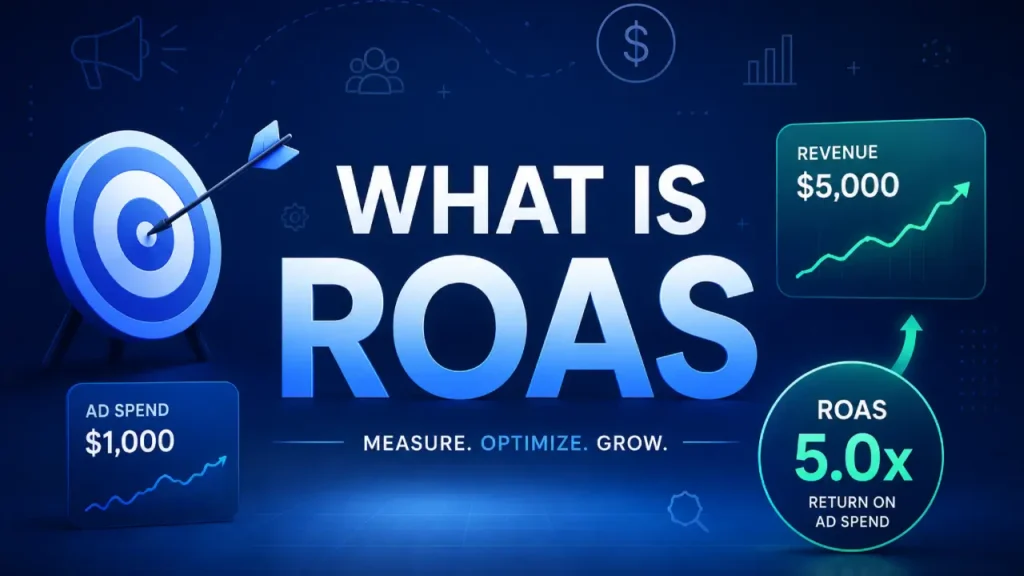
ROAS, or return on ad spend, is a marketing metric that measures how much revenue a business earns for every rupee or dollar spent on advertising. The ROAS formula is straightforward: divide total revenue generated from ads by the total ad spend. For example, if you spent Rs 50,000 on a google ads services and generated Rs 2,00,000 in revenue, your ROAS is 4:1, meaning you earned four rupees for every one rupee spent. ROAS is expressed as a ratio or multiple and is used to evaluate ad profitability, compare campaigns, and set target ROAS goals across channels like Google Ads, Meta, and e-commerce platforms.
Why ROAS Matters in 2026
Ad costs have climbed steadily across every major platform. Google Ads average CPCs in India rose by roughly 15 to 20 percent over the past two years across competitive verticals like insurance, finance, and e-commerce. When you are paying more per click, understanding what is ROAS becomes essential, not optional.
Most advertisers still rely on vanity metrics: impressions, reach, and click-through rates. These numbers feel good on a dashboard but tell you nothing about whether your ad spend is actually generating profit. ROAS cuts through the noise and ties your spend directly to revenue.
According to WordStream’s 2024 Google Ads Benchmarks report, the average conversion rate across Google Ads industries sits at around 4.8 percent on the search network. With click costs rising, maintaining a healthy ROAS requires more than just running ads; it requires knowing your numbers cold. If your campaigns are struggling with rising CPCs, a audit performance marketing services is often the fastest way to identify where spend is leaking.
Understanding the ROAS Formula and How to Calculate It
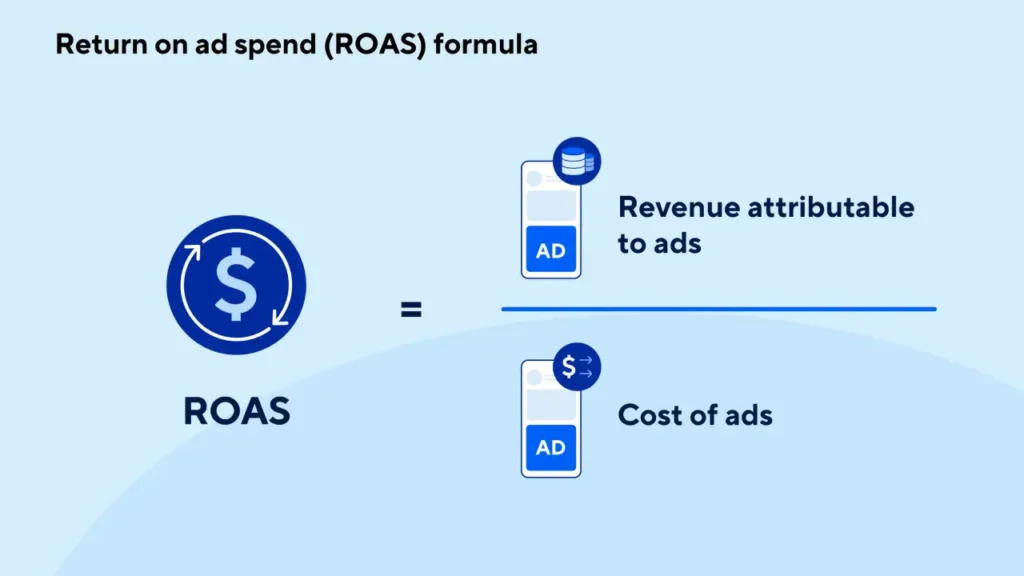
The ROAS formula has no complexity to it. What makes it powerful is how you apply it.
ROAS = Revenue from Ads / Cost of Ads
So if a campaign generated Rs 5,00,000 in sales and cost Rs 1,25,000 to run, your ROAS is 4. In percentage terms, some teams express this as 400%, though the ratio format is more common when reporting Google Ads ROAS or e-commerce ROAS.
What is ROAS in practice?
It depends on your business model. A product with a 60 percent margin needs a very different target ROAS than one running at 20 percent. Here is how to think through it properly.
Step 1: Know your gross margin. Before you set a target ROAS, calculate the gross margin on the products you are advertising. If your margin is 40 percent, a ROAS of 2.5 means you are just breaking even, not profitable.
Step 2: Set a minimum viable ROAS. Divide 1 by your gross margin percentage. A 40 percent margin means you need at minimum a ROAS of 2.5 just to cover cost of goods. Add overhead and you are looking at a minimum target ROAS of 3 to 4 for most product-based businesses.
Step 3: Separate campaign ROAS from blended ROAS. Individual campaign ROAS tells you which specific ads or ad groups are profitable. Blended ROAS (total revenue divided by total ad spend across all channels) gives you the big picture. Both matter.
Step 4: Segment by channel. Google Ads ROAS and Meta ROAS rarely look the same for the same business. Search ads services almost always convert at a higher ROAS than top-of-funnel social. Treat them separately.
Step 5: Account for attribution gaps. In India, a significant portion of conversions happen offline or through WhatsApp after an initial ad click. If your attribution model only counts last-click online purchases, your reported ROAS is almost certainly understated.
Step 6: Review weekly, not monthly. Campaign performance shifts fast. A weekly ROAS review catches declining ad profitability before it wipes out a month’s budget.
Key things to track alongside ROAS:
Cost per acquisition (CPA) to understand unit economics
Average order value (AOV), since higher AOV directly lifts ROAS without changing spend
Customer lifetime value (LTV), especially if you run subscription or repeat-purchase businesses
Impression share, because a campaign with a low ROAS but high impression share may be cannibalising organic traffic
How to Improve ROAS Across Your Campaigns
Knowing what is ROAS is one thing. Improving it is where the real work happens. These strategies are drawn from campaigns across e-commerce and lead generation brands in India and globally.
Tighten Your Audience Targeting
The fastest way to improve ROAS is to stop showing ads to people who will never buy. In Google Ads, this means adding negative keywords aggressively. In Meta, it means testing tighter custom audiences based on purchase history rather than broad interest categories. Facebook ads services and instagram ads services both offer purchase-based custom audiences that consistently outperform interest targeting for ROAS improvement.
For e-commerce ROAS improvement specifically, campaigns remarketing services consistently outperform prospecting on return on ad spend, often by 2x to 3x. Allocate budget accordingly.
Improve Landing Page Conversion Rate
Ad quality is only half the equation. If your landing page converts at 1 percent and a competitor’s converts at 4 percent, they are effectively getting four times the ROAS from the same traffic. Small landing page changes, including headline clarity, social proof, faster load times on mobile, and a single clear call to action, can move ROAS significantly without touching the ad budget. landing page optimisation services is consistently one of the highest-return activities for improving ROAS without increasing spend.
In the Indian market, this is particularly relevant. A large share of traffic comes from mobile devices on slower connections. Pages that load in under two seconds on a 4G connection outperform slower equivalents by a measurable margin on both conversion rate and quality score.
Use Target ROAS Bidding Strategically
Google Ads has a native target ROAS bidding strategy. It works well once a campaign has sufficient conversion data, typically 30 to 50 conversions in the past 30 days. Set the target ROAS based on your margin analysis from earlier rather than an aspirational number. Setting a target ROAS too high causes Google to restrict impressions and throttle delivery.
Start with a target ROAS close to your current actual ROAS, then increase it incrementally by 10 to 15 percent every two weeks as performance holds.Performance max services use a similar target ROAS input across all Google inventory simultaneously, making this bidding discipline even more important at the account level.
Prioritise High-Margin Products
Not all products deserve equal ad budget. Running a ROAS analysis by product category or SKU frequently reveals that a handful of products are generating most of the return on ad spend while others are dragging the average down. Shift budget toward high-margin, high-converting products. For e-commerce brands running shopping ads services, product-level ROAS segmentation is one of the most impactful optimisations available. Pause or restructure campaigns for low-margin products unless they serve a strategic purpose like customer acquisition.
Reduce Wasted Spend with Search Term Audits
One of the most common ROAS killers in Google Ads is search term bleed: your ads showing for irrelevant queries that eat budget without converting. Run a search term report weekly. Add irrelevant terms as exact-match negatives. For Indian advertisers running broad or phrase-match keywords, regional language variations and misspellings can trigger a surprising volume of off-target impressions. A CRO audit cro services that combines search term analysis with landing page review will often surface the biggest efficiency wins in a single pass.
Common Mistakes That Kill Your ROAS
Optimising for clicks instead of conversions. Click-through rate tells you almost nothing about ad profitability. An ad with a 10 percent CTR that drives no purchases has a ROAS of zero. Set your primary campaign goal as revenue or ROAS from day one.
Ignoring the ROAS formula when scaling budgets. Scaling a campaign by doubling the budget rarely doubles revenue. As spend increases, you enter lower-intent audience segments and ROAS typically drops. Scale in 20 to 30 percent increments and monitor ROAS after each increase before scaling further.
Setting the same target ROAS across all product categories. A skincare brand selling a Rs 500 moisturiser and a Rs 5,000 serum should not have the same target ROAS. The margin structures are different, the customer journey is different, and the repeat-purchase behaviour is different. Segment your target ROAS by product tier or category.
Not accounting for seasonality. ROAS fluctuates with seasons, festivals, and sale periods. In India, ROAS for many e-commerce categories spikes during Diwali and dips in January and February. Comparing a Diwali campaign ROAS to a February baseline makes no useful sense. Set benchmarks within comparable periods.
Treating ROAS in isolation from profit. A ROAS of 8 sounds excellent. But if you are running a brand with 10 percent margins, a 10x ROAS is break-even. Return on ad spend is a revenue metric, not a profit metric. Always read ROAS alongside gross margin to understand true ad profitability.
Conclusion
The two things that move ROAS most reliably are reducing wasted spend through tighter targeting and negative keyword management, and improving landing page conversion rate to get more revenue from the same traffic. Both are in your control starting today.
If you are running paid campaigns and are not certain whether your current ROAS is above or below your break-even point, that is the first thing to fix. Book a free ROAS and ad account audit with our team free audit services. We will review your current Google Ads or Meta campaigns, calculate your true minimum viable ROAS based on your margins, and identify where your budget is leaking. No generic report, no sales pitch, just a clear picture of where your ad spend stands.
Frequently Asked Questions
What is ROAS in digital marketing?
ROAS stands for return on ad spend. It measures the revenue earned for every unit of currency spent on advertising, expressed as a ratio. A ROAS of 4 means Rs 4 in revenue was generated for every Rs 1 spent on ads.
What is a good ROAS for e-commerce?
A good e-commerce ROAS depends on your margins. Most e-commerce businesses with margins between 30 and 50 percent target a minimum ROAS of 3 to 5. Businesses with thinner margins need a higher ROAS to remain profitable.
What is the ROAS formula?
The ROAS formula is: Revenue from Ads divided by Cost of Ads. If a campaign generated Rs 3,00,000 in revenue from Rs 75,000 in spend.
How is ROAS different from ROI?
ROAS measures revenue relative to ad spend only. ROI (return on investment) accounts for total costs including cost of goods, overheads, and fulfilment. A campaign can have a high ROAS and a negative ROI if product margins are low.
What is target ROAS in Google Ads?
Target ROAS is a Smart Bidding strategy in Google Ads that automatically adjusts bids to achieve a specific return on ad spend goal. It works best with at least 30 conversions in the past 30 days.
Why is my ROAS dropping?
ROAS can drop due to rising CPCs, audience fatigue, worsening landing page performance, seasonal demand shifts, or increased competition. A systematic audit of search terms, ad copy, landing pages, and bid strategies is the right starting point.
What is a blended ROAS?
Blended ROAS is total revenue divided by total ad spend across all advertising channels combined. It gives a business-level view of overall ad profitability, unlike per-campaign ROAS which is channel-specific.
What ROAS should I target for Google Ads in India?
This varies by industry. For competitive e-commerce categories in India, a target ROAS of 4 to 6 is common. High-margin digital products often target ROAS of 8 to 12 or higher. Always base your target ROAS on your actual gross margin.
Can ROAS be negative?
ROAS cannot technically be negative, since revenue cannot be less than zero. However, if your ROAS falls below the minimum viable level calculated from your margin, you are running at a net loss even if the ROAS ratio looks positive.
How often should I check ROAS?
Review campaign-level ROAS weekly for active campaigns. For strategic decisions like budget allocation or campaign pausing, use a 30-day rolling window to smooth out day-to-day fluctuation.
Does ROAS include VAT or GST in revenue?
It should not. Revenue used in the ROAS formula should be net revenue after tax. Including GST in revenue overstates ROAS and distorts ad profitability calculations.
How do I improve ROAS without increasing budget?
Focus on improving conversion rate, tightening audience targeting, adding negative keywords, testing higher-performing ad creatives, and shifting budget from low-margin to high-margin products. All of these improve ROAS without requiring additional spend.
Is ROAS the same as return on ad spend?
Yes, ROAS is simply the acronym for return on ad spend. Both terms refer to the same metric.
What tools can I use to track ROAS?
Google Ads and Meta Ads Manager both report ROAS natively. For a unified cross-channel view, tools like Google Looker Studio, Northbeam, Triple Whale, and DashThis allow you to pull ROAS data from multiple platforms into one dashboard.