
How to Calculate and Improve Your Customer Acquisition Cost (CAC)
On this page
Most businesses track their ad spend. Very few track their customer acquisition cost accurately enough to make decisions with it. The difference matters enormously: a company spending ₹5 lakh per month on paid acquisition without knowing its true customer acquisition cost has no way of knowing whether that spend is profitable, sustainable, or being wasted on channels that look busy but never convert. This guide covers the CAC formula, how to calculate it correctly, what benchmarks to compare against, and ten specific actions that reduce customer acquisition cost without cutting growth.
What Is Customer Acquisition Cost?
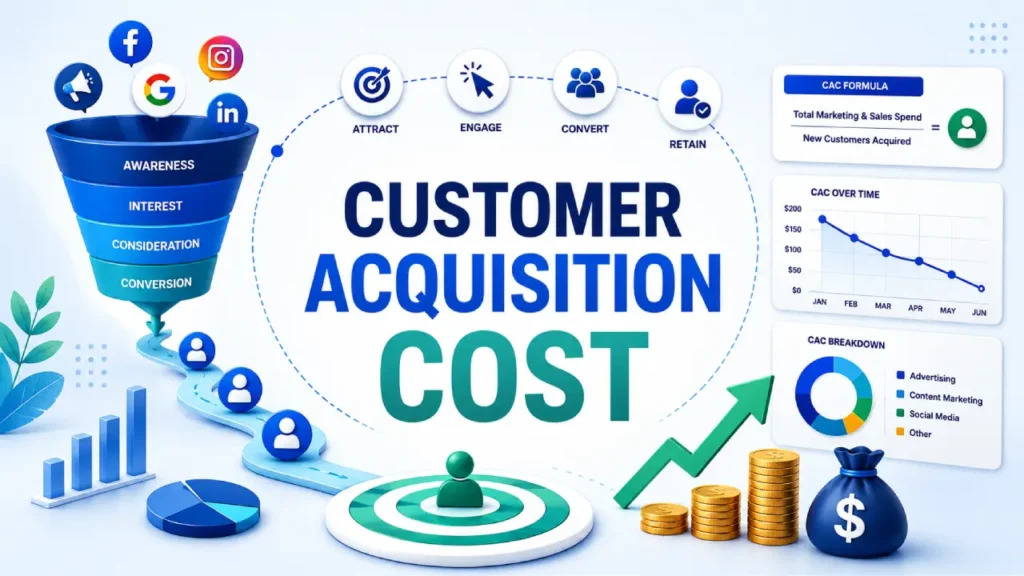
Customer acquisition cost (CAC) is the total amount a business spends to acquire one new paying customer over a given period. It is calculated by dividing all sales and marketing costs in a period by the number of new customers acquired in that same period. These costs include ad spend, agency fees, salaries for marketing and sales staff, software subscriptions, and any other resources directly used to attract and convert new customers. Customer acquisition cost is one of the most important marketing metrics for assessing whether a growth strategy is financially viable in the long run.
Why Customer Acquisition Cost Matters in 2026
Paid acquisition costs have risen across every major digital channel in the past three years. Google Ads CPCs are up across most B2B and D2C categories. Meta Ads costs have increased as more advertisers compete for the same impressions. For Indian businesses, this has been particularly acute: average CPCs in competitive B2B SaaS categories on Google India now range from ₹80 to ₹350 per click, and the cost of generating a qualified lead has risen in parallel.
According to HubSpot’s 2024 State of Marketing Report, 40% of marketers say generating traffic and leads is their biggest challenge. But generating leads without understanding your customer acquisition cost means you cannot tell whether those leads are making your business more profitable or simply more busy.
The relationship between customer acquisition cost and lifetime value (LTV) is what determines whether a business model is viable. A business with an LTV to CAC ratio below 3:1 is typically spending too much to acquire customers relative to the revenue those customers generate. Getting this ratio right is the foundation of sustainable paid acquisition, and it starts with knowing your customer acquisition cost precisely.
How to Calculate Customer Acquisition Cost Accurately
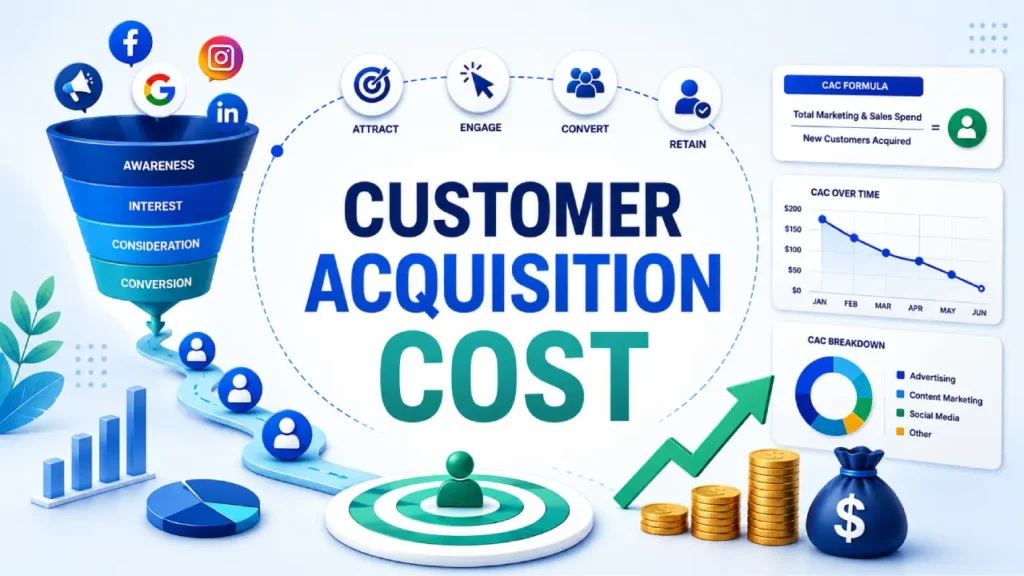
The CAC formula is straightforward on paper but frequently misapplied in practice. Understanding what to include and what period to measure over is where most businesses go wrong.
The CAC formula
Customer Acquisition Cost = Total Sales and Marketing Costs / Number of New Customers Acquired
Both figures must cover the same time period. If you spent ₹10 lakh on sales and marketing in Q1 and acquired 200 new customers in Q1, your customer acquisition cost is ₹5,000 per customer.
What to include in total costs:
The most common mistake is including only ad spend. A complete customer acquisition cost calculation includes:
- Paid media spend: Google Ads, Meta Ads, LinkedIn Ads, programmatic
- Agency and freelancer fees for campaign management and creative
- Marketing team salaries, prorated to the percentage of time spent on acquisition activities
- Sales team salaries and commissions, particularly for outbound or assisted conversion roles
- CRM, marketing automation, and analytics software subscriptions
- Content production costs directly tied to acquisition campaigns
- Event costs, trade show fees, or sponsorships used for lead generation
Blended CAC vs channel-specific CAC
Blended CAC gives you an overall business-level view. Channel-specific CAC tells you which individual channels are efficient and which are not. Both are useful, but channel-specific CAC is more actionable. A blended customer acquisition cost of ₹4,000 might look acceptable, but if your LinkedIn channel is producing customers at ₹2,500 and your programmatic display channel is at ₹12,000, those are very different strategic decisions hiding inside one average number.
LTV to CAC ratio benchmarks
- Below 1:1 means you are losing money on every customer acquired
- 1:1 to 3:1 is break-even to marginal; unsustainable in most markets
- 3:1 is the broadly accepted healthy benchmark for SaaS and B2B businesses
- Above 5:1 often signals underinvestment in growth rather than efficiency
Knowing your LTV to CAC ratio tells you how aggressively you can invest in paid acquisition. If your ratio is 7:1, you likely have room to spend more. If it is 1.5:1, the priority is reducing customer acquisition cost before scaling spend.
10 Proven Ways to Reduce Customer Acquisition Cost
Reducing customer acquisition cost does not mean cutting budget. It means getting more customers from the same spend, or the same number of customers from less. These ten methods work across B2B, SaaS, and e-commerce contexts.
Step 1: Audit your current channel-level CAC Before optimising anything, break your customer acquisition cost down by channel. Most businesses have two or three channels that are significantly more efficient than the others. Identifying these and reallocating budget toward them is the single highest-ROI step in any CAC reduction programme. Use Google Analytics 4 with UTM tracking across all channels, and connect your CRM data to see which channel sources actually close, not just which generate the most leads. Whamply’s performance marketing services include a full channel-level CAC audit as part of onboarding.
Step 2: Improve landing page conversion rates Customer acquisition cost is directly affected by how well your landing pages convert. If your page converts at 2% and you improve it to 4%, your customer acquisition cost halves on that channel without touching your ad spend. Focus on message match, above-the-fold clarity, CTA button copy, and form length. Even a one-percentage-point improvement in conversion rate compounds significantly at scale. Whamply’s landing page optimisation service is specifically designed to address this lever.
Step 3: Tighten your audience targeting Broad audiences generate impressions and clicks from people who will never become customers. Tightening your targeting on LinkedIn, Google, and Meta to match your ICP precisely will typically reduce click volume but increase lead quality, which reduces customer acquisition cost at the pipeline level even if cost per click stays the same. For B2B businesses, this means layering job function, seniority, company size, and geography rather than targeting by interest alone. Whamply’s LinkedIn Ads service is built around this principle of precision-first paid acquisition.
Step 4: Invest in content that reduces reliance on paid acquisition Organic content, SEO, and thought leadership reduce customer acquisition cost over time by generating leads without incremental ad spend. A blog post that ranks for a high-intent keyword and generates 50 leads per month has an ongoing customer acquisition cost close to zero on a marginal basis. The upfront investment in SEO blog writing and content compounding compounds in a way paid acquisition cannot, particularly for businesses where customer lifetime value justifies a longer payback window.
Step 5: Build retargeting into every campaign Retargeting audiences who have already visited your site or engaged with your content convert at significantly higher rates than cold audiences. Higher conversion rates mean lower customer acquisition cost on retargeting spend. Most businesses underinvest in retargeting relative to cold prospecting, which keeps their blended CAC higher than it needs to be. A structured remarketing strategy typically reduces blended customer acquisition cost by 15 to 30% when properly set up.
Step 6: Reduce lead-to-customer drop-off with better nurturing If 100 leads come in and only 5 become customers, your customer acquisition cost is calculated on those 5. Improving the conversion rate from lead to customer (through faster follow-up, better qualification, and stronger nurture sequences) reduces customer acquisition cost without changing a single campaign. Email marketing automation plays a critical role here: leads that receive a structured nurture sequence within the first 24 hours of enquiring close at measurably higher rates.
Step 7: Score and prioritise leads with CRM automation Not all leads have equal close probability. Spending the same amount of sales effort on a cold top-of-funnel contact and a warm demo request wastes resource and inflates effective customer acquisition cost. CRM automation and lead scoring ensure your sales team focuses time on the leads most likely to close, which increases close rates and reduces CAC at the revenue level.
Step 8: Optimise for quality conversions, not volume If your campaigns are optimised for form fills, you get form fills. If they are optimised for qualified leads or actual customers, your customer acquisition cost improves at a business level even if CPL appears to rise temporarily. Switch your campaign objectives to downstream conversion events where your data allows. For Google Ads campaigns with enough conversion history, importing closed-won revenue data from your CRM and bidding on that signal dramatically improves ad spend ROI.
Step 9: Test and iterate creative more frequently Creative fatigue is one of the most underappreciated drivers of rising customer acquisition cost on Meta and LinkedIn. As frequency climbs, CTR falls, CPCs rise, and customer acquisition cost increases on campaigns that once performed well. Rotating creative every four to six weeks and systematically A/B testing headlines, images, and offer framing keeps performance from decaying. Lead automation tools that connect creative performance data to downstream lead quality make this process far more precise than standard platform reporting.
Step 10: Measure CAC payback period, not just CAC in isolation CAC payback period is how many months it takes to recover the customer acquisition cost from a customer’s revenue. A customer acquisition cost of ₹8,000 with a monthly subscription of ₹4,000 has a payback period of two months, which is excellent. The same ₹8,000 CAC with a monthly revenue of ₹500 means 16 months to payback, which is very different strategically. Understanding payback period alongside lifetime value and LTV to CAC ratio gives you the full picture of whether your customer acquisition cost is sustainable. Pairing this analysis with AI sales automation helps compress payback periods by accelerating lead-to-close velocity.
Common Mistakes in Customer Acquisition Cost Calculation and Strategy
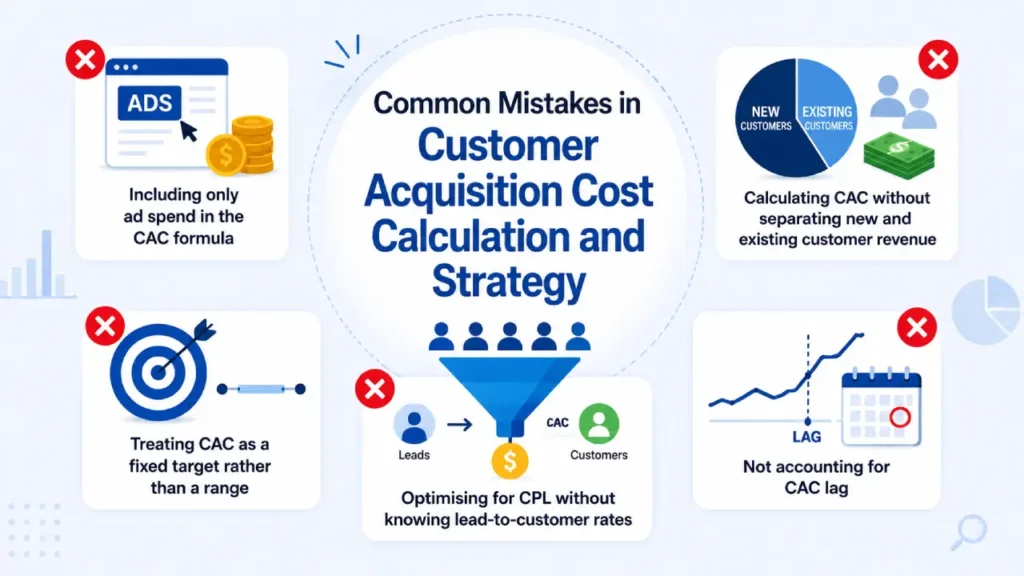
Including only ad spend in the CAC formula This is the most common error. Ad spend is one input. Staff time, agency fees, software costs, and content production all contribute to the cost of acquiring customers. Understating these costs produces a misleadingly low customer acquisition cost figure that makes channels look more profitable than they are. Use the fully-loaded CAC formula every time.
Calculating CAC without separating new and existing customer revenue If you are running retention campaigns, upsell campaigns, and new customer acquisition campaigns simultaneously and mixing costs together, your customer acquisition cost will be distorted. New customer acquisition cost should only include costs and revenues specifically related to acquiring net new customers. Keep acquisition and retention spend separated from the outset.
Treating CAC as a fixed target rather than a range A healthy customer acquisition cost varies significantly by channel, campaign type, audience, and product line. Setting a single CAC target for the whole business and judging all campaigns against it will cause you to cut channels that are actually efficient for specific segments while keeping channels that look average overall but are pulling the blended number down. Think in ranges and by segment.
Optimising for CPL without knowing lead-to-customer rates Cost per lead is a much easier metric to track than customer acquisition cost, which is why many teams default to it. But a channel generating leads at ₹500 each with a 2% close rate has a customer acquisition cost of ₹25,000. A channel generating leads at ₹2,000 each with a 20% close rate has a customer acquisition cost of ₹10,000. The cheaper lead source is actually twice as expensive in real terms. Always connect CPL to close rate before drawing conclusions.
Not accounting for CAC lag There is typically a delay between marketing spend and customer acquisition. In B2B sales cycles, a lead generated in January might not close until March or April. If you calculate customer acquisition cost monthly using that month’s spend and that month’s new customers, you will see wildly varying results that do not reflect the underlying efficiency of your marketing. Use a rolling 90-day or 180-day window for more accurate CAC measurement, particularly in businesses with longer sales cycles.
Conclusion
The two most impactful actions for improving customer acquisition cost are calculating it accurately (with all costs included, broken down by channel) and improving landing page conversion rates. Get those two right and you will have the data and the mechanism to reduce CAC methodically rather than guessing.
If you are not sure where your customer acquisition cost currently sits or which channels are dragging your blended CAC up, a structured marketing audit will answer both questions quickly. Book a free performance marketing audit with Whamply Media and get a channel-by-channel CAC breakdown with a prioritised improvement plan. Claim your free audit today.
Frequently Asked Questions
What is customer acquisition cost (CAC)?
Customer acquisition cost is the total amount spent to acquire one new paying customer, calculated by dividing total sales and marketing costs by the number of new customers acquired in the same period. It includes ad spend, staff costs, agency fees, and software costs, not just paid media budget.
What is the CAC formula?
The CAC formula is: Customer Acquisition Cost = Total Sales and Marketing Costs / Number of New Customers Acquired. Both figures must cover the same time period for the calculation to be meaningful.
What is a good LTV to CAC ratio?
A 3:1 LTV to CAC ratio is the widely accepted benchmark for healthy B2B and SaaS businesses. This means the lifetime value of a customer should be at least three times what it cost to acquire them. Ratios below 1:1 indicate the business is losing money on acquisition. Ratios above 5:1 may indicate underinvestment in growth.
What is included in customer acquisition cost?
Customer acquisition cost includes all costs directly associated with acquiring new customers: paid media spend across all channels, agency and freelancer fees, the prorated cost of marketing and sales team salaries, CRM and marketing software subscriptions, content production costs, and any event or sponsorship spend used for lead generation.
What is the difference between CAC and CPL?
Cost per lead (CPL) measures the cost to generate a lead. Customer acquisition cost measures the cost to acquire a paying customer. CPL is always lower than CAC because not every lead becomes a customer. CAC is the more meaningful metric for assessing business profitability, but CPL is useful as a leading indicator of channel efficiency.
What is a good customer acquisition cost for B2B SaaS?
There is no universal answer; it depends on the product’s price point and LTV. In India, B2B SaaS companies typically target a customer acquisition cost of ₹5,000 to ₹50,000 depending on ACV (annual contract value). The key benchmark is the LTV to CAC ratio rather than the absolute CAC figure in isolation. Whamply’s B2B lead generation service includes CAC benchmarking by industry as part of campaign strategy.
How does ad spend ROI relate to customer acquisition cost?
Ad spend ROI measures the return generated specifically from your advertising budget. Customer acquisition cost is broader and includes all acquisition-related costs. High ad spend ROI can coexist with a high customer acquisition cost if your non-ad costs (staff, software) are also high. Track both to get a complete picture of paid acquisition efficiency.
How often should I calculate customer acquisition cost?
Monthly calculation is standard for most businesses, but use a rolling 90-day window to account for sales cycle lag. For businesses with longer B2B sales cycles (three months or more), a quarterly CAC calculation is often more accurate and less noisy than a monthly figure.
What is CAC payback period?
CAC payback period is the number of months required to recover your customer acquisition cost from a customer’s revenue contributions. It is calculated by dividing CAC by monthly gross margin per customer. A payback period under 12 months is generally considered healthy for SaaS; under 6 months is strong.
How does customer acquisition cost differ by channel?
Customer acquisition cost varies significantly across channels. SEO and content marketing tend to have very low marginal CAC over time but high upfront investment. Paid search has higher CPCs but captures high-intent buyers. LinkedIn Ads often produce higher CPLs but better lead quality and lower effective CAC for B2B businesses. Email marketing to warm audiences has some of the lowest CAC of any channel.
Can improving customer lifetime value reduce the pressure to lower CAC?
Yes, If you improve LTV through better retention, upsells, or pricing, the same customer acquisition cost becomes more acceptable. A customer acquisition cost of ₹15,000 is unsustainable with a customer LTV of ₹20,000 but perfectly healthy with an LTV of ₹75,000. Improving LTV and reducing CAC should be pursued simultaneously, not as alternatives
What tools can I use to track customer acquisition cost?
Google Analytics 4 with UTM parameters tracks channel-level traffic and conversion data. A CRM like HubSpot or Salesforce connects lead source to closed revenue. Combining these two data sources gives you the inputs needed to calculate channel-specific customer acquisition cost accurately. For Indian businesses on tighter budgets, HubSpot’s free CRM tier combined with GA4 is a practical starting point.
How does landing page conversion rate affect customer acquisition cost?
Conversion rate and customer acquisition cost are inversely related on any given channel. Doubling your landing page conversion rate from 2% to 4% halves your customer acquisition cost on that channel, assuming ad spend stays constant. This makes conversion rate optimisation one of the highest-ROI activities for reducing customer acquisition cost.
What is the impact of customer churn on customer acquisition cost strategy?
High churn reduces LTV, which worsens the LTV to CAC ratio even if customer acquisition cost stays constant. A business with 10% monthly churn needs to continually acquire new customers just to maintain revenue, which drives up cumulative acquisition costs. Reducing churn and improving retention is often more impactful on unit economics than reducing CAC alone.
How do I reduce customer acquisition cost for a new business with no data?
Start with the highest-intent channels first: branded search, direct outreach to a well-defined ICP, and referral programmes. These tend to produce the lowest CAC for early-stage businesses because they target people already looking for what you offer. Build a CRM from day one and tag every lead with its source so you have channel-level CAC data as soon as your first customers close. Deploying a chatbot on your site to qualify and capture inbound interest 24/7 can also compress early-stage customer acquisition cost significantly.