
The History of SEO: From 1994 to 2026
On this page
In 1994, a search engine called WebCrawler indexed the full text of web pages for the first time, and site owners noticed something: stuffing a page with the word “cheap flights” fifty times made it rank higher. That single discovery is where the history of SEO begins. Three decades later, Google’s AI Overviews now answer roughly half of all US searches directly on the results page, according to BrightEdge’s 2026 tracking data, and clicking through to a website is no longer the default outcome of a search. This article walks through the full history of SEO, era by era, so you can see exactly how we got from keyword stuffing to answer engines. Understanding the history of SEO is not a nostalgia exercise. It explains why every rule you follow today exists, and why the next one is already being written.
What Is the History of SEO?
The history of SEO is the record of how website owners and search engines have shaped each other’s behaviour since 1994, moving from simple keyword matching on engines like AltaVista and Yahoo, through Google’s PageRank-driven link economy, algorithm updates like Panda and Penguin, mobile-first indexing, and E-E-A-T, to today’s answer engines such as AI Overviews and ChatGPT search. Each phase changed what “ranking well” actually meant. If you want the fuller picture of what the discipline covers today, our guide on what is search engine optimisation breaks down the current definition in detail, and our SEO glossary is a useful reference for any unfamiliar terms along the way.
Why the History of SEO Matters in 2026
Every SEO tactic you use today was built as a reaction to something that happened before, which is exactly why the history of SEO deserves more attention than most marketing teams give it. Keyword density guidelines exist because keyword stuffing worked, then broke. Backlink audits exist because link buying worked, then got penalised. If you don’t know the history of SEO, you end up relearning the same lessons the hard way, usually on a client’s budget.
The stakes are higher now because the pace of change has compressed. It took Google roughly a decade to go from PageRank to its first major quality update in 2011. It took under two years to go from AI Overviews launching in limited beta to covering an estimated 48% of tracked US queries, per BrightEdge’s year-over-year analysis. Organic click-through rates on pages with AI Overviews present have dropped by more than 60% in some studies, which means the economics of ranking well have shifted faster than at any other point in the history of SEO.
For agencies and in-house teams, this matters commercially too. India’s digital advertising spend crossed roughly ₹947 billion in 2025 according to Statista’s EY-sourced figures, and a growing share of that budget is now being redirected toward answer engine visibility rather than pure blue-link rankings. Clients who understand where SEO came from make better decisions about where their budget should go next, and it’s often the first thing we walk through in an SEO consultation with a new client.
There’s also a practical reason to study the history of SEO before setting a 2026 strategy: pattern recognition. Every algorithm shift Google has shipped since 2003 followed roughly the same shape. Webmasters find a shortcut, the shortcut gets abused at scale, Google ships an update to punish the abuse, and the practitioners who were already building for genuine quality barely notice the update happened. That pattern has repeated at least six times across the history of SEO, and there’s no reason to think AI Overviews will be the exception.
I’ve sat in enough client review calls to know how this plays out in practice. A team that spent 2022 chasing thin, AI-assisted content at scale to hit a monthly publishing quota is usually the same team panicking about the Helpful Content Update a year later. A team that spent 2022 building genuinely useful, well-researched pages barely felt the update. The history of SEO rewards patience far more often than it rewards speed.
1994 to 1997: The Birth of Search Engines and the First SEO Tricks
Before Google existed, search was a mess of manually curated directories and primitive crawlers. The history of SEO technically starts here, with engines that had no real concept of quality, only text matching.
WebCrawler launched in 1994 as the first engine to index full page text rather than just titles. Yahoo followed the same year as a human-edited directory, not a crawler at all. AltaVista arrived in 1995 with faster indexing and better relevance than anything before it, and it became the dominant engine of the mid-1990s. Because these early systems ranked pages almost entirely on keyword frequency, webmasters quickly worked out how to game them.
This is the era that gave SEO its bad early reputation, and understanding it is essential to understanding the full history of SEO.
Keyword stuffing: repeating a target phrase dozens of times in visible text, meta tags, and alt attributes.
Invisible text: writing keywords in white font on a white background so crawlers read them but users didn’t see them.
Meta keyword tag abuse: cramming hundreds of unrelated terms into the meta keywords tag, which engines used heavily at the time.
Doorway pages: creating dozens of near-identical pages targeting slight keyword variations, each funnelling users to one real page.
Directory submissions: mass-submitting a site to hundreds of web directories purely for a listing, regardless of relevance.
None of these tactics required understanding the user’s intent, because early search engines didn’t understand intent either. That mismatch is exactly what the next phase of SEO history was built to fix.
It’s worth remembering that “SEO” wasn’t even a formal job title yet during this window. The people doing this work were usually webmasters, a term that itself feels dated now, tinkering with HTML meta tags because they’d noticed a correlation between certain page elements and ranking position. There was no Search Console, no ranking tracker, no documented guidelines. Most of what passed for strategy in 1996 was closer to folklore passed between early internet forums than anything resembling the data-driven discipline SEO became later.
Yahoo’s directory model deserves a mention here too, because it represents a genuine fork in the early history of SEO. While AltaVista and WebCrawler pursued algorithmic indexing, Yahoo relied on human editors to review and categorise submitted sites. For a few years, getting listed in the Yahoo Directory was arguably more valuable than any algorithmic ranking, since it was one of the primary ways users actually navigated the web. That model eventually lost out to algorithmic search entirely, but the idea that a trusted third party vouching for your site matters, editorial trust as a ranking signal, never really went away. It resurfaced later in link authority, and it’s resurfacing again now in how AI systems decide which sources to cite.
1998 to 2003: Google Arrives and Rewrites the Rules
Larry Page and Sergey Brin launched Google in 1998 with a research paper describing PageRank, a system that ranked pages based on how many other pages linked to them, and how authoritative those linking pages were. This is arguably the single most important turning point in the entire history of SEO, and most timelines of the history of SEO treat it as the true starting line.
For the first time, a link from another website functioned as a vote of confidence rather than just a pathway for a crawler. Keyword stuffing alone stopped being enough. Site owners now needed other websites to point back to them, and that requirement created an entirely new industry: link building services.
By 2000, Google had overtaken AltaVista and Yahoo in relevance and market share, largely because its results simply felt more accurate. Site owners who had spent years optimising for keyword density had to learn a new skill almost overnight.
Here’s roughly how the shift played out on the ground during this period:
1998: Google launches with PageRank as its core ranking signal, initially serving a small but fast-growing user base.
1999 to 2000: Early SEO practitioners reverse-engineer PageRank and begin building reciprocal link networks and link farms.
2000: Google Toolbar ships with a visible PageRank score, and site owners start chasing the number itself rather than genuine relevance.
2001 to 2002: Google begins actively penalising obvious link schemes and doorway pages, marking the first real enforcement action in SEO history.
2003: The “Florida” update hits, wiping out rankings for thousands of sites relying on exact-match keyword stuffing combined with weak links, and effectively closing the first era of SEO tactics.
Florida is often cited as the moment SEO stopped being a hobbyist trick and became a discipline that required real strategy.
This period also produced the first genuine SEO industry infrastructure. Google launched its webmaster guidelines during this window, giving site owners an actual reference document instead of guesswork. Search conferences began appearing, and the earliest SEO agencies opened their doors, some of which are still operating today. The idea that a company might hire an outside specialist purely to improve organic visibility was still novel enough that a fair number of business owners assumed it was a scam. That scepticism, oddly, has never fully disappeared from the industry, even now.
What’s easy to miss when looking back at this stretch of the history of SEO is how young the whole discipline still was. Google itself was barely five years old by 2003. The idea of a ranking factor as something you could isolate, test, and optimise for was still being invented in real time. Much of what agencies now teach as basic SEO theory, the relationship between anchor text and relevance, the compounding value of earned links, the risk of over optimisation, was discovered through trial and error during this exact window, often at real financial cost to the businesses that got it wrong.
2004 to 2010: The Content and Link-Building Boom
This period is where SEO turned into a proper profession, agencies formed, and the phrase “content is king” entered the marketing vocabulary. Anyone studying the history of SEO closely will recognise this decade as the point where the industry stopped being a side hustle. It’s also where a lot of the link-building excess of later years was seeded.
Google refined PageRank continuously through this decade, rolling out updates with names like Jagger (2005), Big Daddy (2006), and Vince (2009), each tightening link quality standards a little further. Blogging exploded, and with it came guest posting services, article directories, and paid link networks, most of which were still tolerated or undetected at the time.
Search Engine Land and Moz (then SEOmoz) both launched during this stretch and became the reference points the industry still uses today. SEO agencies started selling link packages by volume, a hundred links for a fixed monthly fee, with almost no regard for relevance. That business model would collapse hard within a few years, but during this window it defined how most companies thought about SEO.
By 2009, Bing had launched as Microsoft’s rebranded search engine, and Google still commanded the overwhelming majority of global search volume, a position it has never really given up since.
This is also the period when SEO tooling began to mature into something recognisable today. Before this decade, most site owners had no reliable way to measure rankings, backlinks, or organic traffic beyond raw server logs. Google Analytics launched in 2005, giving webmasters their first free, detailed view of how organic visitors actually behaved on a site once they landed. Google Webmaster Tools, the predecessor to today’s Search Console, followed shortly after, offering the first direct channel between site owners and Google’s own indexing data.
Third-party tools followed quickly. Early versions of what would become Moz, Ahrefs, and SEMrush began building backlink indexes and rank tracking databases during the late 2000s, though none of them looked anything like their current versions. Before these tools existed, most SEO decisions were made on instinct or anecdote. Their arrival is a genuinely underrated turning point in the history of SEO, because it’s the moment the industry started making decisions based on data rather than guesswork.
The Indian SEO market was still nascent during this window, largely limited to outsourced link-building and content operations serving US and UK agencies, rather than a domestic discipline in its own right. That would change substantially over the following decade as India’s own e-commerce and D2C sectors matured, a shift you can see reflected in how mature ecommerce SEO services strategy has become today.
2011 to 2015: Panda, Penguin, and the Content Quality Reset
If Florida was the first shockwave, Panda and Penguin were the two updates that permanently changed how the SEO industry operated. Any serious account of the history of SEO treats this five-year window as its own chapter, and it’s the stretch most SEO history retrospectives spend the most time on.
Panda launched in February 2011 and targeted thin, low-value, duplicated, or ad-heavy content. Sites built purely to attract search traffic through volume, so-called content farms, lost enormous amounts of traffic overnight. Penguin followed in April 2012 and did to link building what Panda had done to content: it penalised sites with manipulative, low-quality, or over-optimised backlink profiles.
Together, these two updates forced the entire industry to rebuild its playbook. Here’s how most agencies and in-house teams adapted, roughly step by step:
Audit existing content to identify thin or duplicate pages that were dragging down site-wide quality signals, then consolidate or remove them.
Disavow toxic backlinks using Google’s new disavow tool, launched in 2012 specifically because of Penguin fallout.
Shift link building from volume to relevance, targeting fewer but genuinely authoritative, topically related sites through practices like digital pr services.
Invest in original research and long-form content that couldn’t easily be replicated by scraper sites or content farms.
Diversify anchor text away from exact-match keywords, which Penguin had flagged as a manipulation signal.
Build internal linking structures that reflected genuine topical relationships rather than keyword targeting alone, an early form of what we’d now call on page seo services.
This is also the period when Hummingbird arrived in 2013, Google’s first major shift toward understanding whole queries and semantic meaning rather than matching isolated keywords. It quietly set up everything that came after it, including RankBrain two years later.
The human cost of this era gets underplayed in most retrospectives on the history of SEO. Entire agencies built around volume link selling shut down within eighteen months of Penguin. Content farm employees, many of them freelance writers paid a few dollars per five-hundred-word article, lost their income streams almost overnight when sites like Demand Media’s eHow saw traffic collapse by more than 80% following Panda. Businesses that had invested heavily in the old playbook, sometimes their entire marketing budget for a year, watched organic traffic disappear within days of an update rolling out, often with no clear explanation from Google beyond a generic announcement post.
What made this period genuinely different from earlier algorithm changes is that Google started communicating more directly with the industry about what it was penalising, even if the specifics stayed deliberately vague. Matt Cutts, then head of Google’s webspam team, became something close to a public figure within SEO circles, regularly explaining the intent behind updates through blog posts and conference talks. That level of transparency, however limited, helped the industry professionalise faster than it otherwise would have.
2015 to 2019: Mobile-First Indexing, RankBrain, and Voice Search
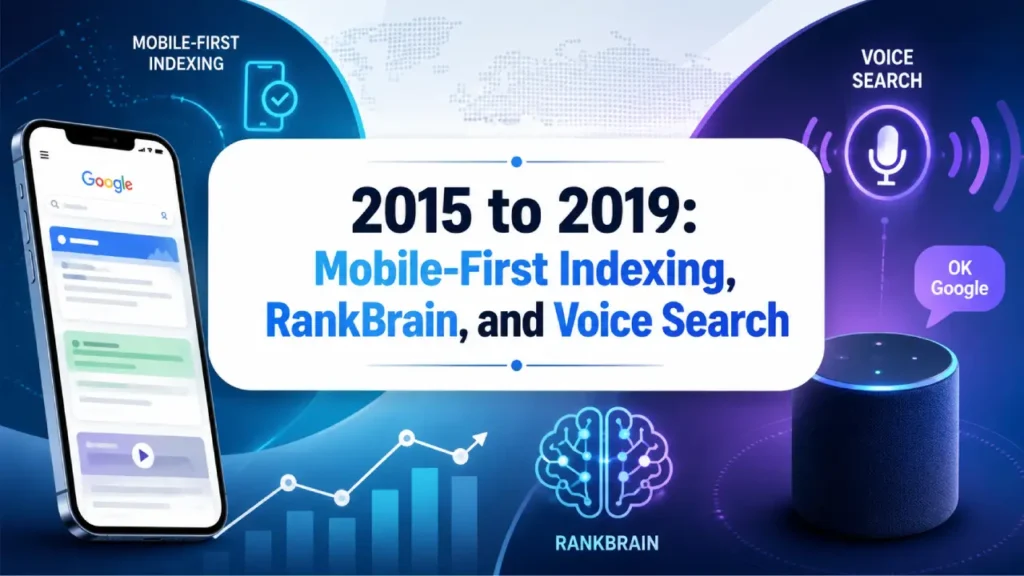
By the mid-2010s, more searches happened on mobile devices than desktop, and Google’s ranking systems had to catch up. This is one of the more technical chapters in the history of SEO, driven less by content or links and more by infrastructure and the kind of technical seo services work that’s now considered table stakes.
RankBrain launched in 2015 as Google’s first machine-learning system integrated directly into its core ranking algorithm. It helped Google interpret ambiguous or never-seen-before queries by comparing them to similar past searches, rather than relying purely on exact keyword matches. This was the moment search intent, not just keyword usage, became a formal ranking factor that SEOs had to actively design for.
Mobile-first indexing rolled out gradually from 2016 onward, meaning Google began using the mobile version of a page as the primary basis for ranking, even for desktop searches. Sites with poor mobile experiences, slow load times, unreadable text, intrusive pop-ups, started losing visibility regardless of how strong their desktop version was.
Voice search also grew meaningfully in this window, driven by smart speakers and mobile assistants, pushing SEO practitioners toward more conversational, question-based content structures. BERT arrived in 2019, another leap in Google’s natural language understanding, helping it grasp the nuance of prepositions and context within a sentence rather than just individual keywords.
By the end of this era, technical SEO, page speed, structured data, mobile usability, had become just as important as content and links. The history of SEO up to this point had been mostly about content and backlinks. Now it had a third, equally demanding pillar.
India’s SEO market genuinely came into its own during this window, largely because of how the country’s internet growth actually happened. Unlike the US or UK, where desktop usage had years to mature before mobile caught up, huge numbers of Indian users came online for the first time directly on affordable Android smartphones, skipping the desktop-first phase almost entirely. That meant Indian SEO teams were dealing with mobile-first realities years before mobile-first indexing became Google’s official global standard, which put a handful of forward-thinking Indian agencies genuinely ahead of the curve rather than playing catch-up, a rare moment in the history of SEO where a regional market led rather than followed.
Schema markup adoption also picked up meaningfully during this period, driven by rich results like star ratings, recipe cards, and FAQ snippets appearing directly in search results. Structured data stopped being a technical curiosity and became a genuine differentiator for click-through rate, since a listing with visible star ratings or pricing tended to outperform a plain blue link even from a lower ranking position.
2020 to 2023: E-E-A-T, Core Web Vitals, and the Helpful Content Update

The early 2020s introduced a stricter, more human-centred version of quality assessment, and this is where the history of SEO starts to feel genuinely modern. Google’s Search Quality Rater Guidelines expanded the long-standing E-A-T concept, expertise, authoritativeness, trust, into E-E-A-T by adding experience as a formal criterion in December 2022.
Core Web Vitals became an official ranking factor in 2021, measuring loading performance, interactivity, and visual stability with hard numeric thresholds for the first time. Sites could no longer treat page speed as a nice-to-have.
Then, in August 2023, the Helpful Content Update went further than any prior algorithm change by explicitly targeting content written primarily to rank rather than to genuinely help a reader. This was a direct response to a flood of AI-generated, low-effort content that had started appearing across the web following the release of ChatGPT in late 2022. For the first time, the history of SEO included a major update aimed specifically at AI-written content, years before AI itself became the dominant search interface.
Common signals that separated sites which survived this period from sites that didn’t included genuine author credentials, first-hand experience described in the content itself, original data or images rather than recycled stock content, and a clear, demonstrable reason for the page to exist beyond ranking for a keyword.
This is also when YMYL, “your money or your life”, became a widely used shorthand across the industry. Google had used the concept internally in its rater guidelines since around 2014, but it became genuinely central to SEO strategy in this period, particularly for health, finance, and legal content, where inaccurate information carries real consequences for readers. Sites operating in these categories found that generic content marketing tactics, which had worked reasonably well for a lifestyle blog, simply didn’t move the needle without demonstrable credentials behind the author.
For agencies working with Indian clients, this period also coincided with growing scrutiny of financial and health content published in Hindi and other regional languages, where the pool of genuinely qualified authors writing in-language was, and in some cases still is, thinner than the English-language equivalent. That gap became a genuine strategic opportunity for agencies willing to invest in properly credentialed regional-language content rather than machine-translating English articles, a shortcut that rarely survived E-E-A-T scrutiny. This is also the era where large organisations began treating this as enterprise seo services work, since credential and content-quality problems at scale need a coordinated, multi-team strategy rather than a one-off fix.
2024 to 2026: Generative AI, AI Overviews, and Answer Engine Optimisation

This is the chapter of SEO history still being written, and it’s the one most agencies are scrambling to understand right now.
Google rolled out AI Overviews (originally Search Generative Experience) more broadly through 2024, then expanded a Gemini-powered version to more than 200 countries and over 40 languages by May 2025. By early 2026, various tracking studies from BrightEdge, Semrush, and Seer Interactive put AI Overview prevalence anywhere between 20% and 60% of US queries depending on methodology, with the most commonly cited commercial-industry figure sitting around 48%. Organic click-through rates on queries with an AI Overview present have dropped by anywhere from 34% to 61% across different studies, though Seer Interactive’s 2026 data shows an encouraging partial rebound, with CTR climbing from a low of around 1.3% in December 2025 back up to roughly 2.4% by February 2026.
Alongside Google’s own shift, standalone AI answer engines, ChatGPT search, Perplexity, and Claude, have grown into meaningful referral sources in their own right. This has given rise to a new discipline sitting alongside traditional SEO: Answer Engine Optimisation, or AEO, which focuses on structuring content so it can be directly extracted and cited by AI systems rather than simply ranked in a list of ten blue links. It’s the reason services like ChatGPT seo services and dedicated AI SEO strategy now exist as distinct offerings rather than an afterthought bolted onto classic SEO.
Practically, this era of SEO history rewards a different set of behaviours than the link-and-content era did:
Clear, extractable definitions near the top of a page, written the way you’d explain something to a colleague, not a search engine.
Structured data and schema markup that make content machine-readable.
Original data points, named sources, and dated statistics that AI systems can cite with confidence.
Genuine topical depth across a full subject rather than one thin page per keyword, often supported by AI keyword research to map coverage gaps at scale.
Content that still earns clicks even when an AI summary answers the surface-level question first, refined through ongoing AI content optimisation.
Nobody in the industry claims to have fully solved AEO yet, because the systems themselves are still changing every few months. That uncertainty is, in a strange way, consistent with the entire history of SEO: the practitioners who study the last update tend to handle the next one better than the ones who don’t. If you’re curious how the mechanics work today, our plain-English guide on how does SEO work covers the current version of the process end to end.
There’s a genuinely useful nuance buried in the 2026 data that most summaries of this period skip past. Pages cited within an AI Overview don’t just lose traffic, several studies, including Presenc AI’s Q1 2026 panel research, show cited domains actually gaining branded search and direct traffic even as raw organic clicks decline. In other words, appearing inside an AI-generated answer is starting to function less like a lost click and more like a brand impression, closer to how a mention on the evening news works than how a traditional search click worked. That reframing matters enormously for how agencies should report SEO performance to clients in 2026, because a pure click-based KPI increasingly misses half the value being generated.
The competitive landscape has also genuinely diversified for the first time in the history of SEO. For roughly two decades, “search visibility” meant one thing: ranking well on Google. Now it means ranking well on Google, appearing accurately inside Google’s AI Overviews, being cited by ChatGPT search, showing up in Perplexity’s source panel, and increasingly, being referenced correctly by Gemini and Microsoft Copilot. Each of these systems weighs sources slightly differently. Perplexity, for instance, tends to favour prominent, clearly attributed citations and delivers a meaningfully higher click-through rate on cited sources than Google’s AI Overviews do, according to BrightEdge’s 2026 comparative data. Treating all of these surfaces as one undifferentiated “AI search” channel is one of the more common strategic mistakes agencies are making right now.
Common Mistakes to Avoid When Learning From SEO History
Assuming old tactics are permanently dead. Practices like keyword stuffing and directory spam don’t work anymore, but variations of the underlying instinct, gaming a system instead of serving a reader, keep reappearing in new forms, from AI content farms to fake review networks. Recognising the pattern matters more than memorising the specific tactic.
Chasing the latest algorithm update instead of the underlying principle: Every major update in the history of SEO, Panda, Penguin, Helpful Content, has rewarded genuine usefulness and penalised manipulation. Teams that build for that principle rarely get blindsided by the next update.
Ignoring technical foundations because content feels more important. Core Web Vitals, mobile usability, and crawlability aren’t glamorous, but sites with brilliant content and broken technical SEO still lose visibility. This mistake shows up constantly in mid-sized Indian D2C brands that invest heavily in blog content while running on slow, unoptimised WordPress themes.
Treating AI Overviews and AEO as a completely separate discipline from SEO. The two overlap enormously. Content that’s genuinely well-structured, well-sourced, and intent-matched tends to perform in both classic rankings and AI citations, because both systems are ultimately trying to reward the same underlying quality signals.
Failing to document what actually changed after an algorithm update. Agencies that keep a running log of ranking and traffic shifts against each confirmed Google update build an internal dataset that’s far more useful than any generic blog post about the history of SEO, including this one.
Treating one Google update as the entire history of SEO. Plenty of teams can recite the Panda and Penguin story in detail but have never studied Florida, Hummingbird, or the Helpful Content Update with the same depth. A partial history of SEO leads to a partial understanding of why current best practices exist, which makes it much harder to predict where the next shift is headed.
Copying competitor tactics without checking when they were built. A backlink profile, content structure, or keyword strategy that’s worked for a competitor since 2018 may be surviving despite current best practice, not because of it. Studying the history of SEO helps distinguish between a genuinely durable strategy and one that simply hasn’t been caught yet. Off page SEO audits are usually where this becomes obvious first.
Conclusion
The biggest practical takeaway from the history of SEO is this: every era rewarded genuine usefulness eventually, even when a shortcut worked temporarily. The second takeaway from the history of SEO is that the surfaces keep changing, from ten blue links to AI Overviews, but the underlying skill, understanding what a real person actually needs when they type a query, hasn’t changed once since 1994.
If your current SEO strategy was built for the 2019 version of Google, it’s probably underperforming against both classic rankings and AI citations right now. A strategy grounded in the full history of SEO, not just the last update you read about, is the difference between reacting to change and anticipating it. Get in touch for a free SEO audit and we’ll show you exactly where the gaps are.
Frequently Asked Questions
When did SEO actually start?
SEO started in 1994, when early search engines like WebCrawler began indexing full page text and webmasters realised keyword repetition affected rankings. The term “search engine optimisation” itself wasn’t widely used until the late 1990s.
Who coined the term SEO?
There’s no single confirmed inventor of the term, though it’s widely believed to have entered common use around 1997, with early SEO forums and consultants popularising it as search marketing became a distinct service.
What was the first major Google algorithm update?
The Florida update in November 2003 is generally considered the first major Google update, since it was the first to visibly and dramatically remove keyword-stuffed, low-quality pages from rankings on a large scale.
What did Google Panda actually target?
Panda, launched in 2011, targeted thin, duplicate, and low-value content, particularly content farms producing mass volumes of low-effort articles purely to capture search traffic.
What is the difference between Panda and Penguin?
Panda focused on content quality, penalising thin or duplicate pages, while Penguin, launched in 2012, focused on backlink quality, penalising manipulative or spammy link-building practices.
When did mobile-first indexing begin?
Google began rolling out mobile-first indexing in 2016 and completed the transition for the vast majority of sites by 2021, meaning the mobile version of a page became the primary basis for ranking.
What is E-E-A-T and when was it introduced?
E-E-A-T stands for experience, expertise, authoritativeness, and trust. Google added the “experience” element to its long-standing E-A-T framework in December 2022, formalising it within its Search Quality Rater Guidelines.
How has AI changed the history of SEO?
AI has changed SEO twice over: first through Google’s Helpful Content Update in 2023 penalising low-effort AI-generated content, and second through AI Overviews and answer engines like ChatGPT search, which now answer many queries directly without a click.
What is Answer Engine Optimisation (AEO)?
AEO is the practice of structuring content so AI systems like Google AI Overviews, ChatGPT, and Perplexity can extract and cite it directly, using clear definitions, structured data, and well-sourced facts.
Is traditional SEO still relevant in 2026?
Yes, traditional SEO fundamentals, technical performance, content quality, and authoritative backlinks, remain the foundation that both classic search rankings and AI citation systems rely on, even as the surfaces displaying results change.
How often does Google update its search algorithm?
Google makes thousands of small algorithm adjustments every year, alongside several confirmed “core updates” annually, which is why the history of SEO reads as a near-constant sequence of adaptation rather than a handful of isolated events.
Did link building disappear after Penguin?
No, link building didn’t disappear, it became far more selective. Post-Penguin SEO favours a smaller number of relevant, authoritative links over large volumes of low-quality ones.
What role did content farms play in SEO history?
Content farms in the late 2000s produced enormous volumes of low-quality articles purely to rank for search traffic, and their dominance directly triggered the 2011 Panda update, which remains one of the most consequential moments in the history of SEO.
How is SEO different in India compared to global markets?
Indian SEO strategy has to account for heavier mobile usage, strong vernacular and regional language search demand, and a market where voice search adoption runs well above the global average, according to Google India’s own usage data.
What’s likely to define the next phase of SEO history?
Most practitioners expect the next phase to centre on AI agents completing tasks and purchases directly, not just answering questions, which will push SEO further toward being visible and citable inside AI systems rather than purely ranking on a results page.
Why does studying the history of SEO help with current strategy?
Studying the history of SEO shows that every major shift rewarded genuine usefulness over manipulation, which means the safest long-term strategy in any era, including 2026, is building content and technical foundations for real users rather than chasing a specific ranking signal.
Was SEO always considered a legitimate marketing discipline?
No, in the early history of SEO, many businesses viewed it with suspicion or dismissed it as a gimmick, and it only gained mainstream marketing credibility gradually through the 2000s as agencies, conferences, and documented case studies proved measurable return on investment.
How did Bing influence the history of SEO?
Bing, launched by Microsoft in 2009, never seriously challenged Google’s market share, but it pushed Google to keep improving relevance and introduced its own webmaster tools and structured data standards, contributing indirectly to broader SEO best practices across the industry.