
How to Build a Performance Marketing Strategy That Actually Converts
On this page
Most businesses running paid ads are bleeding budget on clicks that never become customers. A poorly built performance marketing strategy does not just waste money — it puts an invisible ceiling on your growth. If your cost per acquisition keeps rising while your conversion rate stays flat, the problem is almost never the platform. It is the thinking behind the spend.
What Is a Performance Marketing Strategy?
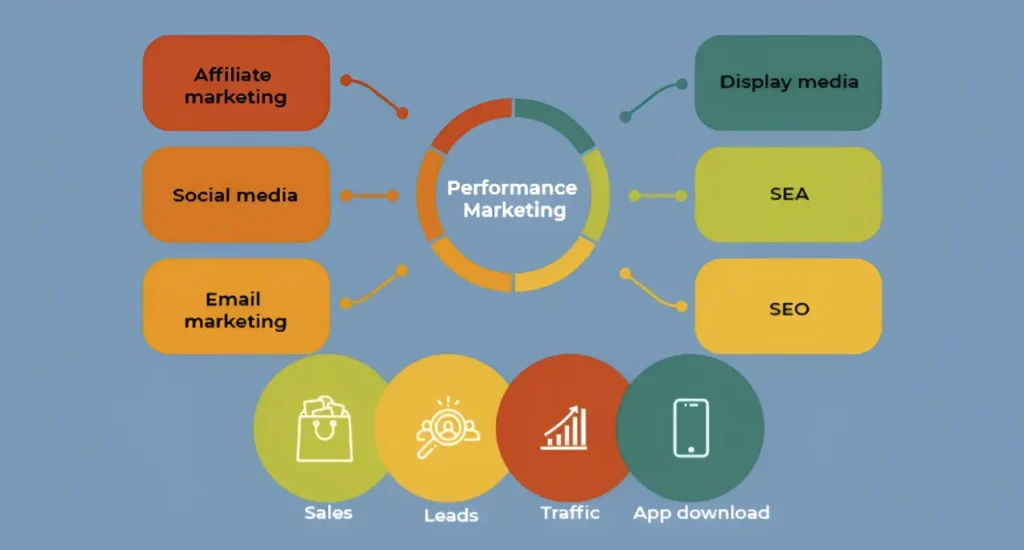
A performance marketing strategy is a structured, data-driven approach to paid media where every campaign element — from audience targeting and creative to bidding and attribution — is built around measurable business outcomes such as leads, sales, or sign-ups. Unlike brand marketing, a performance marketing strategy ties every rupee or pound of ad spend to a result you can actually track and act on — ROAS, cost per acquisition, conversion rate, all visible in real time. If you are evaluating what a full-service performance marketing services can do for your brand, this guide walks through exactly how the model works in practice.
Why a Performance Marketing Strategy Matters More Than Ever in 2026
Digital ad budgets are not growing on goodwill anymore. Marketing leaders are under real pressure to show returns, and the era of running broad campaigns with vague awareness goals is fading. Boards want numbers. CFOs want clean attribution.
According to WordStream’s 2024 Google Ads benchmarks, the average conversion rate across industries on Google Search sits at around 6.96%. Most brands land well below that. The gap between average and top-quartile performance is exactly where a strong performance marketing strategy earns its place.
In India, the performance marketing space has grown sharply alongside the rise of quick commerce and D2C brands. Meta and Google dominate spend, but programmatic tools like DV360 and Amazon DSP are seeing growing adoption — particularly among brands targeting Tier 1 and Tier 2 cities. With CPCs in competitive Indian verticals ranging from INR 15 to INR 150 depending on the category, ad spend optimisation has become a survival skill. In the UK, where CPCs on Google Search regularly exceed £2 to £5 in sectors like finance and legal, the same discipline applies with even higher stakes.
How to Build the Right Foundation for Your Performance Marketing Strategy
The most common mistake brands make is jumping straight into campaign setup before the fundamentals are in place. A performance marketing strategy built on shaky measurement or unclear goals will generate plenty of activity — just not results.
Get these right before you touch a single ad account.
Define your conversion actions precisely. Not “generate leads” — but “submit a form on the pricing page.” Not “drive sales” — but “complete a purchase with a minimum order value of INR 999 or £25.” Vague goals produce vague outcomes.
Audit your tracking setup end to end: Verify that your Google Tag Manager, Meta Pixel, and any server-side tracking are firing cleanly. A broken pixel is one of the most common — and most expensive — problems in paid media, and most teams only catch it after thousands have already been wasted. Working with a specialist google ads services from the start can prevent these costly setup errors before they happen.
Agree on attribution before you launch: First click, last click, or data-driven — the right model depends on your sales cycle. Shorter cycles like e-commerce or app installs often work well with last-click or time-decay. Longer B2B cycles need linear or position-based attribution to give a fairer picture of what is actually driving conversions.
Align your performance marketing strategy with your business funnel — not just the platform’s funnel. Your TOFU awareness campaigns, MOFU consideration campaigns, and BOFU conversion campaigns need distinct KPIs, separate budgets, and the right creative formats for each stage. A well-executed lead generation services sits at the heart of this funnel structure.
Every solid performance marketing strategy foundation needs these in place before anything else:
A clearly defined primary conversion action with a numeric target — for example, CPA under INR 800 or £12. Server-side tracking or enhanced conversions configured to handle cookie restrictions. A creative testing framework with at least two to three variants per ad set. Defined ROAS and cost per acquisition thresholds agreed before any scaling begins. A negative keyword list and audience exclusion set built for each campaign. A reporting cadence that separates performance review from optimisation decisions — these are not the same conversation.
Getting the foundation right means your performance marketing strategy has something real to optimise against from day one.
How to Build and Scale a Performance Marketing Strategy That Actually Delivers
Once your foundation is solid, building out your performance marketing strategy becomes far more systematic. The sequence matters here. Rushing to scale before you have validated performance is one of the leading causes of wasted ad spend — across accounts of every size.
Step 1: Start narrow, not broad.
Launch your first campaigns with tight audience targeting and limited geography. Resist the urge to target everyone at once. A performance marketing strategy that casts too wide a net too early burns through budget without generating the signal you need to improve. Search ads services are usually the right starting point — they capture active demand rather than trying to create it.
Step 2: Run a structured creative test.
Before committing serious budget to any one creative direction, test at least two to three distinct angles. This does not mean changing button colours — it means testing fundamentally different value propositions, hooks, or formats such as video versus static versus carousel. Your performance marketing strategy depends on knowing what actually resonates, not what you assume will. Teams running facebook ads services and instagram ads services in parallel often find that creative learning compounds faster across both platforms at once.
Step 3: Establish your baseline metrics.
Run for two to three weeks at a controlled spend level. Track conversion rate, cost per acquisition, and ROAS daily — but make decisions weekly. Early fluctuations are completely normal. Your performance marketing strategy needs clean data before you can draw any conclusions worth acting on.
Step 4: Identify your best-performing segments.
Break down results by device, time of day, audience segment, and placement. Your paid media strategy should follow the data, not your instincts. Often you will find that one audience segment is driving a disproportionate share of conversions at a fraction of the cost of others. Dynamic remarketing services becomes particularly effective once you have identified which segments show the highest purchase intent.
Step 5: Scale what works. Cut what does not.
Increase budget on winning campaigns by no more than 20 to 30% at a time to avoid triggering a learning phase reset on platforms like Meta. Pause underperforming ad sets without hesitation. A ROI-focused marketing approach has no room for campaigns kept alive out of habit or hope.
Step 6: Build in a creative refresh cycle.
Creative fatigue is real and measurable. Rising ad frequency and falling conversion rates are clear signals that your performance marketing strategy needs new creative input. Build a monthly or bi-monthly refresh into your calendar before performance drops — not as a reaction to it. This is also a good moment to revisit your landing page optimisation services, since the post-click experience often degrades in parallel with creative fatigue.
Common Mistakes That Quietly Kill a Performance Marketing Strategy
Optimising for vanity metrics instead of business outcomes.
Click-through rate and impressions tell you almost nothing about profitability. A performance marketing strategy built around CTR improvements can produce high traffic at a terrible ROAS. Always anchor your optimisation decisions to cost per acquisition and actual revenue impact.
Setting a budget before setting a CPA ceiling.
Many brands decide what they can afford to spend before deciding what they can afford to pay per conversion. This approach almost guarantees overspend. Your CPA target should come from your unit economics — not from what feels like a reasonable monthly number on paper.
Ignoring the post-click experience.
Even the best paid media strategy will underperform if your landing page is slow, confusing, or misaligned with what the ad promised. If your landing page conversion rate is below 2%, the problem is rarely the ad. Run page speed tests, check the mobile experience, and review your CTA hierarchy before adding more spend. If you need a ground-up rebuild, exploring professional web design and website development services is often the faster path to real conversion improvement.
Scaling before the algorithm has enough data.
Google and Meta both need conversion volume to optimise effectively. Pushing spend up too quickly before you have 30 to 50 conversions per campaign per month resets the learning phase and destabilises performance. Patience is a genuine competitive advantage in a well-run performance marketing strategy.
Treating your performance marketing strategy as a set-and-forget system.
Campaigns decay. Audiences saturate. CPCs shift. A performance marketing strategy that is only reviewed when something goes wrong will underperform in months, not years. Schedule weekly check-ins and monthly strategic reviews as non-negotiables. Pairing your paid efforts with consistent seo services also reduces total dependence on paid channels and compounds organic returns alongside your ads over time.
Conclusion
The most actionable thing you can take from this piece is the following: define your cost per acquisition target before you open a single ad account, and do not scale any campaign until it has hit that target consistently over at least three to four weeks. These two disciplines alone will prevent the majority of ad spend waste we see across accounts of all sizes.
If you are running paid campaigns and are not confident your performance marketing strategy is built on the right foundation, the next step is a structured audit. A good audit will surface tracking gaps, CPA inefficiencies, audience overlaps, and creative fatigue signals that most teams miss when they are too close to the campaigns. Talk to our team and walk away with a prioritised action plan, at no cost.
Frequently Asked Questions
What is a performance marketing strategy?
A performance marketing strategy is a data-driven paid media approach where campaigns are planned, executed, and optimised based on measurable outcomes like sales, leads, or sign-ups, rather than brand awareness alone. Every element of spend is tied to a trackable result, making it possible to calculate ROI and cost per acquisition accurately.
How is performance marketing different from brand marketing?
Performance marketing is directly tied to short-term, measurable actions such as clicks, conversions, and purchases. Brand marketing focuses on long-term awareness and perception. A strong performance marketing strategy often incorporates both, but the paid media strategy and budget allocation differ significantly.
What metrics matter most in a performance marketing strategy?
The most critical metrics are ROAS (return on ad spend), cost per acquisition, conversion rate, and ad spend efficiency by channel. Secondary metrics like click-through rate and quality score are useful diagnostics but should not drive strategic decisions on their own.
What is a good ROAS for a performance marketing strategy?
A ROAS of 3x to 5x is commonly cited as a baseline benchmark, but the right number depends entirely on your margins. A brand with 70% gross margin can sustain a lower ROAS than one operating at 30%. Always calculate your target ROAS from your unit economics first.
How much should I spend to test a performance marketing strategy?
A minimum of INR 50,000 to INR 1,50,000 per month (or roughly £500 to £1,500) per channel is recommended to generate enough conversion data for meaningful optimisation. Below this level, the algorithm does not have sufficient signal and performance data becomes statistically unreliable.
How long does it take to see results from a performance marketing strategy?
Most campaigns need four to eight weeks to exit the learning phase and generate reliable data. Expect the first two weeks to be exploratory. A well-structured performance marketing strategy should show directional results within 30 days and optimised performance within 60 to 90 days.
Which platforms should a performance marketing strategy include?
The right platform mix depends on your audience and product. Google Search and Meta Ads are the starting point for most brands. In India, YouTube and Google Performance Max have strong reach. For B2B, LinkedIn often warrants inclusion despite higher CPCs. Your paid media strategy should prioritise platforms where your buyers actually spend time.
What is ad spend optimisation in the context of a performance marketing strategy?
Ad spend optimisation means systematically reallocating budget from lower-performing campaigns, audiences, and placements toward those delivering the best cost per acquisition and ROAS. It involves both automated bidding strategies within platforms and manual budget decisions based on weekly performance reviews.
How do I improve conversion rate within a performance marketing strategy?
Focus first on landing page relevance and speed, then on audience-to-offer alignment, then on creative. Most conversion rate improvements in a performance marketing strategy come from fixing the post-click experience rather than the ad itself. Tools like Google Optimize, VWO, or even simple A/B tests on landing page copy can yield significant gains.
What role does creative play in a performance marketing strategy?
Creative is increasingly the primary variable in paid media strategy performance, particularly on platforms like Meta where targeting options have narrowed post-iOS 14. A strong performance marketing strategy treats creative as a continuous testing and iteration process, not a one-time production task.
Can a small business use a performance marketing strategy?
Yes, and it is arguably more important for smaller businesses with limited budgets. A focused performance marketing strategy with tight targeting, clear CPA goals, and disciplined ad spend optimisation helps smaller brands compete without overspending. The key is starting narrow and scaling only validated campaigns.
What is the biggest mistake brands make with their performance marketing strategy?
Scaling spend before validating performance. Most wasted ad budgets come from pushing money into campaigns that have not yet proven their cost per acquisition is sustainable. A performance marketing strategy should follow a test-validate-scale sequence, not a launch-and-hope approach.
How does attribution affect a performance marketing strategy?
Attribution determines which touchpoints receive credit for a conversion, which directly affects how you allocate budget across channels. A performance marketing strategy using last-click attribution in a multi-touch environment will systematically underfund top-of-funnel campaigns that contribute to conversions without closing them.
What tools are commonly used to manage a performance marketing strategy?
Google Ads, Meta Ads Manager, and Google Analytics 4 are the core stack. For deeper analysis and cross-channel reporting, tools like Supermetrics, Triple Whale, Northbeam, and Looker Studio are widely used. In India, CleverTap and MoEngage are popular for app-based performance marketing strategy execution.
How often should a performance marketing strategy be reviewed?
Weekly for campaign-level optimisation decisions (bids, budgets, creative pausing). Monthly for strategic reviews (channel mix, audience refresh, CPA benchmark updates). Quarterly for full audit and strategic realignment. A performance marketing strategy that is only reviewed when something goes wrong will always be reactive rather than proactive.z