
Influencer Marketing vs Paid Ads: Which Should You Use for Growth
On this page
Brands now spend more on influencer marketing globally than on traditional television advertising in several major markets, yet most marketers still cannot tell you which channel is actually driving their growth. The influencer marketing vs paid ads debate gets framed as an either-or decision when the real answer depends on what stage your brand is at, what you are selling, and how much trust your audience needs before they buy. This guide breaks down the real cost, ROI, and strategic fit of both channels so you can make that decision with data instead of guesswork.
What Is the Influencer Marketing vs Paid Ads Decision?
Influencer marketing vs paid ads refers to the strategic choice between investing in creator partnerships that promote a brand through authentic content and audience trust, versus investing in direct paid advertising on platforms like Meta, Google, and LinkedIn Ads that targets audiences algorithmically. Influencer marketing leverages a creator’s existing relationship with their audience to build credibility, while paid ads use targeting data and bidding systems to reach defined audience segments directly. Most growth strategies in 2026 combine both rather than choosing one exclusively.
Why the Influencer Marketing vs Paid Ads Decision Matters in 2026
Paid ad costs have climbed sharply across every major platform. Meta Ads CPMs have risen as more advertisers compete for the same inventory, and ad fatigue means audiences are increasingly skeptical of branded content that looks and sounds like an advertisement. This shift has made the influencer marketing vs paid ads comparison more relevant than ever, because the two channels solve different parts of the trust problem that performance marketing alone cannot fix.
According to Influencer Marketing Hub’s 2024 Benchmark Report, businesses are making an average of $5.78 for every $1 spent on influencer marketing, with the top quartile of brands generating over $20 in return per dollar spent. These figures vary enormously by execution quality, but they highlight why influencer marketing has moved from an experimental tactic to a core budget line for most consumer brands.
In India, the influencer marketing vs paid ads decision carries specific local dynamics. India’s creator economy has grown rapidly, with micro-influencers commanding strong engagement rates at a fraction of the cost of Western markets. Indian brands typically pay ₹15,000 to ₹50,000 for a micro-influencer post, compared to similar engagement-tier creators in the US or UK costing several times more. This cost advantage makes influencer marketing a particularly efficient growth channel for Indian D2C and e-commerce brands, while Google Ads and other paid channels remain essential for scale and precision targeting that influencer marketing alone cannot deliver.
Influencer Marketing vs Paid Ads: Comparing Cost, Trust, and Speed
Understanding where each channel genuinely outperforms the other is more useful than treating this as a binary choice. Each has structural strengths the other cannot replicate.
Where influencer marketing wins
Influencer marketing builds trust faster than paid ads because the message comes from a source the audience already follows and believes, not a brand talking about itself. This is particularly powerful for categories where purchase decisions rely on social proof, such as beauty, fitness, food, and fashion. Micro-influencer partnerships in particular deliver disproportionately high engagement relative to follower count, often outperforming larger creators on cost-per-engagement.
Where paid ads win
Paid ads offer precision targeting, immediate scalability, and granular measurement that influencer marketing cannot match. You can launch a campaign targeting a specific job title, age range, and interest combination within minutes through Facebook advertising or Instagram, and you can scale spend instantly the moment a campaign proves profitable. Paid ads also generate clean, attributable data through UTM parameters and conversion tracking, while influencer marketing ROI is often harder to measure precisely.
Key comparison points in the influencer marketing vs paid ads decision include:
- Speed to launch: Paid ads can go live within hours; influencer campaigns typically need one to three weeks for creator outreach, negotiation, and content production
- Cost predictability: Paid ads have transparent, real-time cost data; influencer marketing costs vary by creator negotiation and can be harder to forecast precisely
- Trust and authenticity: Influencer marketing generally earns higher trust due to perceived independence from the brand
- Targeting precision: Paid ads allow exact demographic, behavioural, and interest-based targeting; influencer marketing targets through the creator’s existing audience composition
- Measurement clarity: Paid ads provide direct, platform-native attribution; influencer marketing requires UTM tagging, discount codes, or brand lift studies for accurate measurement
- Content reusability: Influencer-generated content (UGC ads) can often be repurposed as paid ad creative, blurring the line between the two channels in mature strategies
The strongest brands do not choose between influencer marketing and paid ads. They use influencer-generated content as creative input for Instagram advertising and paid campaigns, combining the authenticity of creator content with the targeting precision of paid media.
How to Decide Between Influencer Marketing and Paid Ads for Your Brand
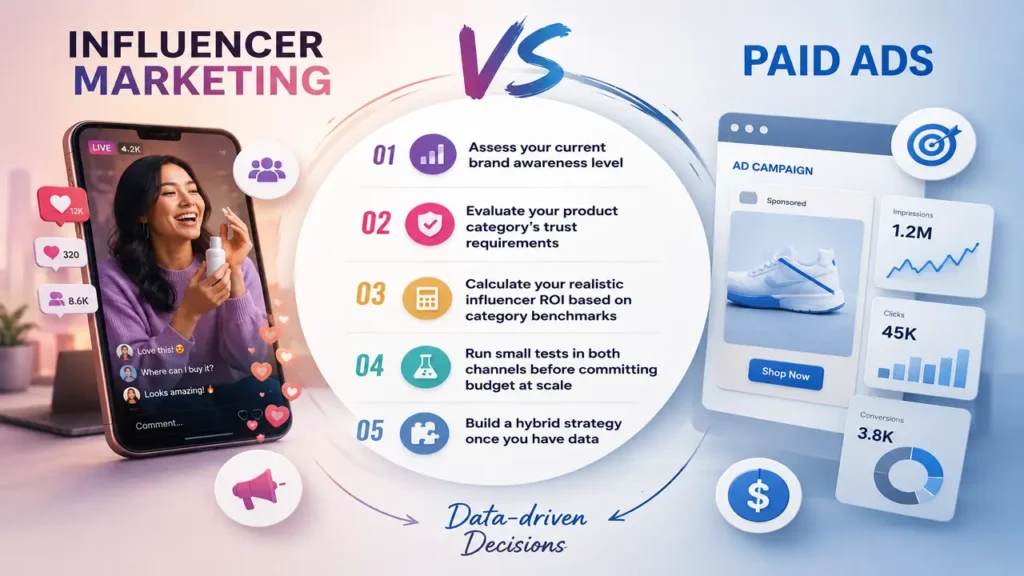
Making the right call on influencer marketing vs paid ads requires assessing your specific situation rather than following generic advice. Here is a structured process to reach that decision.
Step 1: Assess your current brand awareness level
If your brand is unknown to your target audience, influencer marketing typically delivers more efficient awareness because the creator’s existing trust transfers some credibility immediately. If your brand already has reasonable social media marketing awareness and you need to convert warm interest into sales, paid ads with strong retargeting will usually be more cost-efficient.
Step 2: Evaluate your product category’s trust requirements
Categories with higher perceived risk or higher price points, such as skincare, supplements, financial products, and education, benefit significantly from influencer marketing’s trust-building effect. Lower-consideration purchases with clear, easily communicated value propositions often perform well with paid ads alone.
Step 3: Calculate your realistic influencer ROI based on category benchmarks
Look at influencer CPM and engagement benchmarks within your specific category rather than generic averages. A beauty brand and a B2B software company will see vastly different influencer ROI from the same budget, because audience receptiveness to influencer-style content varies dramatically by category.
Step 4: Run small tests in both channels before committing budget at scale
Allocate a test budget split between micro-influencer partnerships and paid social campaigns over a four to six week period. Track cost per acquisition, not just engagement or reach, in both channels to get a true comparison.
Step 5: Build a hybrid strategy once you have data
Once you understand which channel performs better for your specific brand and category, build a hybrid strategy that uses influencer content as both an organic trust-builder and as paid ad creative. Pairing this with ongoing conversion rate optimisation on your landing pages ensures both channels are converting traffic as efficiently as possible once the budget mix is set. This combination consistently outperforms either channel run in isolation for most consumer brands.
Common Mistakes in the Influencer Marketing vs Paid Ads Decision
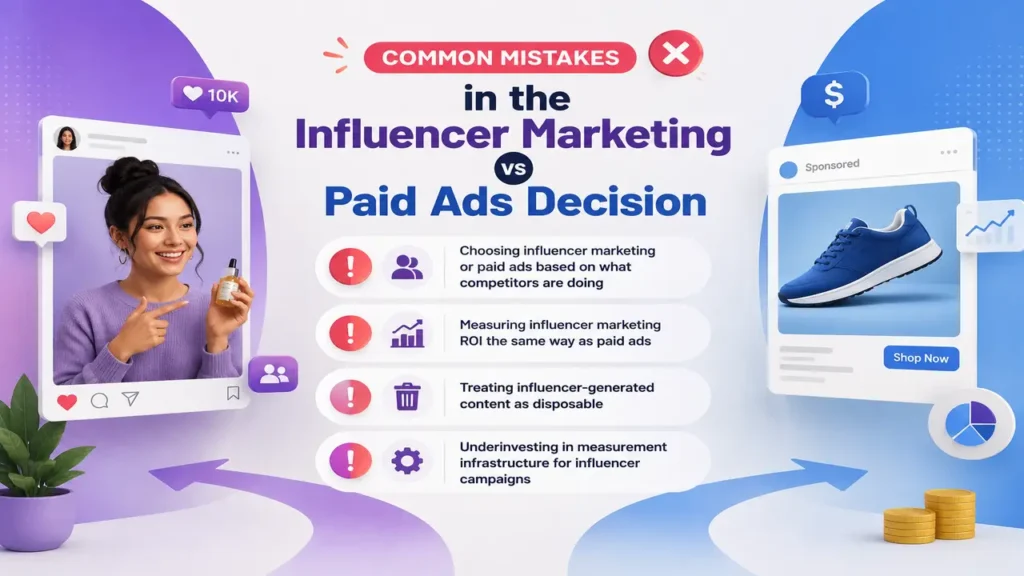
Choosing influencer marketing or paid ads based on what competitors are doing
Copying a competitor’s channel mix without understanding their underlying brand awareness level, audience trust position, or product category dynamics often leads to wasted spend. What works for an established competitor with strong brand recognition may not work for a newer brand still building awareness.
Measuring influencer marketing ROI the same way as paid ads
Paid ads have clean, immediate conversion data. Influencer marketing often has a longer attribution window and a brand-building effect that does not show up in last-click conversion data. Judging influencer campaigns purely against paid ads’ direct-response metrics undervalues the channel’s actual contribution.
Treating influencer-generated content as disposable
Many brands run a single influencer campaign, get the content, and never use it again. The strongest performers extract maximum value by repurposing influencer content as UGC ads in paid campaigns through tools like AI-powered social content workflows, where repurposed creator content consistently outperforms studio-produced creative on engagement and cost per result.
Underinvesting in measurement infrastructure for influencer campaigns
Without UTM-tagged links, unique discount codes, or affiliate tracking per influencer, it becomes impossible to know which creators are actually driving sales versus which are driving reach alone. This measurement gap is one of the biggest reasons influencer marketing budgets get cut during budget reviews, not because the channel underperformed but because its performance was never accurately captured.
Conclusion
The influencer marketing vs paid ads decision is rarely about choosing one over the other permanently. Test both at a small scale first, measure cost per acquisition rather than vanity metrics in each channel, and build toward a hybrid strategy that uses influencer content to fuel your paid campaigns once you understand what resonates with your specific audience.
If you are unsure which channel mix makes sense for your brand right now, a structured growth audit will show you exactly where your budget should go based on your category, audience, and current performance data. Book a free growth marketing audit with Whamply Media’s influencer and paid social team and get a channel allocation plan delivered within 48 hours.
Frequently Asked Questions
Which is better: influencer marketing or paid ads?
Neither is universally better; the right choice depends on your brand’s awareness level, product category, and growth stage. Influencer marketing typically wins for trust-building and awareness, while paid ads win for precision targeting and immediate scalability. Most successful brands combine both rather than choosing one exclusively.
What is the average ROI of influencer marketing compared to paid ads?
Influencer marketing generates an average of $5.78 for every $1 spent, according to Influencer Marketing Hub, with top-performing brands exceeding $20 per dollar. Paid ads ROI varies enormously by platform, industry, and competition, but typically ranges from 2x to 8x return on ad spend for well-optimised campaigns. Direct comparison is difficult because the two channels measure different parts of the funnel.
How much does influencer marketing cost compared to paid ads in India?
Micro-influencer marketing in India typically costs ₹15,000 to ₹50,000 per post depending on category and follower engagement, while macro-influencers and celebrities can cost several lakhs per post. Paid ads costs vary by platform and competition, with Google Ads CPCs ranging from ₹80 to ₹400 in competitive categories and Meta Ads CPMs typically lower but requiring ongoing optimisation.
What is influencer CPM and how does it compare to paid ad CPM?
Influencer CPM measures the cost per thousand impressions generated by an influencer post, calculated by dividing the total fee by estimated reach divided by 1,000. Influencer CPM is often lower than paid social CPM for highly engaged micro-influencer audiences, though paid ads offer guaranteed delivery while influencer reach estimates can be less predictable.
Can influencer marketing replace paid ads entirely?
For most brands, no. Influencer marketing builds trust and awareness effectively but lacks the precision targeting, instant scalability, and granular attribution that paid ads provide. Brands that rely solely on influencer marketing often struggle to scale predictably, while those relying solely on paid ads often face rising costs and audience fatigue without the trust layer influencer content provides.
What are micro-influencers and why are they often more effective than macro-influencers?
Micro-influencers are creators typically with 10,000 to 100,000 followers in a specific niche. They often outperform macro-influencers and celebrities on cost-per-engagement and purchase intent because their smaller, more engaged audiences trust their recommendations more than those of larger, more general creators. They are also significantly more cost-effective for brands testing influencer marketing for the first time.
How do I measure influencer marketing ROI accurately?
Measure influencer marketing ROI by assigning each creator a unique UTM-tagged link or a personalised discount code, then tracking the traffic, leads, and revenue generated from that specific source in your analytics platform. Compare the total creator fee against attributed revenue to calculate a channel-specific ROI figure, rather than relying solely on engagement metrics like likes and comments.
What is UGC and how does it relate to influencer marketing and paid ads?
UGC (user-generated content) refers to authentic content created by customers or influencers rather than a brand’s internal creative team. UGC ads, often sourced from influencer partnerships, consistently outperform traditional studio-produced ad creative on platforms like Meta and TikTok because they feel native to the platform and more trustworthy to viewers. This is the clearest bridge between influencer marketing and paid ads strategies.
Is influencer marketing or paid ads better for B2B brands?
LinkedIn Ads generally perform better for B2B lead generation due to precise job title and company targeting. Influencer marketing in B2B context typically takes the form of thought leadership partnerships with industry experts rather than traditional consumer-style influencer content, and works best as a trust-building layer alongside paid B2B lead generation rather than a primary acquisition channel.
How long does it take to see results from influencer marketing versus paid ads?
Paid ads can generate measurable results within days of launch, particularly for direct-response campaigns with clear conversion tracking. Influencer marketing typically takes longer to show clear ROI, often four to eight weeks, because trust-building and brand awareness effects compound over time rather than converting immediately on first exposure.
What is the difference between influencer marketing and brand partnerships?
Influencer marketing typically refers to paid, often single-campaign collaborations with content creators to promote a product or service. Brand partnerships are usually longer-term, more integrated relationships that may include co-created products, ongoing ambassadorships, or deeper collaborative arrangements beyond individual sponsored posts. Both fall under the broader influencer marketing vs paid ads strategic comparison, but brand partnerships typically require greater investment and commitment.
Should startups prioritise influencer marketing or paid ads for early growth?
Early-stage startups with limited brand awareness often benefit from influencer marketing’s trust-transfer effect, particularly micro-influencer partnerships that are more affordable for smaller budgets. However, startups also need paid ads’ precise targeting and immediate measurability to validate product-market fit quickly. A blended approach with a slightly higher initial weighting toward influencer marketing for trust-building is often the most efficient starting point.
How do platform algorithm changes affect the influencer marketing vs paid ads decision?
Algorithm changes that reduce organic reach push more brands toward paid ads to guarantee visibility, while also increasing the relative value of influencer marketing’s organic distribution through the creator’s existing follower relationship. When organic reach drops, the combination of influencer content amplified through paid promotion often becomes more effective than either channel used independently.
Can I use influencer content as creative for my paid ad campaigns?
Yes, and this is increasingly considered best practice. Repurposing high-performing influencer content as UGC ads in paid campaigns combines the authentic, native feel that drives engagement with the precise targeting and scalability of paid media. Many brands now negotiate content usage rights as part of influencer contracts specifically to enable this strategy.