
How to Track Digital Marketing ROI: The Metrics That Actually Matter
On this page
Only 23% of marketers say they can accurately measure the ROI of their digital marketing campaigns, according to HubSpot. That figure has barely moved in five years, and the reason is not a lack of data. Most teams are drowning in data. The problem is tracking the wrong metrics and drawing the wrong conclusions from them. Digital marketing ROI tracking done correctly connects specific spend decisions to specific revenue outcomes, and that connection is what gives marketing teams the credibility and budget to grow.
What Is Digital Marketing ROI Tracking?
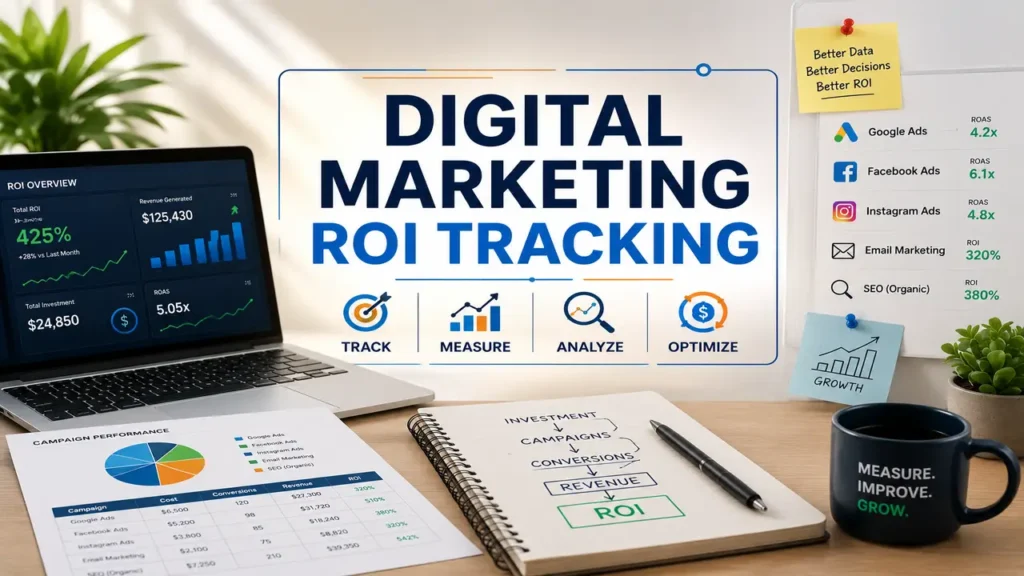
Digital marketing ROI tracking is the process of measuring the financial return generated by marketing activities relative to what was spent on them. It involves setting up conversion tracking across all channels, applying consistent attribution models to assign revenue credit accurately, using UTM parameters to tag traffic sources, and building reporting dashboards that connect ad spend, lead volume, pipeline, and revenue in one view. The goal of digital marketing ROI tracking is to answer a single question with confidence: is this spend making the business more money than it costs?
Why Digital Marketing ROI Tracking Matters in 2026
Marketing budgets are under more scrutiny than they have been in a decade. Finance teams want channel-level justification for every significant spend line. Brands that cannot prove ROI from their paid campaigns, SEO investment, or content programmes are the first to see budget cuts when growth slows. Digital marketing ROI tracking is what keeps marketing funded and what earns the seat at the revenue table that most marketing leaders say they want.
According to HubSpot’s 2024 State of Marketing Report, demonstrating the ROI of marketing activities is the second-biggest challenge marketers face globally, behind only generating traffic and leads. Yet the two problems are connected: poor digital marketing ROI tracking makes it harder to identify which lead generation channels are efficient, which inflates cost per acquisition and makes the traffic problem worse. If cost per lead is already a concern before tracking is fixed, Whamply’s guide on how to reduce cost per lead covers the channel-level changes that work once measurement is in place.
In India, this challenge is particularly acute for mid-market brands running multi-channel campaigns across Google Ads, Meta, LinkedIn, and influencer partnerships simultaneously. Indian businesses spending Rs 5 lakh to Rs 25 lakh per month on performance marketing typically lack a unified reporting dashboard that shows blended ROI across channels. They review individual platform dashboards that each overcount their own contribution, leading to inflated performance reports and poor budget allocation decisions. Pairing spend with a proper SEO audit reveals which organic channels are quietly contributing to pipeline without any attribution credit.
The Marketing Metrics That Actually Measure ROI
Not all metrics tell you about ROI. Most tell you about activity. Understanding the difference is the foundation of any serious digital marketing ROI tracking programme.
Vanity metrics vs business metrics
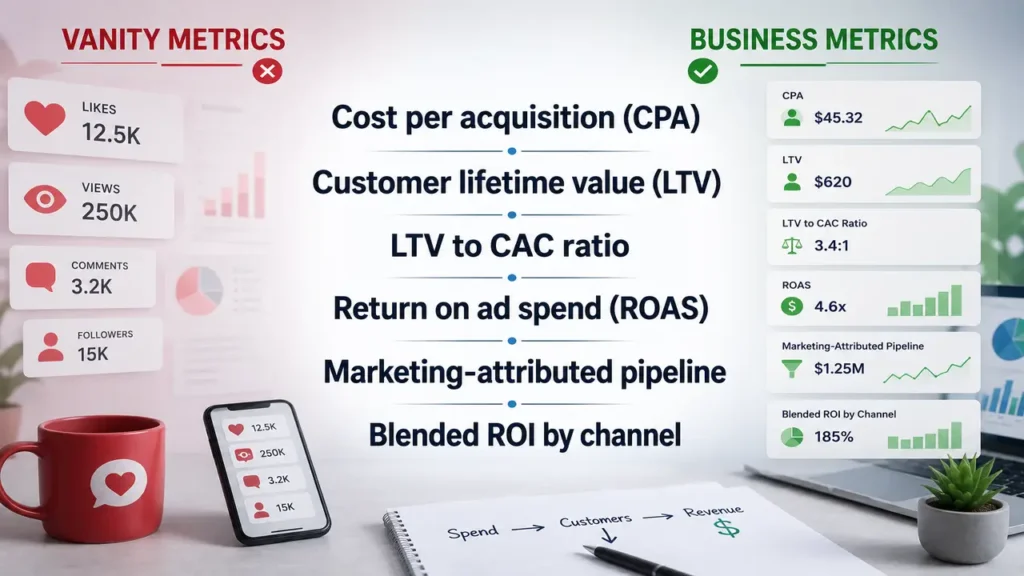
Vanity metrics look good in reports but do not connect to revenue. Impressions, followers, page views, and raw click counts all fall into this category. They have their place as directional indicators, but building your digital marketing ROI tracking around them means you are measuring effort, not outcome.
Business metrics are the ones that close the loop between marketing activity and financial result. The key ones are:
Cost per acquisition (CPA): The fully-loaded cost to acquire one new paying customer, including all channel spend, agency fees, and tool costs. Whamply’s guide on how to calculate and improve customer acquisition cost covers how to build this number accurately when spend is spread across multiple channels.
Customer lifetime value (LTV): The total revenue a customer is expected to generate over their relationship with the brand, which contextualises whether your CPA is sustainable.
LTV to CAC ratio: The ratio of lifetime value to customer acquisition cost. A ratio of 3:1 or above is considered healthy for most business models.
Return on ad spend (ROAS): Revenue generated divided by ad spend, useful for e-commerce and direct-response campaigns but incomplete as a standalone ROI metric.
Marketing-attributed pipeline: The volume of sales pipeline that can be traced back to marketing activity, used in B2B contexts where sales cycles are long.
Blended ROI by channel: Revenue attributed to each channel divided by the total cost of running that channel. This is the most honest measure of channel efficiency and the most reliable input for full-funnel marketing budget decisions, since it captures contribution from every stage of the funnel rather than just bottom-of-funnel conversions.
Attribution models and why they change everything
Attribution is the process of deciding which touchpoints in a customer’s journey get credit for the conversion. The model you use directly changes which channels appear to be performing well and which do not.
Last-click attribution, still the default in many platforms, gives 100% of the credit to the last touchpoint before conversion. This systematically overvalues bottom-of-funnel channels like branded search and undervalues top-of-funnel channels like display, social media marketing, and content marketing. Brands relying on last-click data for digital marketing ROI tracking are making budget decisions on a fundamentally skewed picture.
Google Analytics 4 uses a data-driven attribution model by default, which distributes conversion credit across multiple touchpoints based on actual observed conversion probability. This is more accurate than last-click for most businesses. For Indian brands using GA4 with multi-channel campaigns, switching from last-click to data-driven attribution frequently changes which channels appear most efficient and justifies investment in upper-funnel activity that previously looked invisible in reports.
How to Set Up Digital Marketing ROI Tracking Step by Step
Digital marketing ROI tracking is not a reporting exercise. It is an infrastructure project. Getting it right requires setting up the right foundations before any analysis is possible.
Step 1: Define your conversion events and assign revenue values to them
Before setting up any tracking, list every action that represents meaningful progress toward revenue: a form fill, a free trial sign-up, a product purchase, a phone call. Assign a monetary value to each conversion type based on your average close rate and average order value. A B2B lead with a 10% close rate and a Rs 50,000 average deal value is worth Rs 5,000 in expected revenue. Without these values, your reporting dashboard cannot calculate ROI. For pages where conversion rates are low, working on conversion rate optimisation before scaling traffic is often the higher-ROI first step. The landing page optimisation guide on the Whamply blog covers the specific on-page changes that move conversion rates most reliably before more budget is sent to a page.
Step 2: Install and configure Google Analytics 4 correctly
Google Analytics 4 is the foundation of most digital marketing ROI tracking setups. Configure it with enhanced measurement turned on, import your conversion events from Google Ads, and connect it to your CRM if possible. Set up GA4’s attribution settings to data-driven rather than last-click. Enable BigQuery export if you need to run custom queries across large data sets. Many Indian brands have GA4 installed but not correctly configured, which means their conversion data is incomplete or misleading from day one. Combining GA4 with technical SEO fixes ensures the site itself is not creating gaps in your tracking through broken redirects or missing canonical tags.
Step 3: Implement UTM parameters consistently across all channels
UTM parameters are small tags added to your URLs that tell GA4 and other analytics tools exactly where a visitor came from. Every paid campaign, email marketing automation sequence, social post, and influencer link should carry UTM parameters with consistent naming conventions. Without UTM parameters, traffic from different sources merges into “direct” or “referral” categories, making channel-level digital marketing ROI tracking impossible. Use a shared UTM builder spreadsheet that every team member and agency partner follows without exception.
Step 4: Connect your CRM to your marketing platforms
GA4 tells you about website behaviour. Your CRM tells you what happened after the form fill: did the lead qualify, did it move through the pipeline, did it close? Connecting these two data sources gives you the full picture of digital marketing ROI tracking from impression to revenue. HubSpot and Salesforce both offer native GA4 and Google Ads integrations. For brands using CRM automation, this connection is often already in place and just needs to be configured to pass revenue data back to the ad platforms for closed-loop attribution.
Step 5: Build a unified reporting dashboard
Individual platform dashboards (Google Ads, Meta Ads Manager, LinkedIn Campaign Manager) each show their own data in isolation and each attribute more conversions to themselves than is accurate. A unified reporting dashboard that pulls data from all sources into one view, with consistent attribution, is essential for honest digital marketing ROI tracking. Tools like Looker Studio (free), Supermetrics, or custom GA4 dashboards work well for this. The dashboard should show spend, leads, pipeline, and revenue by channel in a single table, updated at least weekly. Brands using lead automation can connect their lead scoring data directly to the dashboard, giving a real-time view of lead quality by channel alongside volume and cost metrics.
Step 6: Establish a regular reporting cadence with defined review actions
Tracking data without acting on it is not digital marketing ROI tracking. It is data hoarding. Set a weekly 30-minute review of channel-level performance against your defined marketing KPIs, a monthly deeper analysis of LTV and CAC trends by cohort, and a quarterly budget reallocation review that moves spend toward channels with the strongest blended ROI. Each review should produce at least one concrete action: a campaign paused, a budget shifted, a test initiated. For brands running dynamic remarketing alongside prospecting campaigns, the monthly review is also when you adjust audience exclusions and retargeting budgets based on the latest conversion data.
Common Mistakes in Digital Marketing ROI Tracking
Using platform-reported conversions as your source of truth
Every ad platform, Google, Meta, LinkedIn, attributes more conversions to itself than actually occurred. This is because each platform counts a conversion if a user was exposed to an ad within its attribution window, even if that user also clicked ads on other platforms. Using platform reports as your primary digital marketing ROI tracking method produces double or triple-counted conversions. Always cross-reference platform data with GA4 and CRM data to get an accurate figure. This is precisely the gap that makes channel comparisons so unreliable without a neutral source of truth. Whamply’s SEO vs PPC breakdown explains how each channel’s self-reported data distorts the picture when reviewed without a unified attribution layer.
Tracking leads without tracking lead quality
A campaign generating 200 leads per month at Rs 500 each looks excellent in a cost-per-lead report. If 190 of those leads never qualify or close at a fraction of your average rate, the real cost per acquired customer could be Rs 50,000 or more. Digital marketing ROI tracking must include lead quality data from the CRM, not just lead volume from the ad platform. Set up a lead quality score with your sales team and feed that data back into your channel performance reports. Brands running B2B lead generation campaigns in particular need to track MQL-to-SQL conversion rates alongside CPL to get an accurate picture of which channels are generating revenue-ready leads.
Setting up UTM parameters inconsistently
When different team members or agencies use different naming conventions in UTM parameters (utm_source=google vs utm_source=Google vs utm_source=google-ads), GA4 creates separate traffic segments for each variant. This fragments your data and makes channel-level digital marketing ROI tracking inaccurate. Establish a single UTM naming convention document before any campaigns go live and make it a mandatory step in every campaign launch checklist.
Not accounting for the time lag between spend and revenue
In B2B businesses with 60 to 180 day sales cycles, the revenue generated from this month’s marketing spend will not appear for three to six months. Comparing this month’s spend to this month’s closed revenue produces a misleadingly low or high ROI figure depending on where you are in the cycle. Use cohort analysis to match the marketing spend in a given month to the revenue it eventually generated from that cohort of leads, rather than the revenue closed in that same calendar month.
Relying on last-click attribution for budget decisions
Last-click attribution makes bottom-of-funnel channels like branded search appear extremely efficient because they capture intent that was built by earlier touchpoints. Brands that allocate budget based on last-click data systematically underinvest in SEO, content, and LinkedIn Ads campaigns that create that intent in the first place. Switch to data-driven attribution in GA4 and use it as your primary source for digital marketing ROI tracking and budget allocation.
Conclusion
The two foundations of credible digital marketing ROI tracking are consistent UTM parameters across every channel and a unified reporting dashboard that shows spend, pipeline, and revenue in one view. Get those two in place and you will surface insights within weeks that most teams spend years guessing at.
If your current reporting setup relies on individual platform dashboards and you cannot confidently state which channel generated the most revenue last quarter, a structured analytics audit will identify the gaps and give you a clear implementation plan. Book a free digital marketing audit with Whamply Media’s analytics team and get a channel-by-channel ROI assessment delivered within 48 hours.
Frequently Asked Questions
What is digital marketing ROI tracking?
Digital marketing ROI tracking is the process of measuring the financial return generated by marketing activities relative to their cost. It connects ad spend, lead data, pipeline, and revenue across all channels using tools like Google Analytics 4, UTM parameters, attribution models, and CRM integrations to give a complete picture of marketing efficiency.
How do I calculate digital marketing ROI?
Digital marketing ROI is calculated as: (Revenue Attributed to Marketing minus Marketing Costs) divided by Marketing Costs, expressed as a percentage. For example, if you spent Rs 2 lakh on marketing and it generated Rs 8 lakh in revenue, your ROI is (8,00,000 minus 2,00,000) divided by 2,00,000, which equals 300%. Always use fully-loaded costs including agency fees and tool subscriptions, not just ad spend.
What is the difference between ROAS and ROI?
ROAS (return on ad spend) measures revenue generated divided by ad spend only. ROI is broader and accounts for all costs associated with marketing, including staff, agency fees, and software. ROAS is a useful tactical metric for optimising individual campaigns. ROI is the strategic metric for evaluating whether your overall marketing investment is financially justified.
What are UTM parameters and why do they matter for ROI tracking?
UTM parameters are tags added to URLs that identify the source, medium, campaign, and content of a traffic visit in analytics tools. They are essential for digital marketing ROI tracking because without them, GA4 cannot accurately attribute website visits to specific campaigns, making it impossible to calculate channel-level ROI. Every paid campaign, email, and social post should carry correctly structured UTM parameters.
What is data-driven attribution in Google Analytics 4?
Data-driven attribution in GA4 is a model that distributes conversion credit across multiple touchpoints in a customer’s journey based on observed conversion probability patterns in your actual data. Unlike last-click attribution, it accounts for the role of upper-funnel touchpoints like awareness ads and content in driving eventual conversions, making it more accurate for digital marketing ROI tracking in multi-channel campaigns.
Which marketing KPIs should I track for ROI?
The core marketing KPIs for digital marketing ROI tracking are: cost per acquisition (CPA), customer lifetime value (LTV), LTV to CAC ratio, return on ad spend (ROAS), marketing-attributed pipeline, and blended ROI by channel. Supplement these with leading indicators like cost per lead and lead-to-customer conversion rate so you can identify performance problems before they affect revenue.
How do I connect Google Analytics 4 to my CRM for ROI tracking?
GA4 connects to CRMs like HubSpot and Salesforce through native integrations or via middleware tools like Zapier. The key is to pass the GA4 client ID into your CRM at the point of lead capture, then import offline conversion events (qualified lead, deal closed) back into GA4 and Google Ads. This closes the attribution loop and enables true revenue-based digital marketing ROI tracking rather than lead-based tracking.
What is a reporting dashboard and how do I build one for digital marketing ROI?
A reporting dashboard is a single view that aggregates data from multiple sources (Google Ads, Meta, GA4, CRM) into consistent, comparable metrics. For digital marketing ROI tracking, build your dashboard in Looker Studio with a table showing spend, leads, pipeline, and revenue by channel. Update it weekly and review it in a standing meeting with defined actions following each review.
How does multi-touch attribution improve digital marketing ROI tracking?
Multi-touch attribution assigns conversion credit across multiple touchpoints rather than giving all credit to the last click. This gives a more accurate view of which channels are contributing to revenue, including upper-funnel channels that rarely get last-click credit. For most businesses running five or more channels simultaneously, switching to a data-driven multi-touch model in GA4 changes the apparent ROI ranking of channels significantly.
What is the best tool for digital marketing ROI tracking?
Google Analytics 4 is the foundation for most digital marketing ROI tracking setups due to its native integration with Google Ads, data-driven attribution, and free access. Supplement it with a CRM (HubSpot or Salesforce) for lead-to-revenue tracking, and Looker Studio for unified reporting dashboards. For Indian businesses on tighter budgets, this three-tool stack covers the vast majority of ROI tracking needs without enterprise software costs.
How do I track ROI from SEO and content marketing?
SEO and content marketing ROI is tracked through organic search revenue attribution in GA4, which assigns revenue credit to organic sessions that led to conversions. Track organic-attributed leads and revenue monthly, compare to the fully-loaded cost of your SEO investment (agency fees, content production, tool subscriptions), and calculate the same ROI formula used for paid channels. SEO ROI compounds over time, so a 12-month view is more accurate than a monthly one. Whamply’s SEO services include monthly organic ROI reporting as standard.
How long does it take to set up digital marketing ROI tracking properly?
A basic digital marketing ROI tracking setup (GA4 configured, UTM parameters implemented, conversion events tagged) takes one to two weeks for a team with existing technical access. A complete setup including CRM integration, custom reporting dashboards, and attribution model configuration typically takes four to six weeks. The investment pays back quickly: most brands identify at least one significant budget misallocation within the first 30 days of having accurate channel-level data.
What is a good ROAS benchmark for digital marketing campaigns in India?
For Indian e-commerce brands on Google Shopping Ads and Meta Ads, a blended ROAS of 3x to 5x is generally considered acceptable, with top-performing accounts achieving 7x to 12x on optimised product categories. LinkedIn Ads typically show lower short-term ROAS in B2B due to longer sales cycles, but higher LTV per customer. Always evaluate ROAS in the context of your gross margin, not just revenue.
How do I track ROI from influencer marketing?
Track influencer marketing ROI by assigning each influencer a unique UTM-tagged link or discount code, then measuring the traffic, leads, and revenue generated by that specific source in GA4. Compare total influencer fees to attributed revenue for a channel-level ROI figure. In India, where influencer marketing budgets range from Rs 15,000 to Rs 5 lakh per campaign, this level of tracking is often skipped, which means brands cannot identify which creators drive actual sales versus which drive reach alone.
What is marketing-attributed pipeline and why does it matter for B2B ROI tracking?
Marketing-attributed pipeline is the total value of sales opportunities that can be traced back to a marketing source. It matters for B2B digital marketing ROI tracking because revenue closes months after the marketing activity that generated it. Tracking pipeline gives marketing teams a leading indicator of revenue performance and justifies investment in channels that contribute to early-stage pipeline even when they do not show up in closed-revenue reports within the same quarter.