
How to Set Up a Facebook Retargeting Campaign That Actually Works
On this page
Only 2% of website visitors convert on their first visit. The other 98% leave, get distracted, and forget your brand exists within hours. A well-structured Facebook retargeting campaign exists specifically to solve this problem: it follows those warm visitors across Meta’s network and brings them back at the exact moment they are ready to take action. Retargeted users are 70% more likely to convert than those who never see a follow-up ad, and retargeting campaigns typically deliver CPA reductions of up to 50% compared with campaigns targeting cold audiences. Most businesses either skip this entirely or set it up badly. This guide covers how to do it right.
What Is a Facebook Retargeting Campaign?
A Facebook retargeting campaign is a paid advertising strategy on Meta’s platform that shows ads specifically to people who have already interacted with your brand, whether by visiting your website, engaging with your Facebook or Instagram content, watching your videos, or adding a product to their cart. It uses pixel tracking and custom audience data to identify these warm visitors and serve them targeted, relevant ads designed to bring them back and convert them. A Facebook retargeting campaign is fundamentally different from cold audience advertising because it speaks to people who already know you exist.
Why Facebook Retargeting Campaigns Matter More in 2026
Meta’s Performance Advertising Benchmarks Report, compiled from 2.1 million active ad accounts across 190 countries, confirmed that retargeted ads on Facebook now achieve a CTR that is 94% higher than standard display ads, driven by Meta’s Andromeda AI ad ranking system improving creative-to-audience match scores. The competitive environment for cold audience advertising has become more expensive year on year. Retargeting your warm audience is one of the few remaining high-efficiency channels in Meta’s ecosystem.
For businesses in India, the case is even stronger. With Facebook commanding over 384 million users as of 2025 and average CPMs significantly lower than in Western markets, a well-executed Facebook retargeting campaign in India can run efficiently at daily budgets as low as ₹500 to ₹1,000 while still reaching meaningful audience sizes. The cost advantage over cold traffic is substantial: retargeting CPLs in Indian service-sector campaigns routinely come in 40 to 60% below what the same brands pay for prospecting campaigns. A social media marketing strategy that treats retargeting as its primary conversion engine, rather than an afterthought, consistently produces a lower overall cost per lead across both paid and organic channels.
According to DemandSage, 77% of marketers use retargeting for their Facebook and Instagram accounts as an advertising strategy, making it one of the most widely adopted performance tactics across both B2B and B2C businesses. The brands not running a Facebook retargeting campaign are leaving recoverable revenue on the table every single day.
Setting Up Your Facebook Retargeting Campaign: The Technical Foundation
Before a single ad goes live, three things need to be in place: pixel tracking, the Conversions API, and properly constructed custom audiences. Skipping any of these does not just reduce performance. It makes meaningful optimisation impossible.
Pixel Tracking and the Conversions API
The Meta Pixel is a piece of JavaScript code placed on your website that tracks visitor behaviour and sends that data back to Meta. It is what allows Meta to build your custom audience and optimise your Facebook retargeting campaign for the conversion events that matter.
Installing the pixel alone is no longer sufficient. With iOS privacy updates reducing browser-side data collection by 30 to 40%, the Conversions API (CAPI) is now essential. CAPI sends conversion data directly from your server to Meta, bypassing browser restrictions. Businesses with both pixel and CAPI running together consistently outperform those relying on pixel alone.
Here is what needs to be verified before launching any Facebook retargeting campaign:
- Pixel is installed on every page of your website, not just the homepage. Use Meta’s Pixel Helper Chrome extension to confirm it is firing correctly on landing pages, product pages, and the thank you or confirmation page.
- Standard events are set up correctly. ViewContent, AddToCart, InitiateCheckout, and Purchase events need to fire at the right moments. These are what Meta uses to build segmented retargeting audiences and optimise delivery.
- Conversions API is active. Most CMS platforms (Shopify, WordPress, Webflow) have native CAPI integrations. If yours does not, a developer will need to implement it. This single step can recover 20 to 40% of data that browser-side tracking misses.
- Advanced Matching is enabled. This passes hashed customer data (email, phone number) to Meta, improving the match rate between your website visitors and Meta user profiles. Higher match rates mean larger, more accurate retargeting audiences.
- Event deduplication is configured. When both pixel and CAPI are running simultaneously, the same conversion can be counted twice. Deduplication using the event ID parameter prevents this from inflating your reported conversions.
A performance marketing setup that skips the tracking stage will optimise toward the wrong signals from day one. If you suspect your tracking has gaps, an SEO audit services combined with a paid account review often surfaces data issues that have been quietly distorting campaign results for months.
Building Your Custom Audiences
With tracking in place, you can build the custom audiences that power your Facebook retargeting campaign. Meta allows you to create custom audiences based on website activity, video views, Instagram and Facebook page engagement, lead form interactions, and customer lists.
The key is segmentation. A Facebook retargeting campaign that shows the same ad to a first-time blog visitor and a cart abandoner will underperform both. These two people are in completely different mental states and need different messages.
How to Structure a Facebook Retargeting Campaign That Converts
A Facebook retargeting campaign that consistently converts is built on audience segmentation by behaviour and funnel stage, not by demographic. Here is the step-by-step structure used in campaigns that actually work.
Step 1: Segment your custom audiences by behaviour and recency
Create separate custom audiences for each of the following groups, using the time windows in brackets as a starting point:
- All website visitors (last 30 days)
- Specific page visitors, for example, pricing or services pages (last 14 days)
- Video viewers, at least 50% watch time (last 30 days)
- Instagram or Facebook page engagers (last 60 days)
- Lead form openers who did not submit (last 14 days)
- Add-to-cart without purchase (last 7 days)
- Initiated checkout without purchase (last 7 days)
Recency matters more than most advertisers realise. A visitor from two days ago is far warmer than one from 25 days ago. Splitting by time window allows you to bid more aggressively on the freshest, highest-intent segments.
Step 2: Build exclusion audiences to prevent wasted spend
Every Facebook retargeting campaign needs clean exclusions. Exclude anyone who has already converted from acquisition and mid-funnel retargeting ads. Exclude recent purchasers (last 30 to 60 days) from cart abandonment campaigns. Exclude existing customers from lead generation campaigns unless you are cross-selling a different product. Instagram advertising campaigns running alongside your Facebook retargeting campaign should share the same exclusion lists to prevent the same user from being hammered across both placements simultaneously.
Step 3: Match your ad creative to each audience segment
The message for a cold blog reader should not be the same as the message for someone who added to cart and left. Here is a practical creative framework for your Facebook retargeting campaign:
- Blog readers and content consumers: social proof, case studies, or a free resource. The goal is to move them from awareness to consideration.
- Pricing page visitors: testimonials, comparison content, or a limited-time offer. They are evaluating. Give them a reason to choose you.
- Cart and checkout abandoners: urgency, reassurance, or a specific incentive. A ₹500 discount or free shipping offer for Indian e-commerce brands at this stage often recovers 10 to 25% of abandoned sessions.
- Lead form abandoners: a simplified path back. Sometimes a shorter form or a direct call option removes the friction that stopped them the first time.
The landing page copy services the retargeting ad leads to is equally important as the ad itself. Mismatched messaging between the ad and the landing page is one of the most consistent conversion killers in retargeting. If the ad promises a 30% discount, the landing page must confirm it immediately, above the fold, before the visitor has to scroll.
Step 4: Set frequency caps to prevent ad fatigue
Research shows that once ad frequency exceeds 2.5 views per person, conversion rates typically start declining. Set a frequency cap of 2 to 3 impressions per person per week for most retargeting audiences. For very small, high-intent audiences like cart abandoners, you can push to 4 to 5 without significant fatigue, but monitor weekly.
Step 5: Choose the right campaign objective
For retargeting warm audiences, use the Sales or Leads objective with a focus on website conversions. Avoid Traffic or Engagement objectives for retargeting. They optimise for clicks and interactions, not purchases or form fills, and attract a different, lower-intent profile of user within your custom audience.
Step 6: Monitor, test, and refresh creative regularly
A Facebook Ads campaign is not a set-and-forget activity. Creative fatigue hits faster with retargeting audiences than with cold audiences because the pool of people is smaller and they see your ads more frequently. Refresh ad creative every 10 to 14 days for small retargeting audiences. Track frequency and CPM trends as early warning signals that fatigue is setting in before your conversion rate drops.
Advanced Retargeting Strategies Worth Implementing in 2026
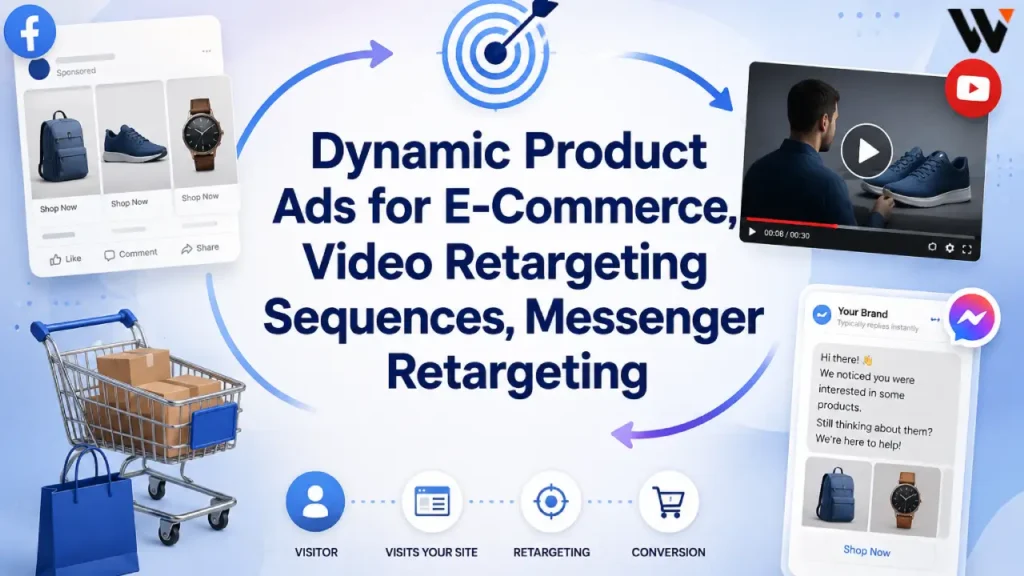
Once your core Facebook retargeting campaign structure is running and producing consistent results, these three strategies reliably push performance further.
Dynamic Product Ads for E-Commerce
If you run an online store, Dynamic Product Ads (DPAs) are the highest-leverage retargeting format available on Meta. They automatically show each visitor the exact products they viewed or added to their cart, using your product catalogue feed. Facebook dynamic product ads recover 10 to 25% of abandoned carts, and dynamic retargeting can generate CPA improvements of 20 to 35% for online retailers.
Setting up DPAs requires a verified product catalogue in Meta Commerce Manager and a pixel with AddToCart and ViewContent events firing correctly. Once configured, the campaign runs almost autonomously, with Meta’s algorithm matching the right product to the right person in real time. The e-commerce SEO and paid retargeting combination works particularly well for DTC brands: SEO drives product discovery and first visits, while DPA retargeting converts the browsers who left without purchasing.
Video Retargeting Sequences
Video is one of the most cost-efficient ways to build a warm retargeting audience on Meta. Running a short awareness video to cold audiences, even at ₹200 to ₹500 per day in India, generates a 25%, 50%, or 75% video view custom audience at very low CPM. You can then retarget that audience with a conversion-focused ad.
This approach solves a common problem for businesses with small website traffic: not enough pixel data to build meaningful website custom audiences. Video views accumulate quickly, giving you a sizeable warm audience to retarget even if your site only gets a few hundred visitors per month. YouTube marketing feeds naturally into this approach: video content produced for YouTube can be repurposed as Facebook awareness ads, building retargeting audiences across both platforms simultaneously.
Users retargeted with video are 34% more likely to convert than those retargeted with static images, making the added production effort worthwhile. Even a simple 30 to 60 second talking-head video, filmed on a smartphone, outperforms a well-designed static graphic in most retargeting contexts.
Messenger Retargeting
Messenger retargeting messages see 60 to 80% open rates, compared to 20 to 25% for email. For service businesses, real estate, healthcare, and coaching brands in India, Messenger retargeting can function as a direct follow-up channel that converts high-intent visitors into booked appointments without requiring them to fill out a form.
Setting up Messenger retargeting requires a Click-to-Messenger ad campaign driving conversations, followed by a retargeting audience built from people who have messaged your page. This is a more active management approach but delivers unusually strong engagement for high-consideration purchases. Pairing Messenger retargeting with a structured email marketing automation sequence creates a multi-touch follow-up system that maintains contact with warm leads across channels, significantly improving overall conversion rates compared to either channel alone.
Facebook Retargeting Campaign: Audience Segmentation That Scales
Most Facebook retargeting campaigns plateau because the audience pool is too small to sustain performance. Here is how to expand your warm audience without sacrificing relevance.
Lookalike audiences from retargeting pools: Create lookalike audiences from your highest-quality custom audience segments, such as past buyers, lead form submitters, or checkout initiators. Lookalike audiences based on existing customer data outperform interest-based targeting by 35%, making this one of the most scalable bridges between retargeting and cold prospecting. A dynamic remarketing strategy that uses converters as the source for lookalikes consistently produces better prospecting results than interest stacking.
Engagement audiences: Instagram profile visitors, Facebook page engagers, and people who have saved your posts or clicked your ads are all buildable as custom audiences in Meta. These people have shown intent without reaching your website, and they are often available in much larger volumes than website custom audiences. Include these in your Facebook retargeting campaign structure as a mid-funnel layer. Consistent Facebook marketing activity, including regular organic posts, Reels, and story content, continuously feeds this engagement audience pool at no extra ad spend.
Customer list uploads: Uploading your existing customer email list or CRM contacts to Meta creates a customer list custom audience. This is the most privacy-compliant, first-party-data-powered audience available to you. Use it for cross-sell and upsell campaigns, and as the source for your highest-quality lookalike audiences. For Indian businesses using CRMs like Zoho, Leadsquared, or HubSpot, the upload process is straightforward: export contacts as a CSV, hash the email column, and upload directly to Meta Audiences. Meta typically matches 30 to 60% of uploaded contacts to active Facebook accounts, depending on data quality. Email lead generation programmes that consistently grow your CRM list are therefore also growing the quality and scale of your retargeting pool at the same time.
How Facebook Retargeting Fits Into a Full-Funnel Strategy
A Facebook retargeting campaign in isolation is only part of the picture. The brands generating the strongest results from retargeting are those that have a deliberate full-funnel approach: they invest in cold audience prospecting to continuously refill the top of the funnel, run retargeting campaigns to convert the warm middle, and use post-purchase campaigns to increase customer lifetime value at the bottom.
For B2B businesses, LinkedIn advertising often handles top-of-funnel awareness while Facebook retargeting converts warm visitors who have arrived via LinkedIn, organic search, or direct referral. The two platforms complement each other particularly well for high-ticket B2B services where multiple touchpoints are required before a decision is made.
For e-commerce and DTC brands, Performance Max campaigns on Google can be paired with Facebook retargeting to create cross-platform warm audience coverage. A visitor who discovers a product through Google Shopping and does not convert can be retargeted on Facebook within the same 24-hour window, maintaining brand presence across the platforms they use throughout the day.
Influencer marketing campaigns also feed the Facebook retargeting funnel directly. When an influencer post drives traffic to your website or profile, those visitors automatically enter your custom audiences. Brands that run influencer campaigns without a simultaneous Facebook retargeting campaign are losing a significant portion of the warm audience those campaigns generate.
Common Mistakes That Kill Facebook Retargeting Campaign Performance
Retargeting everyone with the same ad
Running one ad to one giant “all website visitors” audience treats a person who spent 8 seconds on your homepage the same as someone who spent 12 minutes reading your pricing page and then left. These two people need completely different messages. Failing to segment custom audiences by behaviour and intent level is the single most common reason a Facebook retargeting campaign underperforms expectations. Build separate ad sets for each meaningful behaviour segment and test messaging independently across each.
Not excluding converters from retargeting audiences
If someone has already purchased, filled out your lead form, or booked a call, they should not keep seeing your conversion-focused retargeting ads. Showing a “Get a Free Quote” ad to someone who just paid you ₹80,000 for a service damages trust and wastes budget. Always create a custom audience of converters (last 30 to 60 days) and exclude it from every retargeting campaign at the ad set level. This is a foundational setup step, not an optional optimisation.
Relying only on the pixel without the Conversions API
Pixel-only tracking has become increasingly unreliable since Apple’s iOS 14 privacy changes in 2021. Without CAPI, a significant portion of your conversion events are never reported back to Meta. This means the algorithm is training on incomplete data, optimising for a distorted picture of who is converting. The result is a Facebook retargeting campaign that appears to be running but is not finding the right people within your custom audience. Setting up CAPI is a one-time technical task that has a permanent positive effect on attribution accuracy and campaign performance.
Setting audience windows too long for the business type
A 180-day website visitor audience might seem larger and therefore better. But for a business where purchase intent cools quickly, such as event tickets, seasonal products, or time-sensitive services, a 180-day window is mostly cold traffic with a warm label. Use 7 to 14 day windows for your most aggressive retargeting creatives. Save 30 to 60 day windows for softer, brand-reinforcing content rather than hard conversion messages.
Ignoring ad frequency until it is too late
Frequency is one of the most important metrics in a Facebook retargeting campaign, and most advertisers check it too infrequently. By the time you notice frequency at 7 or 8, your CPM has already risen, your CTR has already fallen, and your audience is actively tuning out your brand. Set up a custom column in Meta Ads Manager to display frequency at ad set level and check it at least twice per week. Refresh creative before frequency hits 4, not after.
Conclusion
The difference between a Facebook retargeting campaign that generates consistent, profitable results and one that bleeds budget comes down to two things: proper pixel tracking including CAPI, and meaningful audience segmentation by behaviour. Get those two right and everything else becomes optimisation rather than damage control.
If your business is running Facebook ads but not a dedicated Facebook retargeting campaign, you are doing the expensive part (building warm audiences with cold traffic spend) without doing the profitable part (converting those warm audiences at a fraction of the cost).
Book a free audit with Whamply and get a complete review of your pixel setup, custom audience structure, and retargeting campaign performance, with a prioritised action plan delivered within 48 hours.
Frequently Asked Questions
What is a Facebook retargeting campaign?
A Facebook retargeting campaign is a paid advertising strategy that uses Meta Pixel data and custom audiences to show ads specifically to people who have already interacted with your brand, such as website visitors, video viewers, or cart abandoners. It targets warm audiences who are significantly more likely to convert than cold audiences seeing your brand for the first time.
How does Facebook retargeting work technically?
The Meta Pixel places a cookie on a visitor’s browser when they visit your website. This sends behavioural data back to Meta, which uses it to build custom audiences. When you run a retargeting campaign, Meta shows your ads specifically to people in those custom audiences as they scroll through Facebook and Instagram.
How much does a Facebook retargeting campaign cost in India?
A Facebook retargeting campaign in India can be started with daily budgets as low as ₹300 to ₹500. Effective campaigns for small and mid-sized businesses typically run on ₹500 to ₹2,000 per day depending on audience size and objective. Retargeting CPMs in India are generally lower than cold audience CPMs, making it one of the most cost-efficient formats on the platform.
What is a custom audience in Facebook retargeting?
A custom audience is a group of people defined by specific behaviour, such as website visitors, video viewers, Facebook page engagers, or customer list uploads, that Meta uses to target your retargeting ads. Custom audiences are the core of every Facebook retargeting campaign and the quality of your segmentation directly determines how well the campaign converts.
How long should my Facebook retargeting window be?
For most businesses, a 7 to 30 day retargeting window works best for conversion-focused campaigns. Use 14 to 30 day windows for general site visitors, 7 day windows for cart abandoners, and 30 to 60 day windows for awareness or nurture campaigns. Avoid 180-day windows for hard conversion messages unless your sales cycle is genuinely that long.
What is pixel tracking and why does it matter for retargeting?
Pixel tracking is the process by which the Meta Pixel records user behaviour on your website and sends that data back to Meta. Without pixel tracking, you cannot build website-based custom audiences, cannot optimise your campaign for specific conversion events, and cannot accurately measure which ads drove actions on your site. It is the foundational technical requirement for any Facebook retargeting campaign.
What is the ideal frequency cap for a retargeting campaign?
The optimal frequency for most retargeting audiences is 2 to 3 ad views per person per week. Once frequency exceeds 4 to 5, conversion rates typically decline while CPMs rise, indicating audience fatigue. Monitor frequency at the ad set level in Meta Ads Manager and refresh creative before the threshold is reached.
Should I use the same creative for retargeting as for cold audiences?
No, Retargeting creative should be specifically designed for people who already know your brand. Cold audience ads focus on awareness and education. Retargeting ads should focus on removing purchase barriers, addressing objections, creating urgency, or offering a specific incentive. Showing the same generic brand awareness ad to a cart abandoner is a missed opportunity and delivers poor results.
What campaign objective should I use for a Facebook retargeting campaign?
Use the Sales objective optimised for website conversions for retargeting campaigns aimed at generating purchases or leads. Avoid Traffic or Engagement objectives as they optimise for clicks and interactions rather than conversions, and tend to attract lower-intent interactions within your custom audience.
How do I prevent ads from showing to people who already converted?
Create a custom audience of recent converters (last 30 to 60 days) and add it as an excluded audience at the ad set level in every retargeting campaign. This stops converted users from seeing acquisition ads and prevents budget waste on people who no longer need to be persuaded.
What is the Conversions API and do I need it?
The Conversions API (CAPI) is a server-side integration that sends conversion event data directly from your server to Meta, bypassing browser-based privacy restrictions. Without CAPI, you may be missing 20 to 40% of your conversion data, which causes Meta’s algorithm to optimise based on an incomplete picture of your actual customers. It is now essential, not optional.
Can I run a Facebook retargeting campaign without a website?
Yes, You can build retargeting audiences from Facebook or Instagram page engagement, video views, lead form interactions, and customer list uploads, none of which require website visits. For businesses without significant website traffic, building a warm audience through video content and page engagement is an effective alternative path to a functioning Facebook retargeting campaign.
What is a Facebook funnel in the context of retargeting?
A Facebook funnel is the structured progression of ads shown to a user as they move from cold awareness to warm consideration to purchase decision. In a retargeting context, the funnel typically runs: cold audience video ad (awareness), retargeting of video viewers with a product or service ad (consideration), retargeting of link clickers or page visitors with a conversion offer (decision).
How quickly can I see results from a Facebook retargeting campaign?
For warm audiences, particularly cart abandoners and recent page visitors, retargeting campaigns often show measurable conversion activity within the first 48 to 72 hours. Wider retargeting audiences such as 30-day site visitors may take 7 to 14 days to produce statistically meaningful data. Allow at least two to three weeks before making significant structural changes.
How do dynamic product ads work within a Facebook retargeting campaign?
Dynamic product ads automatically pull product information from your Meta catalogue and show each user the specific items they viewed or added to cart on your website. They require a verified product catalogue in Meta Commerce Manager and correct pixel event firing. Once live, they match creatives to users automatically, making them the most scalable format for e-commerce retargeting.