
What Is SEO? The Complete Beginner’s Guide for 2026
On this page
Over 49,500 people search for “what is SEO” every month, which tells you something important: most businesses still do not understand the one marketing channel responsible for the majority of their website traffic. Google processes over 8.5 billion searches a day, and every single one of those searches presents an opportunity for a business to be found, or to be invisible. This guide explains what SEO actually is, how it works, and exactly what you need to do to start ranking, written for someone who has never touched it before.
What Is SEO?
SEO, or search engine optimisation, is the practice of improving a website so it ranks higher in search engine results pages like Google, increasing organic (unpaid) visibility and traffic. The SEO meaning covers three core areas: technical optimisation (how easily search engines can crawl and understand your site), on-page optimisation (content quality and relevance), and off-page optimisation (authority signals like backlinks). Understanding what is SEO is the first step to building sustainable, long-term organic growth for any website.
Why SEO Matters in 2026
Search engines remain the starting point for most online journeys, even with the rise of AI chat tools. People still search Google before buying, researching, or deciding where to go, and that behaviour has not meaningfully changed despite predictions that it would.
According to BrightEdge research, organic search drives over 53% of all trackable website traffic, making it the single largest traffic source for most businesses, ahead of paid search, social, and direct combined. Understanding what is SEO and investing in proper SEO services is no longer optional for any business with an online presence.
In India, SEO has become particularly important as digital ad costs have risen sharply across Google Ads and Meta. Indian businesses spending ₹50,000 to ₹5 lakh per month on SEO are seeing it become one of the most cost-efficient channels available, since organic rankings, once achieved, continue generating traffic without the ongoing per-click cost of paid advertising. For startups and small businesses with limited budgets, learning what is SEO and applying it correctly often delivers better long-term ROI than any paid channel.
How SEO Works: The Three Pillars Explained
Understanding what is SEO requires understanding how search engines actually find, evaluate, and rank web pages. Google uses automated programmes called crawlers to discover pages across the internet, index their content, and then rank them based on hundreds of ranking factors when someone performs a search.
Technical SEO
Technical SEO ensures search engines can crawl, index, and understand your website properly. Without solid technical foundations, even the best content will struggle to rank, because search engines simply cannot access or interpret it correctly.
On-page SEO
On-page SEO covers everything within your content and HTML that signals relevance to search engines and value to users. This includes keyword usage, title tags, header structure, internal linking, and content quality.
Off-page SEO
Off-page SEO and link building refers to actions taken outside your own website that build authority and trust signals, primarily through backlinks from other reputable websites. Search engines treat backlinks as votes of confidence, and sites with more high-quality backlinks generally rank better for competitive search terms.
The core elements that make up how SEO works include:
- Crawling: Search engine bots discover new and updated pages by following links across the web
- Indexing: Discovered pages are analysed and stored in the search engine’s database
- Ranking algorithms: Complex systems evaluate relevance, quality, and authority to determine page order in search results
- Keywords: The specific terms and phrases people type into search engines that content needs to target
- Backlinks: Links from other websites that signal authority and trustworthiness to search engines
- User experience signals: Page speed, mobile-friendliness, and engagement metrics that increasingly influence rankings
Understanding what is SEO means recognising that all three pillars work together. Strong content with weak technical foundations will not rank, and a technically perfect site with thin content will not rank either.
How to Start Doing SEO: A Step-by-Step Guide for Beginners
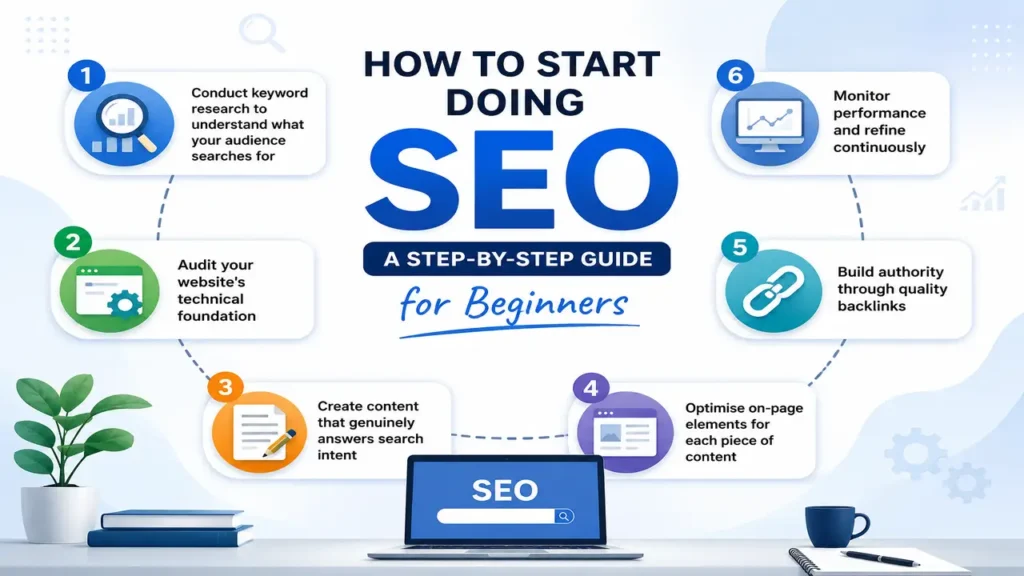
Once you understand what is SEO conceptually, the next question is how to actually start applying it. Here is the process beginners should follow, in order.
Step 1: Conduct keyword research to understand what your audience searches for
Before creating any content, identify the specific terms and phrases your target audience types into Google. Use free tools like Google Keyword Planner or Google Search Console (if you already have traffic) to find keywords with reasonable search volume and manageable competition. A keyword with 49,500 monthly searches and an easy keyword difficulty score, similar to “what is SEO” itself, represents a strong opportunity for newer websites to target. Whamply’s keyword research process identifies these high-opportunity terms systematically rather than relying on guesswork.
Step 2: Audit your website’s technical foundation
Check that your website is mobile-friendly, loads quickly (under 3 seconds ideally), uses HTTPS, and has no major crawl errors. Google Search Console (free) will flag indexing issues, mobile usability problems, and crawl errors that need fixing before content efforts will pay off. A full technical SEO audit goes deeper than Search Console alone, surfacing issues like duplicate content, crawl budget waste, and structured data gaps.
Step 3: Create content that genuinely answers search intent
For each target keyword, understand what the person searching actually wants to find, then create content that answers that question more thoroughly and clearly than what currently ranks. Google’s algorithm increasingly rewards content that demonstrates real expertise and directly satisfies what the searcher is looking for, rather than content stuffed with keywords. Investing in proper SEO content production at this stage is what separates pages that rank from pages that sit on page three indefinitely.
Step 4: Optimise on-page elements for each piece of content
Include your target keyword naturally in the title tag, the first 100 words, at least one header, and throughout the body without forcing it unnaturally. Write a compelling meta description that encourages clicks from the search results page, and add relevant internal links to other pages on your site.
Step 5: Build authority through quality backlinks
Earn backlinks from other reputable websites through genuinely useful content, digital PR, guest contributions, or partnerships. Avoid buying links or using link schemes, since search engines actively penalise manipulative link-building practices and the short-term gains rarely outweigh the long-term risk. A structured link building campaign focused on earning links from relevant, authoritative sites compounds in value over time far more reliably than shortcut tactics.
Step 6: Monitor performance and refine continuously
Use Google Search Console and Google Analytics 4 to track which keywords are driving traffic, which pages are ranking, and where opportunities exist to improve. SEO is not a one-time task. Search engine algorithms change regularly, and ongoing monitoring and refinement, often through a recurring SEO audit, is what separates websites that maintain rankings from those that lose them over time.
Common Mistakes Beginners Make When Learning What Is SEO
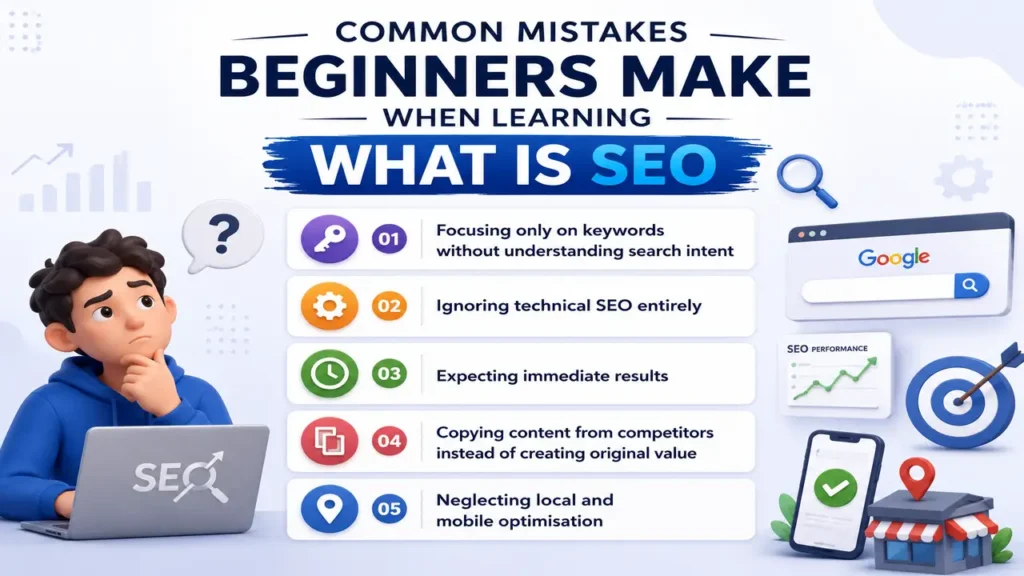
Focusing only on keywords without understanding search intent
Stuffing a page with a target keyword without genuinely answering what the searcher wants produces content that ranks poorly and converts even worse. Search intent, the actual reason behind a search query, matters more than keyword density. Google has become very good at detecting content written for algorithms rather than people.
Ignoring technical SEO entirely
Many beginners focus exclusively on content and skip technical SEO basics like site speed, mobile-friendliness, and proper indexing. A slow, poorly structured website will struggle to rank no matter how good the content is, because search engines cannot crawl and evaluate it efficiently.
Expecting immediate results
SEO is a long-term strategy, not a quick fix. New websites or new content typically take three to six months to start seeing meaningful organic traffic, and competitive keywords can take longer. Beginners who expect results within weeks often abandon SEO efforts prematurely, just before they would have started paying off.
Copying content from competitors instead of creating original value
Closely mimicking a competitor’s content structure and claims, rather than adding genuinely new insight or a different angle, rarely outranks the original. Search engines, and increasingly AI answer engines, favour content that demonstrates unique expertise and provides additional value beyond what already exists. A well-planned content marketing strategy built around genuine audience research consistently outperforms competitor-copying approaches.
Neglecting local and mobile optimisation
The majority of searches, particularly in markets like India, now happen on mobile devices, and many beginners also overlook local SEO entirely when their business depends on local discovery. A website that is not properly optimised for mobile users will see both poor rankings and poor conversion rates, since Google primarily uses mobile-first indexing to evaluate and rank websites.
Conclusion
The most important thing to understand about what is SEO is that it rewards genuine quality and patience over shortcuts and speed. Start with solid technical foundations, create content that truly answers what your audience is searching for, and build authority steadily through legitimate means rather than chasing quick wins that search engines will eventually penalise.
If you are ready to move beyond understanding what is SEO and want a clear, prioritised plan to start ranking, a structured SEO audit will show you exactly where your website stands today and what to fix first. Book a free SEO audit with Whamply Media’s SEO team and get a comprehensive action plan delivered within 48 hours.
Frequently Asked Questions
What is SEO in simple terms?
SEO stands for search engine optimisation, the practice of improving a website so it appears higher in search engine results pages like Google. It involves optimising content, technical site structure, and building authority through backlinks to increase organic, unpaid traffic from search engines.
What does SEO stand for?
SEO stands for search engine optimisation. The term covers the full set of practices used to improve a website’s visibility in organic (non-paid) search engine results, primarily on Google, but also Bing and other search engines.
How does SEO work?
SEO works through three main processes: search engines crawl the web to discover pages, index those pages by analysing and storing their content, and then rank them in search results based on hundreds of factors including relevance, content quality, technical performance, and backlink authority. Websites that satisfy these factors best for a given search query rank higher.
Why is SEO important for a website?
SEO is important because organic search drives the majority of trackable website traffic for most businesses, more than paid search, social media, or direct traffic combined. Good SEO generates consistent, cost-effective traffic over time without the ongoing per-click costs associated with paid advertising channels.
How long does SEO take to work?
SEO typically takes three to six months to show meaningful results for new websites or new content, though this varies based on competition, domain authority, and content quality. Highly competitive keywords and newer domains generally take longer, while niche, low-competition keywords can rank faster.
What is the difference between SEO and SEM?
SEO (search engine optimisation) focuses on improving organic, unpaid rankings in search results. SEM (search engine marketing) is a broader term that includes both SEO and paid search advertising, such as Google Ads. SEO traffic is free once rankings are achieved; SEM paid traffic stops the moment ad spend stops.
What are the three main types of SEO?
The three main types of SEO are technical SEO (crawlability, site speed, mobile-friendliness), on-page SEO (content quality, keyword usage, title tags, internal linking), and off-page SEO (backlinks and external authority signals). All three need to work together for a website to rank well.
What is a keyword in SEO?
A keyword in SEO is a specific word or phrase that people type into a search engine when looking for information, products, or services. Identifying the right keywords, those with meaningful search volume and achievable competition, is a foundational step in any SEO strategy, since content needs to be built around what people are actually searching for.
What are backlinks and why do they matter for SEO?
Backlinks are links from other websites pointing to your website. They matter for SEO because search engines treat them as a signal of trust and authority. Generally, the more high-quality, relevant backlinks a website has, the more authoritative it appears to search engines, which positively influences rankings for competitive keywords.
Can I do SEO myself or do I need an agency?
You can do basic SEO yourself using free tools like Google Search Console, Google Keyword Planner, and Google Analytics, particularly for smaller websites with less competitive keywords. However, competitive industries, larger websites, and businesses wanting faster, more comprehensive results often benefit from working with an SEO agency that has the experience and tools to execute at scale.
What is on-page SEO?
On-page SEO refers to all the optimisation work done directly on a webpage to improve its search engine ranking and relevance, including title tags, header structure, keyword placement, internal linking, content quality, and meta descriptions. It is one of the three core pillars of what is SEO, alongside technical and off-page SEO.
What is technical SEO?
Technical SEO involves optimising the backend structure of a website so that search engines can efficiently crawl, index, and understand it. This includes site speed, mobile-friendliness, secure HTTPS connections, clean URL structures, XML sitemaps, and the elimination of crawl errors or duplicate content issues.
Does SEO still matter with the rise of AI search and chatbots?
Yes, SEO still matters significantly, though it is evolving. AI search tools and chatbots often pull information from well-optimised, authoritative web content, meaning strong SEO fundamentals now also influence visibility in AI-generated answers, not just traditional search results. Businesses with poor SEO foundations are likely to be invisible in both traditional search and AI answer engines.
How much does SEO cost for a small business in India?
SEO costs for small businesses in India typically range from ₹15,000 to ₹75,000 per month for foundational services, with more competitive industries or comprehensive strategies costing ₹1 lakh or more per month. Costs vary based on website size, competition level, and the scope of work, including content production and technical fixes required.