
SEO vs PPC: Which Should Your Business Invest In First
On this page
Most businesses waste the first six months of their digital marketing budget by picking the wrong channel, and the SEO vs PPC debate is usually where that decision goes sideways. Organic search drives 53% of all website traffic globally, yet most small and mid-sized businesses in India still pour the bulk of their budget into paid ads from day one. Neither channel is wrong. But investing in the wrong one first, for your specific situation, is expensive. This article gives you a framework to make that call correctly.
What Is the SEO vs PPC Decision About?
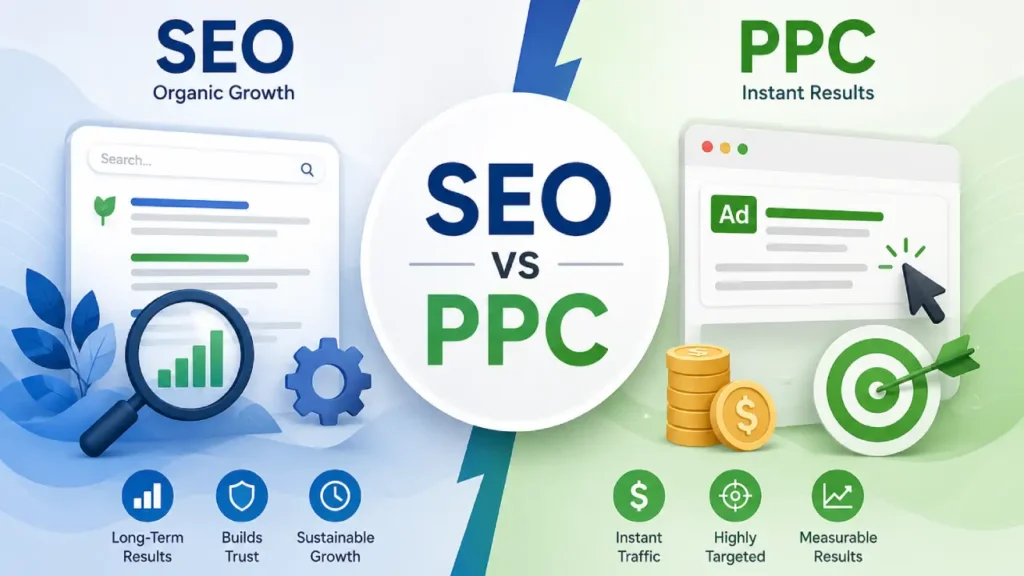
The SEO vs PPC question is about deciding whether to invest in organic search visibility, which builds long-term, compounding traffic through content and technical optimisation, or paid search advertising, which buys immediate placement on search results for a cost per click. SEO typically delivers stronger ROI over 12 to 36 months, while PPC generates traffic within days but stops the moment spend stops. The right first investment depends on your budget, timeline, and business model.
Why the SEO vs PPC Choice Matters More in 2026
The cost of getting this wrong has gone up. According to WordStream’s 2025 Google Ads Benchmarks, the average CPC across all industries on Google Ads has reached $5.26 globally, with 87% of industries seeing year-on-year CPC increases. In India, average CPCs sit between ₹8 and ₹50 for most sectors, but real estate and financial services keywords now command ₹80 to ₹300 per click in metro markets like Delhi and Mumbai. Every rupee spent on the wrong channel at the wrong time is a rupee that could have been compounding elsewhere.
SEO vs PPC is no longer a simple speed-versus-cost argument. With Google’s AI Overviews now appearing in over 13% of search queries, and organic content feeding directly into AI answer engines, the strategic value of long-term SEO has increased significantly. Brands that invested in SEO two years ago are now appearing in AI search results without additional spend.
At the same time, PPC has become more sophisticated. Smart Bidding, Performance Max campaigns, and automated creative generation have lowered the floor for entry. A well-run PPC campaign in India can start generating qualified leads within 72 hours of launch. The question is not which channel works. Both work. The question is which one should absorb your first serious investment.
Understanding SEO: What You Are Actually Buying
When businesses invest in SEO services, they are not buying rankings. They are building a compounding asset. A well-optimised page that reaches position one on Google for a high-intent keyword will generate traffic in month three, month nine, month eighteen, and beyond, without any additional per-click cost. That is the structural advantage of organic vs paid search, and it is why SEO ROI widens the longer you hold the investment.
Here is what the SEO process actually involves and why each stage matters:
- Technical SEO: Site speed, crawlability, mobile optimisation, structured data, and Core Web Vitals all affect how Google processes and ranks your pages. These are the foundations. A technical SEO engagement will typically surface critical issues within the first 30 days.
- On-page SEO: Keyword targeting, content structure, internal linking, and meta optimisation ensure each page is correctly matched to its target search query. On-page SEO handles this systematically across an entire site, not just page by page.
- Off-page SEO and link building: Google treats backlinks as votes of authority. Earning links from credible, relevant domains improves your site’s overall ranking ability. Off-page SEO and link building are among the most impactful and most often neglected components of a long-term SEO strategy.
- Content strategy: SEO without content is infrastructure without a building. SEO content writing creates the topic clusters, pillar pages, and blog content that build the topical authority Google rewards with consistent rankings.
- Local SEO: For businesses serving specific cities or regions in India, Google My Business (GMB) services and local SEO are often the fastest route to qualified organic leads, sometimes producing results within 60 to 90 days.
- E-commerce SEO: Online retailers need category page optimisation, product schema, and crawl efficiency. Shopify SEO is a distinct discipline for DTC brands, not a generic content strategy applied to an online store.
SEO timelines are real and non-negotiable. For competitive keywords in established markets, expect three to six months before meaningful organic traffic arrives. In lower-competition niches or local markets, you may see traction within 60 days. After month six, the curve typically bends upward and the cost per organic lead begins to drop steadily. After 12 months, a well-executed SEO strategy in most Indian B2B and service sectors will produce leads at a fraction of what PPC charges for the same query.
The honest trade-off: SEO demands patience and upfront investment in content and technical work, with no guarantee of an exact ranking position. It is an earned result, not a purchased one.
Understanding PPC: What You Are Actually Buying
When businesses invest in paid ads, they are buying placement and control. PPC is the most direct path from budget to traffic. Launch a Google Ads campaign on a Monday and you can have qualified visitors on your landing page by Wednesday. For a new business, a product launch, or a time-sensitive campaign, that speed is genuinely valuable and cannot be replicated by SEO.
Here is how to think through whether PPC makes sense as your first investment:
- Assess your sales cycle. If you sell a high-ticket service or product with a long decision timeline, PPC can put you in front of high-intent searchers exactly when they are evaluating options. Search Ads work particularly well in India for service businesses where buyers are actively comparing options.
- Calculate your maximum CPA. Before spending a rupee on paid ads, work backwards from your deal value. If a customer is worth ₹50,000 in revenue and your gross margin is 40%, your maximum CPA is ₹20,000. If your industry’s CPL is ₹3,000 and your close rate is 20%, your CPA is ₹15,000. The maths work. If they do not, PPC will drain budget without profit.
- Evaluate your landing page. PPC traffic is only as good as the page it lands on. A conversion-optimised landing page services can be the difference between a 2% and an 8% conversion rate on identical traffic, which is the difference between a profitable and an unprofitable campaign.
- Define your campaign type. Google Search Ads target active searchers. Performance Max campaigns distribute budget automatically across Search, Display, YouTube, Gmail, and Discover. Each serves a different purpose, and mixing them without intent wastes budget.
- Set up conversion tracking before you spend. Without proper conversion events firing in Google Ads and GA4, you are optimising blind. This step is not optional. It is the foundation everything else sits on.
- Plan for a test-and-learn period. Most PPC campaigns take 30 to 60 days before the algorithm has enough conversion data to optimise effectively. Budget for this learning period without expecting full efficiency from week one.
The honest trade-off with PPC: the moment you stop spending, traffic stops. There is no residual value. A brand that has run PPC for two years and paused campaigns will have zero organic traffic from that channel the following month. PPC builds no lasting asset unless you deliberately use campaign data to inform an SEO content strategy running in parallel.
SEO vs PPC: Comparing the Numbers Side by Side
Let us look at the data without bias, because both channels have genuine merits.
On ROI: SEO wins decisively over time. Research by First Page Sage puts median SEO ROI at 748% over a 36-month period, compared to approximately 200% for PPC. The #1 organic result on Google earns a 27.6% click-through rate, while the top paid ad earns 2.1%. Organic leads close at 14.6% on average, while PPC leads close at 3.75%. These numbers reflect the trust gap: roughly 70 to 80% of users actively skip paid ads and click organic results instead.
On speed: PPC wins with no contest. SEO results in competitive markets take three to six months to materialise. PPC delivers traffic on day one. For businesses needing immediate lead flow, there is no SEO vs PPC comparison to be made on this dimension.
On cost per lead in India: SEO’s advantage is significant once momentum builds. The average organic CPL in India, across service-based businesses, typically falls between ₹200 and ₹800 after the six-month mark. PPC CPLs in the same sectors often range from ₹800 to ₹5,000 depending on industry and competition. Real estate and legal sectors in Tier-1 Indian cities sit consistently at the top end of that range for paid search.
On flexibility: PPC wins again. You can pause, scale, redirect, and test with paid ads in real time. SEO strategy changes take weeks or months to reflect in rankings.
The practical answer most experienced digital marketing budget planners reach: use PPC to generate cash flow while SEO builds, then use SEO to reduce dependence on paid ads as it matures. Most well-run agencies recommend a starting allocation of roughly 70% SEO to 30% PPC for businesses in their first year, adjusting based on vertical, competition, and available budget.
SEO vs PPC by Business Type: A Practical Framework
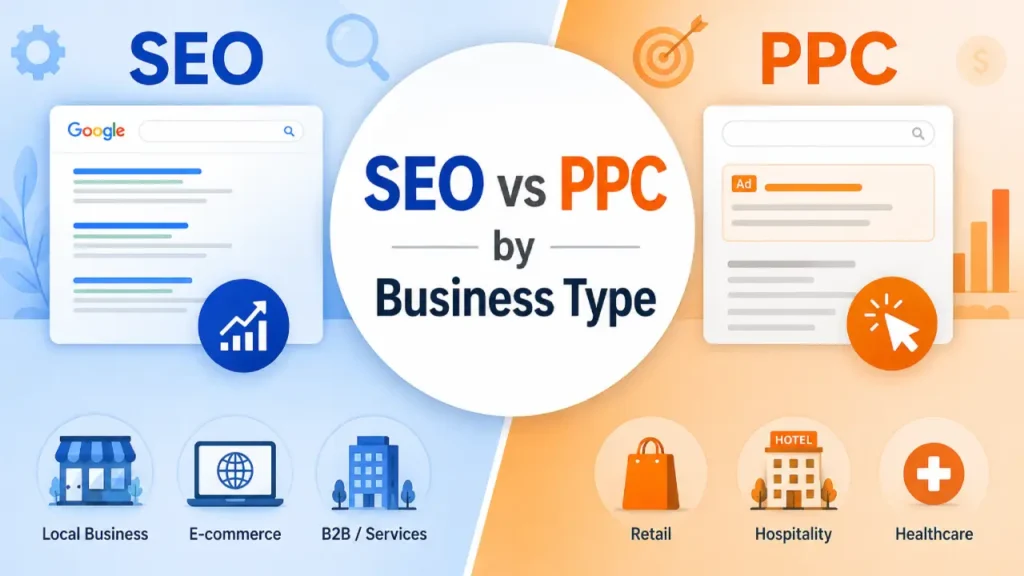
The SEO vs PPC decision is not one-size-fits-all. Different business models, budgets, and goals produce different right answers.
Startups and new websites: Start with PPC for immediate lead validation, but invest in SEO from month one. A new domain has no authority and will take longer to rank, but the content and technical foundation you build in year one pays dividends in year two. Running email lead generation alongside a modest PPC budget creates a resilient early-stage acquisition mix that does not depend entirely on any single paid channel.
Established businesses in competitive verticals: If you are in real estate, healthcare, or financial services in India, PPC alone is becoming financially unsustainable. CPCs in these sectors are rising annually. The businesses that invested in organic search three years ago are now generating leads at a fraction of the cost of their PPC-dependent competitors.
E-commerce businesses: PPC, particularly Shopping Ads and Performance Max, delivers strong short-term ROAS for e-commerce. But category-level SEO, product schema, and site architecture are what separate e-commerce brands that scale sustainably from those perpetually dependent on ad spend. Both channels are essential. A well-structured Shopify development build, done right from the start with SEO in mind, prevents months of expensive technical remediation later.
B2B service businesses: Long sales cycles, high deal values, and research-heavy buyers make SEO the more powerful long-term investment for B2B. A strong blog writing programme that targets problem-aware and solution-aware keywords builds authority with buyers during their research phase, well before they are ready to request a proposal. PPC captures the bottom-of-funnel queries once trust is established.
Local service businesses in India: For a dental clinic, law firm, coaching institute, or interior design firm targeting a specific city, GMB services and local SEO deliver the highest ROI of any channel. A well-optimised Google Business Profile in a mid-competition Indian city can generate 40 to 80 enquiries per month at near-zero ongoing cost. PPC can supplement this, but local SEO should be the foundation.
SaaS companies: SaaS businesses need both channels, and they need AI SEO as an emerging priority. With AI search tools like ChatGPT and Perplexity now influencing software discovery, being cited in AI-generated answers requires the kind of authoritative, well-structured content that a long-term SEO strategy produces. PPC captures high-intent trial and demo requests. SEO and AI SEO build the trust that drives inbound at scale.
Common Mistakes to Avoid in the SEO vs PPC Decision
Treating SEO and PPC as mutually exclusive choices
Most businesses that ask “SEO or PPC?” are framing the question incorrectly. The right question is: “What is the right allocation between SEO and PPC for my budget, timeline, and goals?” Choosing only one channel permanently is rarely optimal. SEO builds the asset. PPC monetises demand while that asset matures. Brands that treat them as competitors rather than complements consistently underperform those that integrate both into a coherent search engine marketing strategy.
Stopping PPC too early because SEO is showing early signs of traction
A common mistake is cutting PPC spend the moment an SEO campaign shows early ranking movement. SEO results are not linear. A page that reaches position eight in month four may drop to position 15 after an algorithm update in month five, then recover to position three in month seven. Cutting paid leads during that volatility creates damaging gaps in your pipeline. Maintain PPC at a sustainable level until SEO is consistently delivering enough qualified volume to cover your targets.
Running PPC without a conversion-ready landing page
Sending paid traffic to a homepage or a generic service page is one of the most expensive PPC mistakes. Conversion is where most budgets fail. A dedicated landing page with a single CTA, relevant social proof, and a fast load time is not optional for a profitable PPC campaign. Website speed optimisation alone, often overlooked, can lift landing page conversion rates meaningfully and reduce effective CPL without changing a single ad.
Measuring SEO success on the wrong timeline
Business owners who evaluate SEO after 60 days and declare it unsuccessful are measuring a three-year investment on a two-month timeline. The right milestones for SEO are: technical issues resolved in month one, first rankings appearing in months two to three, meaningful traffic growth in months four to six, and compounding lead volume from month seven onwards. Applying PPC measurement expectations to SEO will produce inaccurate conclusions every time.
Ignoring search intent when allocating budget between channels
Not all keywords belong in both channels. Informational queries are better served by SEO content that educates and builds trust. Transactional queries are where PPC earns its keep with high-intent, bottom-of-funnel placement. Allocating PPC budget to informational queries wastes spend. An SEO consultation at the strategy stage is the most efficient way to map your keyword universe to intent before committing budget to either channel.
Conclusion
The SEO vs PPC decision comes down to two things: your timeline and your ability to wait. If you need leads within 30 days, start with PPC and build SEO alongside it. If you have six months of runway and are thinking about the next three years, put SEO at the centre of your digital marketing budget and use PPC selectively to fill gaps. If you can fund both properly, do it. The data is consistent across studies: businesses that integrate organic and paid search consistently outperform those that commit to only one channel.
Before allocating serious budget to either channel, the most valuable thing you can do is understand exactly where your search presence stands right now.
Book a free audit services with Whamply and get a full review of your organic rankings, Google Ads account structure, and keyword gap analysis, delivered within 48 hours with a prioritised action plan your team can act on immediately.
Frequently Asked Questions
What is the main difference between SEO and PPC?
SEO earns visibility in organic search results through content, technical improvements, and backlinks, with no per-click cost. PPC purchases placement in paid search results, with a cost charged every time a user clicks. SEO builds long-term compounding traffic. PPC delivers immediate, controllable traffic that stops when spend stops.
Which is better for a new business, SEO or PPC?
For a brand new business, PPC is typically the better first investment because it generates traffic and leads immediately, while SEO takes three to six months to produce results. However, SEO should be started concurrently, even at a modest level, because building domain authority early pays compounding dividends in years two and three.
Is SEO cheaper than PPC?
Over a 12 to 36 month horizon, SEO is significantly cheaper per lead than PPC. Research from First Page Sage puts average organic CPL at $14 compared to $44 for PPC globally. In India, organic CPLs in service sectors typically fall to ₹200 to ₹800 after the SEO strategy matures, versus ₹800 to ₹5,000 for PPC in competitive verticals.
How long does SEO take to show results?
In most competitive markets, meaningful organic traffic from SEO begins appearing between months three and six. Local SEO in lower-competition Indian markets can show results in 60 to 90 days. Full ROI from an SEO investment typically becomes visible between months 9 and 18.
Does PPC help SEO rankings?
PPC does not directly influence organic search rankings. Google’s algorithm does not factor in ad spend when determining organic positions. However, PPC indirectly supports SEO by providing keyword conversion data that helps prioritise SEO content investments, and by building brand awareness that can increase branded organic search volume over time.
What is a good digital marketing budget split between SEO and PPC?
A commonly recommended starting split for businesses with enough budget to run both channels is 70% SEO and 30% PPC. This reflects SEO’s superior long-term ROI while maintaining a paid channel for immediate lead flow during the SEO build period. The ratio should shift further toward SEO as organic traffic matures.
Which delivers better ROI, SEO or PPC?
SEO delivers better ROI over a 12 to 36 month period, with median ROI measured at 748% versus approximately 200% for PPC (First Page Sage, 2026). PPC delivers stronger short-term ROI in the first three to six months when SEO has not yet gained traction. The best long-term ROI comes from running both channels in an integrated search engine marketing strategy.
Is PPC worth it in India given the lower CPCs?
Yes. India’s lower average CPCs (₹8 to ₹50 for most sectors) make PPC more accessible for small and mid-sized businesses than in Western markets. However, CPCs in competitive Indian industries like real estate, finance, and legal are rising annually. The lower CPC environment makes India a particularly good market to test PPC early while building an SEO foundation.
Can I do SEO without PPC?
Yes. Many businesses run highly successful SEO-only strategies, particularly in content-heavy niches, local service markets, and B2B sectors with long buying cycles. The trade-off is a slower start to lead flow and dependence on the SEO timeline, which can be challenging for businesses that need revenue quickly.
Can I do PPC without SEO?
Yes, and many businesses do. But PPC without SEO creates total dependence on paid traffic channels. If ad costs rise, platforms change their policies, or budgets get cut, leads stop immediately. Businesses built entirely on PPC have no organic traffic asset to fall back on.
How do I know which keywords to target through SEO vs PPC?
Use search intent as the primary filter. Informational keywords are better suited to SEO content. Transactional keywords are where PPC earns faster returns. Competitive research using tools like Ahrefs, SEMrush, or Google’s Keyword Planner helps identify which terms competitors are ranking for organically versus bidding on in paid ads.
Does SEO work for e-commerce businesses?
Absolutely. E-commerce SEO covering product schema, category page optimisation, and technical site architecture is one of the highest-ROI long-term investments an online store can make. It works best alongside PPC: Shopping Ads deliver immediate product visibility while SEO builds category authority that reduces long-term CPA.
What happens to my SEO if I run PPC at the same time?
Running PPC alongside SEO does not harm your organic rankings. In fact, the two channels reinforce each other. PPC data reveals which ad copy and keywords convert best, informing your SEO content strategy. Appearing in both organic and paid positions for the same query increases total SERP visibility and brand trust.
Is local SEO better than PPC for small businesses in India?
For most local businesses targeting a specific city or region, local SEO and Google My Business optimisation deliver the best long-term ROI. A well-optimised local presence can generate consistent enquiries at near-zero ongoing cost after the initial setup. PPC can supplement local SEO for high-priority keywords or seasonal demand spikes.
How do I measure whether my SEO vs PPC investment is working?
For SEO: track organic traffic growth in GA4, keyword ranking positions, and organic-attributed leads from your CRM. For PPC: track cost per click, cost per conversion, and ROAS. The most important metric for both is cost per qualified lead, tracked through to pipeline and closed revenue, not just form fills.