
SEO Glossary 2026: 200+ Terms Every SEO Must Know
On this page
Google’s ranking algorithm uses over 200 known signals to decide which pages rank on page one, and misunderstanding even a handful of the terms behind those signals leads to wasted budget and effort in the wrong places. This SEO glossary covers more than 200 SEO terms used daily by practitioners, from crawl budget and canonical tags to E-E-A-T and zero-click searches. Whether you are new to SEO or building a team that needs a shared reference, this SEO dictionary is the definitive starting point. Every definition in this SEO glossary is written for clarity, not to impress with jargon.
What Is an SEO Glossary?
An SEO glossary is a structured reference guide that defines the key terms, concepts, abbreviations, and technical vocabulary used in the practice of search engine optimisation. A comprehensive SEO glossary covers all major areas of SEO, including technical SEO, on-page optimisation, off-page and link building, content strategy, analytics, and algorithm updates, with plain-English definitions that practitioners at any level can apply immediately.
Why an SEO Glossary Matters in 2026
SEO has become more technically complex with every passing year. What was once a discipline focused primarily on keyword placement now spans server-side rendering, Core Web Vitals, structured data, entity-based search, and AI-generated search results. Teams without a shared SEO vocabulary make expensive mistakes, from blocking Googlebot by accident to confusing correlation with causation in analytics reporting.
According to BrightEdge research, organic search drives 53% of all trackable website traffic, making it the single largest acquisition channel for most businesses. Investing in structured SEO services rather than ad-hoc tactics is what separates brands that build lasting organic visibility from those that chase short-term ranking gains. Every percentage point of organic visibility lost or gained translates directly into revenue, which is why fluency in SEO terminology is a business competency, not just a technical nicety.
In India, where SEO spend ranges from ₹20,000 to several lakhs per month depending on company size, misaligned terminology between clients and agencies has been a consistent source of wasted investment. When a client asks for “more backlinks” without understanding the difference between a dofollow and nofollow link, or when an SEO team talks about “domain authority” without clarifying whether they mean a third-party metric or an actual Google signal, the result is mismatched expectations and poor results. This SEO glossary exists to close that gap.
The Complete SEO Glossary: A to Z Definitions
A
Above the Fold
The portion of a webpage visible to the user without scrolling. Content placed above the fold receives more attention and engagement than content below it. In search engine optimisation, critical page elements like headlines, CTAs, and value propositions should appear above the fold.
Algorithm
A set of rules and calculations search engines use to rank web pages. Google’s algorithm uses over 200 ranking signals and is updated thousands of times per year. Major confirmed updates include Panda, Penguin, Hummingbird, BERT, and the Helpful Content Update.
Anchor Text
The clickable, visible text of a hyperlink. In SEO vocabulary, anchor text matters because it signals to search engines what the linked page is about. Over-optimised anchor text (too many exact-match links) can trigger spam filters.
AMP (Accelerated Mobile Pages)
An open-source framework developed by Google to create fast-loading mobile web pages. AMP pages are stripped-down HTML versions of standard pages. Google no longer gives preferential ranking treatment to AMP pages following the Core Web Vitals update.
Authority
A measure of how trustworthy and credible a website or page appears to search engines, based primarily on backlink quality and quantity. Authority is not an official Google metric but is approximated by third-party tools using proprietary formulas.
Alt Text (Alternative Text)
A written description added to image HTML tags that describes the visual content. Alt text helps search engines understand images, improves accessibility for visually impaired users, and contributes to image search rankings.
AI Overviews
Google’s AI-generated answer summaries displayed at the top of some search results pages, pulling information from multiple sources. Optimising content for AI Overviews is an emerging area of SEO definitions that involves structured, authoritative, clearly cited content.
B
Backlink
A hyperlink from one website pointing to another. Backlinks are one of the strongest ranking signals in Google’s algorithm. High-quality, topically relevant backlinks from authoritative sites carry more weight than links from low-authority or irrelevant sources.
Bounce Rate
The percentage of sessions where a user visits a single page and leaves without interacting further. A high bounce rate can indicate poor page relevance, slow load times, or a mismatch between the searcher’s intent and the page content. In GA4, this metric is replaced by “Engaged Sessions.”
Black Hat SEO
SEO practices that violate Google’s Webmaster Guidelines, including keyword stuffing, cloaking, paid link schemes, and private blog networks. Black hat SEO may produce short-term ranking gains but typically results in manual penalties or algorithmic suppression.
Breadcrumb Navigation
A secondary navigation structure that shows users their location within a website hierarchy. Breadcrumbs appear in search results as structured data and improve both user experience and crawl efficiency.
Brand Signal
An indirect ranking factor based on branded search volume, brand mentions across the web, and social media presence. Strong brand signals indicate to Google that a site is a legitimate, recognised entity.
Bot / Crawler
An automated programme used by search engines to discover, crawl, and index web content. Googlebot is the primary crawler for Google’s search index. Also referred to as a spider or web crawler in SEO terms.
C
Canonical Tag (rel=canonical)
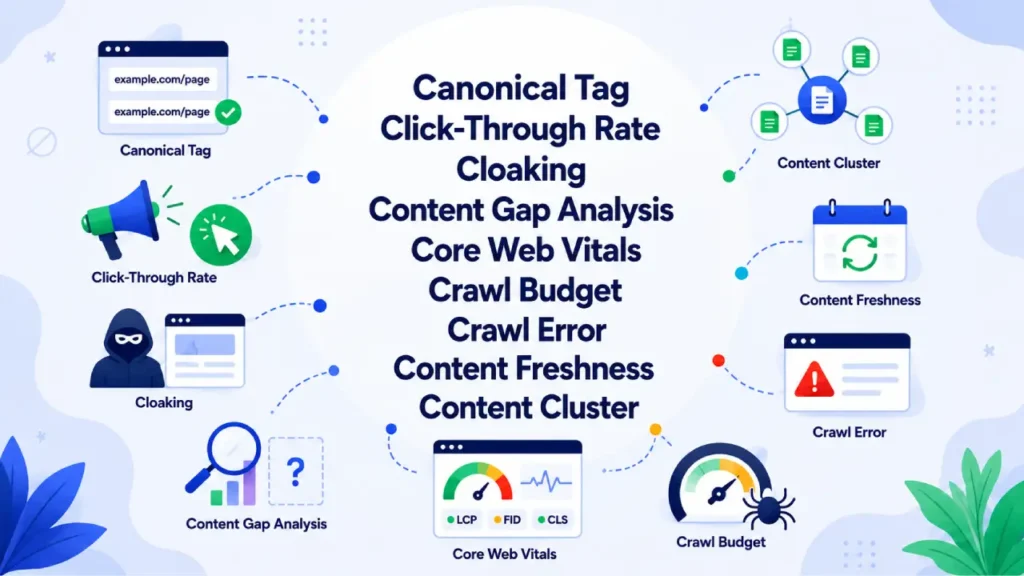
An HTML element that tells search engines which version of a page is the “preferred” or “master” version when duplicate or near-duplicate content exists. Using canonical tags correctly prevents duplicate content penalties and consolidates ranking signals.
Click-Through Rate (CTR)
The percentage of users who click on a search result after seeing it in the SERP. CTR is calculated as clicks divided by impressions. Higher CTR signals relevance and can indirectly influence rankings over time.
Cloaking
A black hat SEO technique where the content shown to search engine crawlers differs from the content shown to human users. Cloaking violates Google’s guidelines and can result in permanent deindexing.
Content Gap Analysis
The process of identifying topics and keywords that competitors rank for but your site does not. Content gap analysis informs content planning by revealing missed opportunities within a competitive landscape.
Core Web Vitals
A set of three user experience metrics introduced by Google as ranking signals: Largest Contentful Paint (LCP), Interaction to Next Paint (INP), and Cumulative Layout Shift (CLS). These measure loading speed, interactivity, and visual stability respectively.
Crawl Budget
The number of pages Googlebot will crawl on a given website within a specific timeframe. Large sites with crawl budget issues may have important pages left uncrawled and unindexed. Managing crawl budget involves reducing crawl waste on low-value URLs.
Crawl Error
A problem encountered by a search engine crawler when attempting to access a URL. Common crawl errors include 404 (page not found), server errors (5xx), and redirect loops. Crawl errors are reported in Google Search Console.
Content Freshness
A ranking signal that considers how recently content was published or updated. Google favours fresh content for time-sensitive queries but values established, comprehensive content for evergreen topics.
Content Cluster
A content strategy model where a central “pillar” page covers a broad topic comprehensively, supported by multiple cluster pages targeting specific subtopics. Content clusters signal topical authority to search engines.
D
DA (Domain Authority)
A third-party metric developed by Moz that predicts a website’s ranking ability on a scale of 1 to 100. Domain Authority is not a Google metric. Google uses its own internal signals to evaluate site authority.
Dead Link
A hyperlink pointing to a URL that no longer exists or returns an error. Dead links create poor user experiences and waste crawl budget. Identifying and fixing dead links is a standard part of technical SEO maintenance.
Deep Link
A backlink pointing to a specific internal page of a website rather than the homepage. Deep links are generally more valuable for SEO purposes because they distribute link authority directly to the target content.
Deindexing
The removal of a page or entire website from Google’s index, either voluntarily (through a noindex tag) or as a penalty for guideline violations. Deindexed pages cannot appear in search results.
Disavow
A Google Search Console tool that allows website owners to tell Google to ignore specific backlinks when evaluating their site. Disavowing links is appropriate when a site has acquired toxic or manipulative backlinks that may trigger a penalty.
Dofollow Link
A standard hyperlink that passes link equity (ranking power) from the linking page to the linked page. Dofollow links are the primary currency of off-page SEO. All links default to dofollow unless a nofollow attribute is added.
Duplicate Content
Identical or near-identical content appearing at multiple URLs. Duplicate content can confuse search engines about which version to index and rank, diluting ranking signals. Canonical tags and 301 redirects are used to resolve duplicate content issues.
Dynamic Rendering
A technique where a server detects whether the visitor is a crawler or a human and serves different versions of a page accordingly. Used for JavaScript-heavy sites where content may not be visible to crawlers. Not considered cloaking when implemented correctly.
E
E-E-A-T (Experience, Expertise, Authoritativeness, Trustworthiness)
Google’s quality evaluation framework used by its human quality raters. E-E-A-T is especially important for YMYL (Your Money or Your Life) content, such as health, finance, and legal topics. Strong E-E-A-T signals include author credentials, citations, and transparent sourcing.
Engagement Rate
In GA4, this metric measures sessions where a user spent at least 10 seconds, had a conversion event, or visited at least two pages. It replaced bounce rate as the primary engagement signal in Google’s analytics platform.
Entity
In SEO definitions, an entity is a distinct, well-defined object such as a person, place, organisation, or concept that Google’s Knowledge Graph recognises. Entity-based SEO focuses on being clearly associated with specific entities rather than just keyword strings.
External Link
A hyperlink pointing from one website to a different domain. External links from high-authority sites are the foundation of off-page SEO. External links from your site to authoritative sources also signal quality and topical depth to search engines.
F
Featured Snippet
A highlighted answer box that appears at the top of Google search results, pulling a short extract directly from a webpage to answer a search query. Featured snippets appear for approximately 8% of searches and are a primary target for structured, clearly formatted content.
Follows / Nofollow
HTML link attributes that instruct search engines whether to pass link equity through a link. Dofollow links pass equity; nofollow links do not. Other link attribute values include “sponsored” (for paid links) and “ugc” (for user-generated content links).
Fresh Content
Updated or newly published content that signals currency to search engines. The frequency with which Google recrawls a page often correlates with how frequently that page is updated.
G
Google Search Console (GSC)
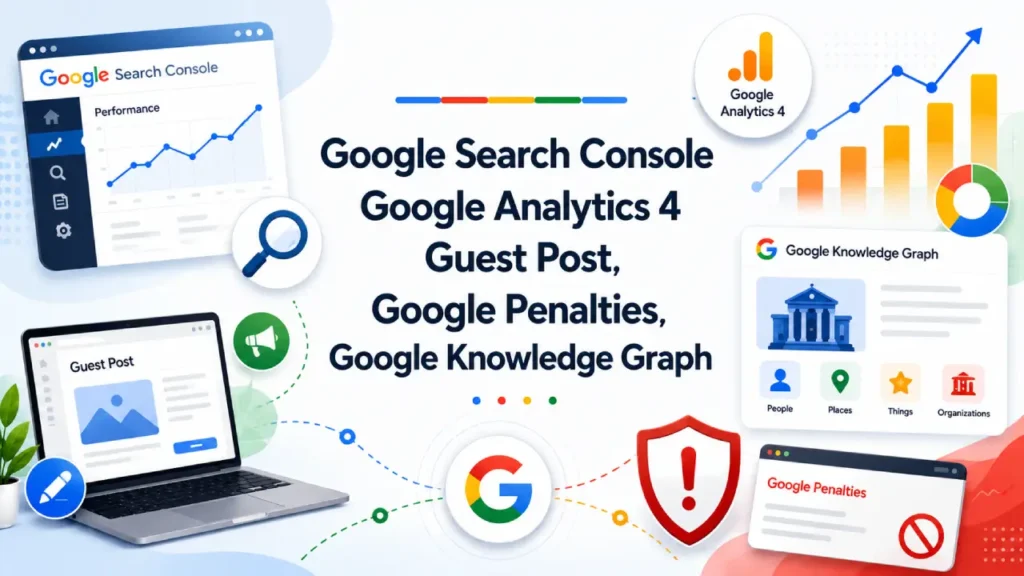
A free tool provided by Google that allows website owners to monitor organic search performance, index coverage, Core Web Vitals, manual actions, and crawl stats. Google Search Console is the most essential free tool in any SEO practitioner’s toolkit.
Google Analytics 4 (GA4)
Google’s current analytics platform, which replaced Universal Analytics in July 2023. GA4 uses an event-based data model, includes cross-device tracking, and integrates with Google Ads and Search Console for attribution analysis.
Guest Post
Content published on a third-party website, typically by an outside contributor. Guest posts are a common link building technique when they include a backlink to the author’s site. Google distinguishes between editorial guest posts (acceptable) and paid guest posts placed purely for links (against guidelines).
Google Penalties
Actions taken by Google against websites that violate its Webmaster Guidelines. Penalties can be manual (reviewed by a human at Google) or algorithmic (triggered automatically by algorithm updates). Penalties result in ranking drops or complete deindexing.
Google Knowledge Graph
A knowledge base Google uses to understand relationships between entities, people, places, and things. Appearing in the Knowledge Graph (via a Knowledge Panel) is a strong trust signal for branded search queries.
H
Heatmap
A visual representation of user behaviour on a webpage, showing where users click, move their cursor, and scroll. Heatmaps from tools like Hotjar or Microsoft Clarity are widely used in conversion rate optimisation and SEO vocabulary to understand how visitors interact with content, informing both UX improvements and on-page SEO refinements.
Hreflang
An HTML attribute that tells search engines which language and regional version of a page to serve to users in specific locations. Hreflang is essential for international SEO on multilingual websites.
HTTP vs HTTPS
HTTP (Hypertext Transfer Protocol) is the standard for data transfer between browsers and servers. HTTPS adds an SSL/TLS encryption layer, which Google confirmed as a minor ranking signal in 2014. Virtually all modern websites should use HTTPS.
Hilltop Algorithm
An early Google algorithm component that identified “expert pages” as key nodes in the link graph. While largely superseded, it influenced how Google evaluates topical authority, a concept that remains central to modern SEO vocabulary.
I
Index
Google’s massive database of web pages that have been discovered, crawled, and evaluated as worthy of inclusion in search results. Only indexed pages are eligible to appear in SERPs. Checking index status is done through the URL Inspection tool in Google Search Console.
Indexability
Whether a page can be crawled and added to Google’s index. Pages blocked by noindex tags, robots.txt disallow rules, or password protection are not indexable. Checking indexability is a core part of technical SEO auditing.
Internal Link
A hyperlink pointing from one page on a domain to another page on the same domain. Internal links distribute page authority across a site, help search engines understand site structure, and guide users to related content.
INP (Interaction to Next Paint)
One of Google’s Core Web Vitals metrics, measuring how quickly a page responds to user interactions. INP replaced FID (First Input Delay) as a Core Web Vitals metric in March 2024.
J
JavaScript SEO
The practice of ensuring that content rendered via JavaScript is accessible to search engine crawlers. Since Googlebot processes JavaScript in a separate, delayed crawl queue, JavaScript-heavy pages can face indexing delays. JavaScript SEO is an increasingly important area of technical SEO definitions.
K
Keyword
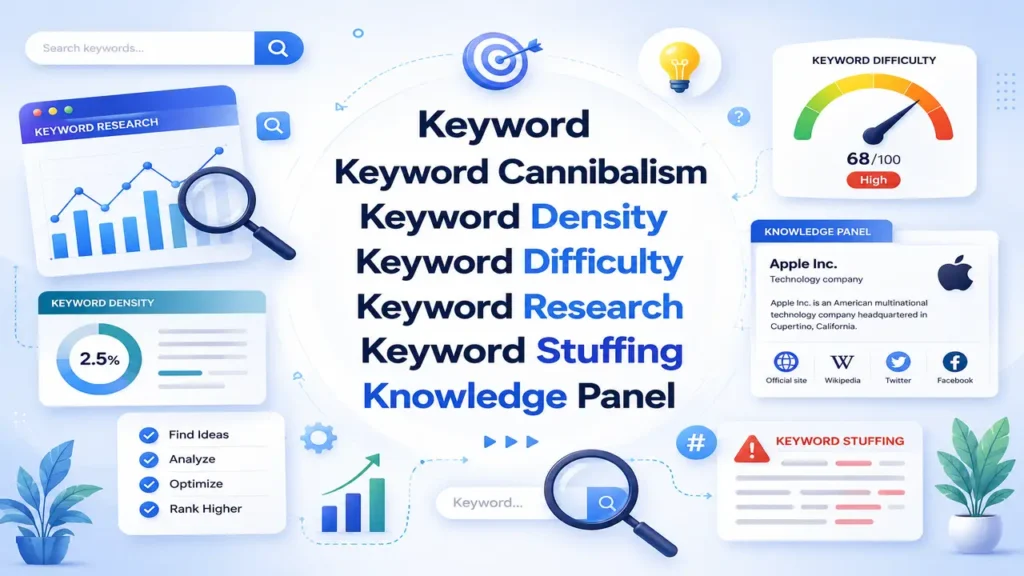
A word or phrase that users type into search engines to find information. Keywords are the foundation of SEO strategy, informing content creation, on-page optimisation, and competitive analysis.
Keyword Cannibalism
When multiple pages on the same website compete for the same keyword, splitting ranking signals and weakening the performance of both pages. Resolving keyword cannibalism involves consolidating competing pages or clearly differentiating their intent targeting.
Keyword Density
The percentage of times a keyword appears on a page relative to total word count. Keyword density is no longer a reliable SEO signal; search engines now evaluate semantic relevance and topic coverage rather than raw frequency.
Keyword Difficulty (KD)
A third-party metric that estimates how hard it would be to rank on page one for a specific keyword, based on the authority of pages currently ranking. Keyword difficulty scores are available in tools like Ahrefs, Semrush, and Moz.
Keyword Research
The process of discovering what search terms your target audience uses and evaluating their volume, competition, and relevance. Keyword research is the starting point for all SEO content strategy. Whamply’s keyword research process maps full topic clusters rather than individual terms, revealing the full landscape of ranking opportunities within a niche.
Keyword Stuffing
The practice of excessively repeating keywords in content or metadata in an attempt to manipulate rankings. Keyword stuffing is a black hat technique that Google actively penalises.
Knowledge Panel
An information box that appears in Google search results, typically on the right side of the SERP, for recognised entities such as businesses, people, and organisations. Knowledge Panels are populated from the Google Knowledge Graph.
L
Landing Page
A standalone web page designed to receive traffic from a specific source, typically a search query or ad campaign, with a clear conversion goal. In SEO vocabulary, landing pages are optimised for both relevance to the target keyword and conversion rate.
LCP (Largest Contentful Paint)
A Core Web Vitals metric measuring the time it takes for the largest visible content element (usually a hero image or heading) to load. Google’s recommended threshold is under 2.5 seconds.
Link Building
The practice of earning or acquiring backlinks from external websites to improve a site’s authority and search rankings. Link building is a core component of off-page SEO and includes tactics such as digital PR, guest posting, and content-led outreach. A structured link building campaign focused on topically relevant, high-authority sources produces compounding ranking improvements over time.
Link Equity (Link Juice)
The ranking power passed from one page to another through a hyperlink. Dofollow links pass link equity; nofollow links do not. Link equity is distributed across all outgoing links on a page.
Link Profile
The complete set of backlinks pointing to a website or page. A healthy link profile is diverse (links from varied domains), relevant (links from topically related sites), and earned (not purchased or manufactured through spam).
Link Velocity
The rate at which a website acquires new backlinks over time. An unnaturally rapid increase in link velocity can be a red flag for Google’s spam detection systems.
Local SEO
A branch of search engine optimisation focused on improving visibility in local search results, including Google Maps and the Local Pack. Local SEO involves optimising a Google Business Profile, managing citations, and earning local reviews. Whamply’s local SEO services are specifically designed for Indian businesses targeting city-level and neighbourhood-level search visibility.
Log File Analysis
The analysis of web server log files to understand how Googlebot and other crawlers interact with a website, including which pages are crawled, how frequently, and where crawl budget is being spent. Log file analysis is an advanced technical SEO technique.
Long-Tail Keyword
A longer, more specific search query with lower individual search volume but higher intent and often lower competition. Long-tail keywords collectively account for the majority of all search queries. They are a central concept in SEO vocabulary for content strategy.
M
Manual Action
A penalty applied manually by a member of Google’s webspam team after reviewing a site for guideline violations. Manual actions are reported in Google Search Console under “Security and Manual Actions.” Common triggers include unnatural link patterns and thin content.
Meta Description
An HTML attribute that provides a summary of a page’s content. Meta descriptions appear as the descriptive text beneath a page title in search results. They do not directly influence rankings but affect click-through rate.
Meta Title (Title Tag)
An HTML element that specifies the title of a web page. The title tag appears as the clickable headline in search results and is one of the most important on-page SEO elements. Titles should include the target keyword and stay under 60 characters.
MFA (Made for Advertising)
A Google quality rating term for low-quality websites built primarily to display ads, with thin or automatically generated content. MFA sites are targeted by Google’s Helpful Content system.
Mobile-First Indexing
Google’s approach of using the mobile version of a website as the primary version for crawling and indexing. All new sites are indexed mobile-first. Sites without mobile-optimised versions may have indexing issues and ranking disadvantages.
N
NAP (Name, Address, Phone Number)
The three core pieces of business information that must be consistent across all online directories, citations, and listings for effective local SEO. Inconsistent NAP data can harm local search rankings.
Nofollow
An HTML attribute applied to a link that instructs search engines not to pass link equity to the linked page. Nofollow links do not contribute directly to rankings but may still drive referral traffic. Common on user-generated content, paid links, and comments.
Noindex
A meta tag or HTTP header directive that instructs search engines not to index a specific page. Noindex tags are commonly used on admin pages, duplicate content, and staging environments that should not appear in search results.
Niche
A specific, focused market segment. In SEO vocabulary, targeting a niche means focusing content and link building efforts on a narrow topical area rather than competing across broad categories, often producing faster ranking results for newer sites.
O
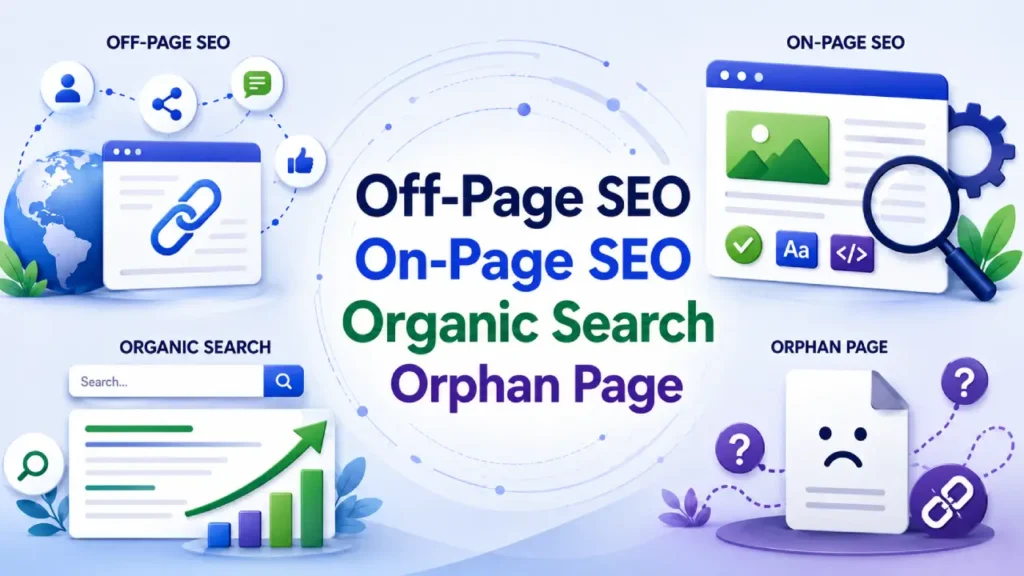
Off-Page SEO
All SEO activities conducted outside of a website, primarily link building, digital PR, and brand mentions. Off-page SEO signals help search engines evaluate a site’s authority, trustworthiness, and relevance beyond its own content.
On-Page SEO
Optimisation work carried out directly on a webpage, including title tags, meta descriptions, headers, content quality, keyword placement, internal linking, and image alt text. On-page SEO directly communicates relevance to search engines. Whamply’s on-page SEO services cover title tags, header structure, internal linking, and content depth across entire site sections rather than page by page.
Organic Search
Unpaid search engine results driven by relevance and authority rather than advertising spend. Organic search is the primary focus of SEO activity and consistently delivers more traffic than Google Ads and other paid search channels for most websites over a 12-month horizon, particularly once domain authority and content depth are established.
Orphan Page
A page with no internal links pointing to it from other pages on the same site. Orphan pages are difficult for search engine crawlers to discover and receive no internal link equity, limiting their ranking potential.
P
Page Authority
A Moz-developed metric that predicts the likelihood of a specific page ranking in search results, on a scale of 1 to 100. Page Authority is not an official Google metric.
Page Experience
A set of signals Google uses to evaluate how users experience a webpage, including Core Web Vitals, mobile-friendliness, HTTPS, and intrusive interstitial penalties. Page Experience is a confirmed ranking factor introduced in 2021.
PageRank
Google’s original algorithm for evaluating the authority of web pages based on the number and quality of backlinks pointing to them. PageRank, named after Google co-founder Larry Page, was the foundation of Google’s ranking system and remains influential, though its internal workings are now far more complex.
Pagination
The division of website content across multiple pages, such as page 1, page 2, and page 3 of a blog or product category. Handling pagination correctly in SEO involves proper use of canonical tags or load-more patterns to avoid duplicate content issues.
Pillar Page
A comprehensive piece of content that covers a broad topic in depth and acts as the hub for a content cluster. Pillar pages link out to cluster pages that cover specific subtopics in greater detail. Building pillar pages is a core part of any content marketing strategy that aims to establish topical authority in a competitive niche.
PBN (Private Blog Network)
A network of websites created specifically to build backlinks to a target site. PBNs are a black hat SEO technique that violates Google’s guidelines. Sites caught using PBNs can receive severe ranking penalties or deindexing.
R
Ranking Factor
Any signal that Google’s algorithm uses to determine the position of a page in search results. Confirmed ranking factors include content relevance, backlink authority, page experience, mobile-friendliness, and page speed.
Redirect
An instruction that sends users and crawlers from one URL to another. A 301 redirect is permanent and passes full link equity to the destination URL. A 302 redirect is temporary and typically does not pass full equity.
Robots.txt
A text file in a website’s root directory that provides instructions to search engine crawlers about which pages or sections they are allowed or not allowed to crawl. Incorrectly configured robots.txt files can accidentally block entire sections of a site from being crawled.
Rich Snippet
An enhanced search result that includes additional information such as star ratings, pricing, event dates, or FAQs, generated from structured data (schema markup) on the page. Rich snippets improve visibility and click-through rates in search results.
S
Schema Markup (Structured Data)
Code added to a page’s HTML that helps search engines understand the content and context of the page. Common schema types include Article, FAQ, Product, Review, Local Business, and Event. Schema markup can trigger rich snippets in search results.
Search Intent
The underlying reason behind a search query, categorised as informational (seeking information), navigational (looking for a specific site), commercial (researching before purchase), or transactional (ready to buy). Matching content to search intent is one of the most critical SEO ranking factors.
Search Volume
The average number of times a keyword is searched per month within a given location. Search volume is a key metric in keyword research for understanding the size of the audience a keyword represents.
SERP (Search Engine Results Page)
The page displayed by a search engine in response to a search query, containing organic results, paid ads, featured snippets, People Also Ask boxes, local packs, and other rich features.
Site Architecture
The organisation and hierarchy of pages within a website. Good site architecture makes it easy for both users and search engines to navigate a site and find content. Flat architectures (fewer clicks to reach any page) are generally preferred for SEO.
Sitemap (XML Sitemap)
A file that lists all the important URLs on a website and provides metadata about each page. Submitting an XML sitemap through Google Search Console helps Googlebot discover and index pages more efficiently.
Spam Score
A third-party metric from Moz that estimates the proportion of sites with similar link profiles that have been penalised by Google. Spam score is not an official Google metric but is useful for evaluating link profile risk.
SERP Features
Non-standard elements in search results beyond ten blue links, including featured snippets, knowledge panels, image packs, video carousels, People Also Ask boxes, local packs, and AI Overviews. Appearing in SERP features often drives more traffic than ranking in position one of standard organic results.
T
Technical SEO
The branch of SEO focused on improving website infrastructure to ensure search engines can efficiently crawl, index, and understand a site. Technical SEO covers areas including site speed, mobile-friendliness, crawl budget, indexation, structured data, and HTTPS. A full technical SEO audit is the standard starting point for identifying infrastructure issues that prevent pages from ranking regardless of content quality.
Thin Content
Content with little to no value for users, typically very short, auto-generated, or copied from other sources. Thin content is targeted by Google’s algorithms and quality raters, and it can drag down the overall quality assessment of an entire website.
Title Tag
See Meta Title.
Topical Authority
A website’s perceived expertise and depth of coverage within a specific subject area. Topical authority is built through consistent, comprehensive content production on related topics, and it is increasingly important for ranking competitively in a given niche.
Trust Flow
A Majestic-developed metric that measures the quality of backlinks pointing to a website based on proximity to trusted seed sites. Trust Flow is not an official Google metric but is widely used as a proxy for link quality evaluation.
U
URL Structure
The format and organisation of a website’s web addresses. Clean, descriptive URL structures (such as /seo-glossary rather than /page?id=4872) are easier for users to understand and help search engines interpret page content.
User Experience (UX)
The overall experience a visitor has when interacting with a website, including navigation, readability, load speed, mobile responsiveness, and accessibility. Google’s Page Experience ranking signals are largely derived from UX quality metrics.
User-Generated Content (UGC)
Content created by website users rather than the site itself, including comments, reviews, and forum posts. UGC links should carry the “ugc” rel attribute. UGC can introduce low-quality or spammy content risks if not moderated.
V
Voice Search
Search queries made using voice commands through devices like smartphones, smart speakers, and virtual assistants. Voice search queries tend to be longer and more conversational than typed queries, influencing how some SEO practitioners approach content optimisation.
W
White Hat SEO
SEO practices that comply with Google’s Webmaster Guidelines and focus on building genuine value for users. White hat SEO produces sustainable, long-term rankings. Examples include producing high-quality content, earning legitimate backlinks, and fixing technical issues.
Web Vitals
Google’s set of metrics for measuring real-world user experience on the web, focused on loading (LCP), interactivity (INP), and visual stability (CLS). Core Web Vitals are a confirmed ranking factor in Google’s Page Experience signals.
X
XML Sitemap
See Sitemap.
Y
YMYL (Your Money or Your Life)
A category of content that Google holds to higher E-E-A-T standards because it could significantly affect a user’s health, financial stability, safety, or happiness. Examples include medical advice, financial guidance, legal information, and news. For brands in these categories, building E-E-A-T through credentialed authors and authoritative citations is as important as any performance marketing investment in terms of long-term brand trust.
Z
Zero-Click Search
A search query where the user finds the answer directly in the SERP, without clicking through to any website. Featured snippets, knowledge panels, and AI Overviews drive zero-click searches. Understanding zero-click behaviour is increasingly important for SEO strategy in 2026.
How to Use This SEO Glossary Effectively
This SEO dictionary is designed for ongoing reference, not one-time reading. Here are the most practical ways to apply it.
1. Use it to onboard new team members
Agency and in-house SEO teams that share a common SEO vocabulary make fewer costly miscommunications. Walk new hires through 20 to 30 core terms from this SEO glossary in their first week.
2. Use it to align with clients or stakeholders
When presenting SEO reports or strategy documents, share relevant definitions from this SEO terms list to ensure the audience interprets metrics correctly, particularly on concepts like domain authority, bounce rate, or crawl budget.
3. Use it to self-audit your knowledge gaps
Practising SEOs who can explain technical SEO vocabulary (such as crawl budget, dynamic rendering, or JavaScript SEO) to a non-technical audience tend to produce better-structured technical recommendations than those who cannot. A formal SEO audit then provides the data layer beneath the terminology, showing where those concepts are failing in practice on a specific site.
4. Use it when evaluating agency or freelancer proposals
If a proposal references terms from this SEO dictionary in ways that seem inaccurate or conflated, that is a useful signal about the quality of the work you are likely to receive.
5. Use it as a benchmark for content briefs
Writers producing SEO content need to understand the terms they are writing about. Providing relevant definitions from this SEO glossary as part of a content brief consistently improves content accuracy and depth, reducing the number of revisions needed before publication.
Common Mistakes in How People Apply SEO Terminology
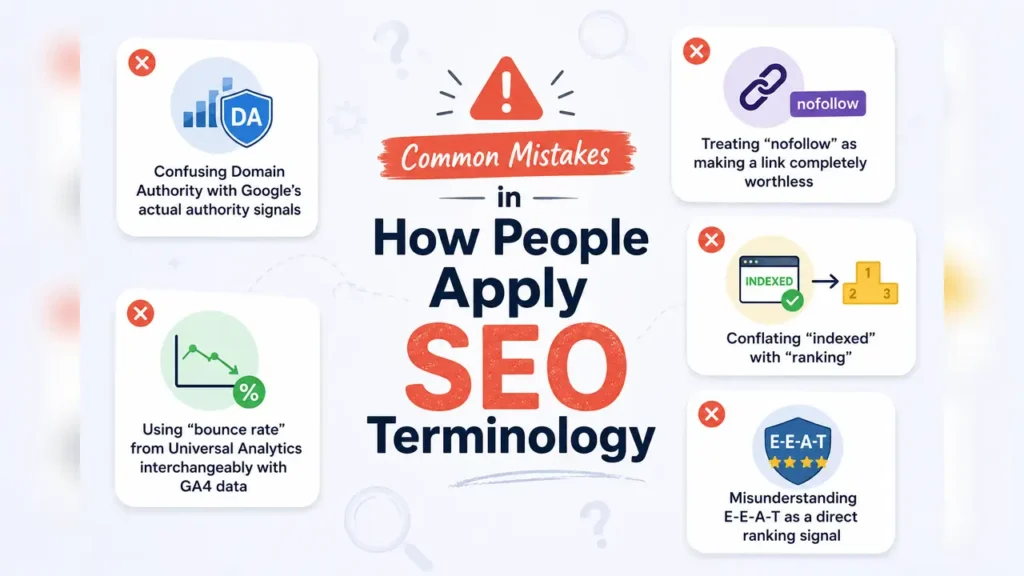
Confusing Domain Authority with Google’s actual authority signals
Domain Authority is a Moz metric, not a Google signal. Many clients and some practitioners treat DA as if it were an official measure of how Google values a site. Decisions made purely on DA without considering Google Search Console data, organic traffic trends, and backlink quality can lead to misallocated effort.
Using “bounce rate” from Universal Analytics interchangeably with GA4 data
Since Google Analytics switched to GA4, bounce rate is no longer the primary engagement metric. GA4 uses Engaged Sessions instead. Comparing GA4 engagement data against historical UA bounce rate data produces misleading trend analysis, a common error in analytics reporting.
Treating “nofollow” as making a link completely worthless
Google has confirmed that nofollow links are treated as “hints” rather than hard instructions since 2019. This means Google may choose to count some nofollow links as signals. Discarding all nofollow link opportunities based on outdated SEO vocabulary is an oversimplification.
Conflating “indexed” with “ranking”
A page being indexed means it is eligible to appear in search results. It does not mean it will rank on page one or even page five for any meaningful query. Many SEO reports present indexation as evidence of success without addressing where pages actually rank or for what terms.
Misunderstanding E-E-A-T as a direct ranking signal
E-E-A-T is a framework used by Google’s human quality raters to evaluate content quality. It is not a direct algorithmic ranking signal with a measurable score. Improvements to E-E-A-T influence algorithm signals indirectly, through better content quality, clearer author attribution, and more authoritative sourcing.
Conclusion
The most practical use of this SEO glossary is not reading it once but returning to it when a term appears in an audit, report, or strategy document that you are not certain you fully understand. Fluency in SEO vocabulary is what separates practitioners who can explain their decisions clearly from those who apply tactics without understanding why they work.
If you want a clear picture of where your website stands across the technical, on-page, and off-page areas covered in this SEO glossary, a structured audit will surface the specific issues affecting your rankings and give you a prioritised plan to address them. Book a free SEO audit with Whamply Media’s team and get an actionable report delivered within 48 hours.
Frequently Asked Questions
What is an SEO glossary?
An SEO glossary is a reference guide that defines the key terms, abbreviations, and concepts used in search engine optimisation. It covers technical SEO vocabulary, on-page and off-page SEO terms, analytics definitions, and algorithm-related terminology used by practitioners daily.
What are the most important SEO terms to know?
The most essential SEO terms include: keyword, backlink, crawling, indexing, ranking, on-page SEO, technical SEO, off-page SEO, E-E-A-T, Core Web Vitals, search intent, SERP, canonical tag, robots.txt, and sitemap. These form the foundation of any SEO practitioner’s vocabulary.
What does SEO stand for?
SEO stands for search engine optimisation, the practice of improving a website to rank higher in unpaid search engine results. The full SEO definition covers content relevance, technical performance, and external authority.
What is the difference between on-page and off-page SEO?
On-page SEO covers optimisation work done on the website itself, including content, title tags, internal links, and page speed. Off-page SEO refers to activity outside the website, primarily earning backlinks from other sites that signal authority to search engines.
What is a backlink in SEO terms?
A backlink is a hyperlink from one website to another. In SEO vocabulary, backlinks are treated as trust signals by search engines. High-quality, relevant backlinks from authoritative websites are among the strongest ranking factors.
What is search intent in SEO?
Search intent is the underlying reason behind a user’s search query, categorised as informational, navigational, commercial, or transactional. Matching content format and depth to search intent is a critical ranking factor in 2026 SEO strategy.
What is E-E-A-T in SEO?
E-E-A-T stands for Experience, Expertise, Authoritativeness, and Trustworthiness. It is Google’s quality evaluation framework used by human raters to assess content quality, particularly for health, finance, legal, and other high-stakes topics.
What are Core Web Vitals in SEO?
Core Web Vitals are three Google-confirmed ranking signals measuring user experience: Largest Contentful Paint (loading speed), Interaction to Next Paint (interactivity), and Cumulative Layout Shift (visual stability). All three should meet Google’s recommended thresholds.
What is the difference between dofollow and nofollow links?
Dofollow links pass link equity (ranking power) from the linking page to the linked page. Nofollow links carry the rel=”nofollow” attribute and historically did not pass equity, though Google now treats them as hints rather than hard rules.
What is crawl budget in SEO?
Crawl budget is the number of pages Googlebot will crawl on a site within a given period. Large sites need to manage crawl budget carefully to ensure important pages are crawled and indexed promptly, while low-value URLs do not consume crawl resources unnecessarily.
What is technical SEO?
Technical SEO is the branch of search engine optimisation focused on website infrastructure, including crawlability, indexation, page speed, mobile-friendliness, HTTPS, and structured data. Technical SEO ensures that search engines can efficiently access and understand a site’s content.
What is a featured snippet?
A featured snippet is a highlighted answer box that appears at the top of some Google search results, extracting a short passage from a ranked page to answer a query directly. Featured snippets are an important SERP feature to target for high-traffic, informational queries.
What is keyword cannibalism in SEO?
Keyword cannibalism occurs when multiple pages on the same website compete for the same keyword, splitting ranking signals and weakening both pages. It is resolved by consolidating competing pages or clearly differentiating their keyword and intent targeting.
What is a canonical tag?
A canonical tag is an HTML element that indicates the preferred version of a page when duplicate or near-duplicate content exists across multiple URLs. It prevents duplicate content issues and consolidates link equity to the designated master page.
What is the difference between black hat and white hat SEO?
White hat SEO follows Google’s guidelines and focuses on building genuine value for users through quality content, legitimate link building, and technical best practices. Black hat SEO uses manipulative tactics that violate guidelines, such as cloaking, keyword stuffing, and paid link schemes, producing short-term gains at the risk of penalties.