
How Does SEO Work? A Plain English Explanation
On this page
22,200 people search for “how does SEO work” every month, and most of them get answers full of jargon that explain nothing useful. Google ranks over 50 billion web pages, yet only one set shows up for any given search, decided by a process that is far less mysterious than most explanations make it sound. This guide breaks down exactly how does SEO work, step by step, in language that does not require a marketing degree to follow.
What Is How Does SEO Work?
How does SEO work is the question of understanding the process search engines use to discover, evaluate, and rank web pages in response to a search query. The SEO process follows three core stages: crawling (discovering pages), indexing (storing and organising page content), and ranking (ordering pages by relevance and quality using algorithms). Understanding how does SEO work means understanding this crawl, index, rank sequence and the hundreds of signals that influence the final ranking outcome.
Why Understanding How Does SEO Work Matters in 2026
Search engines remain the primary discovery mechanism for most online activity, even as AI tools change how people research and ask questions. Understanding how does SEO work gives businesses control over a channel that drives the majority of their visibility, rather than treating organic rankings as something that happens by chance. Whamply’s full SEO services are built around this mechanics-first approach, rather than guesswork or generic tactics.
According to Google’s own Search Central documentation, Google’s index contains hundreds of billions of webpages and is well over 100,000,000 gigabytes in size, and the ranking systems sort through this index in a fraction of a second for every single search. Knowing how does SEO work at even a basic level helps businesses avoid common errors that prevent their pages from being found at all.
In India, understanding how does SEO work has become increasingly valuable as digital ad costs rise and competition for paid placements intensifies. Indian businesses investing ₹30,000 to ₹3 lakh per month in SEO are seeing it deliver compounding returns precisely because they understand the underlying mechanics well enough to prioritise the right fixes first, rather than guessing at tactics without grasping why they work. A structured SEO audit is often the most effective starting point for identifying exactly where a site is failing across the three stages.
The Three-Stage SEO Process: Crawl, Index, Rank
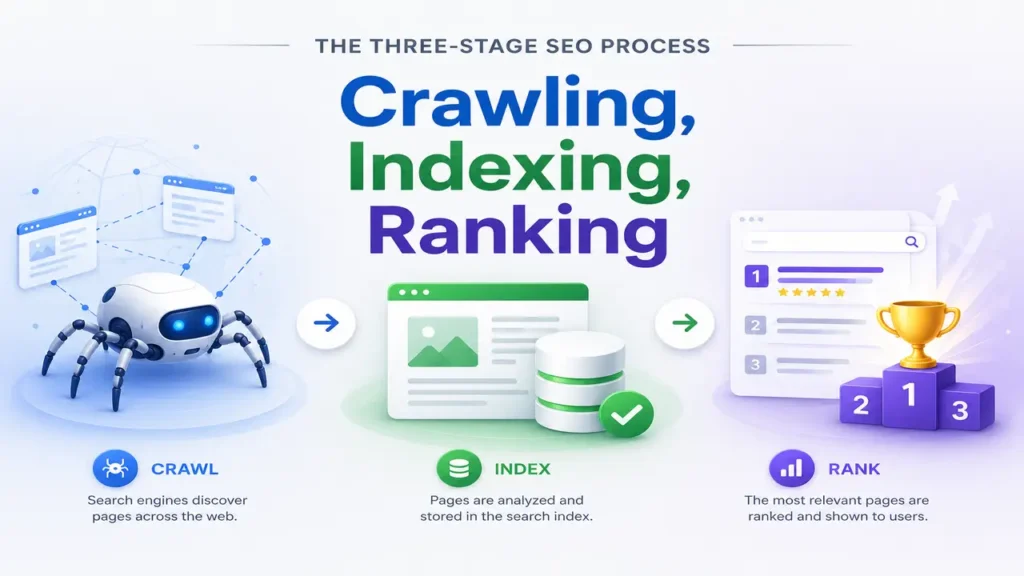
To understand how does SEO work, you need to understand the three sequential stages every webpage goes through before it can appear in search results. Skipping or failing any one of these stages means a page simply will not rank, no matter how good the content is.
Stage 1: Crawling
Crawling is how search engines discover that a page exists. Google uses automated programmes called crawlers, or Googlebot, that follow links from page to page across the internet, much like a person clicking through a website. If a page has no links pointing to it and is not submitted through a sitemap, Googlebot may never find it at all, which is one of the most common reasons businesses turn to a dedicated technical SEO audit to diagnose discoverability issues.
Stage 2: Indexing
Once a page is crawled, Google analyses its content, including text, images, and structured data, then decides whether to store it in the index. A page can be crawled but not indexed if Google judges it to be low quality, duplicate, or blocked by technical settings. Pages that regularly produce high-quality, topically relevant SEO content are indexed faster and more consistently than thin or infrequently updated sites.
Stage 3: Ranking
When someone performs a search, Google’s ranking algorithms scan the index and order the most relevant, useful pages for that specific query. This is where the bulk of SEO work happens. Ranking factors include:
- Content relevance and quality: How well the page answers the search query, an area strong on-page SEO practices directly influence through structure, depth, and clarity
- Backlinks and authority: How many quality external sites link to the page, signalling trust
- Page experience signals: Site speed, mobile-friendliness, and overall usability
- Search intent match: Whether the page format (guide, product page, list) matches what searchers expect for that query
- Freshness: How recently the content was published or updated, particularly important for time-sensitive topics
- Technical accessibility: Whether the page is properly structured and free of crawl or indexing errors
Understanding how does SEO work through this crawl, index, rank lens makes it clear why fixing technical issues, creating quality content, and building authority all matter together, not in isolation.
How Does SEO Work in Practice: A Step-by-Step Breakdown
Knowing the theory behind how does SEO work is one thing. Applying it to an actual website requires a structured sequence of actions. Here is what that looks like in practice.
Step 1: Google’s crawlers discover your page
Googlebot finds your page either by following a link from another page it has already crawled, or by reading your XML sitemap, which you submit through Google Search Console. New websites with no existing backlinks often wait longer to be discovered, which is why submitting a sitemap directly and running a full technical SEO review speeds up the process significantly.
Step 2: Google renders and analyses the page content
Googlebot processes the page much like a browser does, reading the text, rendering JavaScript, analysing images, and identifying the page’s primary topic and structure. Pages that are slow to load or rely heavily on JavaScript that does not render properly can confuse this stage of the process. Well-structured content built with clean HTML and proper headings makes this analysis far easier for crawlers to complete accurately.
Step 3: The page is added to Google’s index
If the content meets Google’s quality standards and is not blocked by a noindex tag or robots.txt rule, the page enters Google’s index. This is the stage where the page becomes eligible to appear in search results, though being indexed does not guarantee ranking for any specific query.
Step 4: A user performs a search query
When someone types a search into Google, the ranking algorithms scan the entire index in real time, identifying every page that could plausibly be relevant to that query. Strong keyword research ahead of content creation ensures your pages are positioned to compete for the queries your actual audience is typing in, rather than guessing at search terms that may have low or no volume.
Step 5: Ranking algorithms order the results
Google’s systems evaluate the matching pages against hundreds of factors, including content relevance, link building authority, page experience, and search intent match, then order them from most to least relevant for that specific search.
Step 6: Results are displayed and continuously re-evaluated
The search engine results page (SERP) is generated and shown to the user. Importantly, this entire process repeats continuously. Google re-crawls and re-evaluates pages regularly, meaning rankings can shift as content ages, competitors publish new pages, or algorithm updates change how relevance is calculated.
Common Misunderstandings About How Does SEO Work
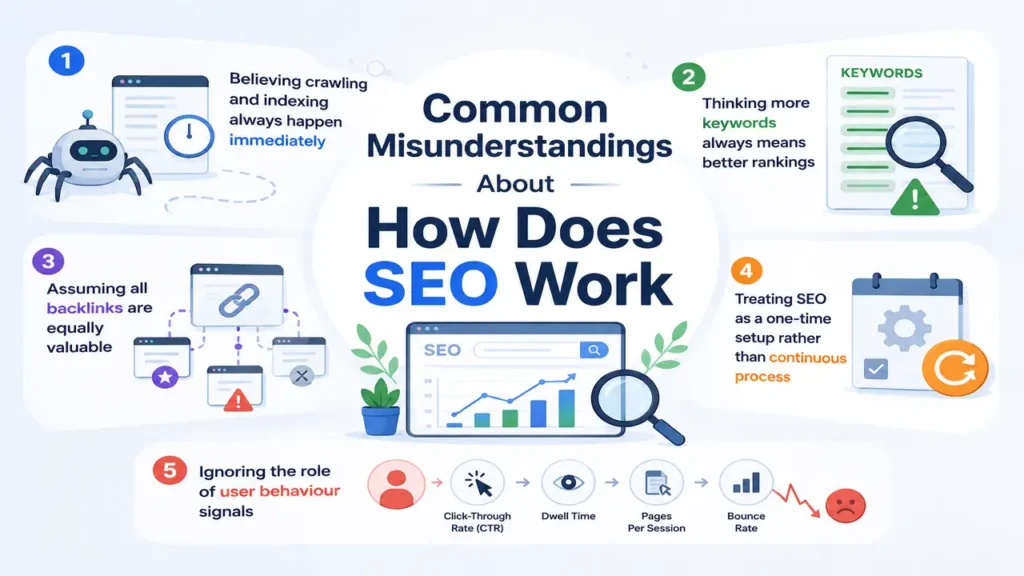
Believing crawling and indexing always happen immediately
Many beginners assume that publishing a page means it instantly appears in Google search results. In reality, crawling and indexing can take anywhere from a few hours to several weeks, particularly for new websites with limited authority and few existing backlinks pointing to them.
Thinking more keywords always means better rankings
Repeating a target keyword excessively throughout a page does not improve rankings and often triggers quality penalties. Modern ranking algorithms evaluate semantic relevance and topic coverage far more than exact keyword frequency, meaning natural, comprehensive content consistently outperforms keyword-stuffed pages.
Assuming all backlinks are equally valuable
Not every backlink contributes positively to rankings. Links from low-quality, irrelevant, or spammy websites can do little to help and occasionally hurt a site’s standing. Understanding how does SEO work at the backlink level means recognising that link quality and relevance matter far more than raw link quantity, which is why a focused link building campaign targets relevant, authoritative sources rather than chasing volume.
Treating SEO as a one-time setup rather than continuous process
Because ranking is recalculated constantly, a page that ranked well a year ago can lose its position if competitors publish stronger content or if the page itself becomes outdated. Ongoing monitoring and content refreshes through an active content marketing programme are part of how SEO actually works in practice, not optional extras.
Ignoring the role of user behaviour signals
How users interact with a page after clicking through from search results, including how long they stay and whether they return immediately, can influence how search engines evaluate that page’s relevance and quality over time. Pages that fail to satisfy user intent despite ranking well often see their positions decline, which is why businesses with a local footprint should also pay attention to local SEO signals that affect how nearby searchers engage with their listings.
Conclusion
Understanding how does SEO work comes down to remembering three words: crawl, index, rank. Make sure your pages can be discovered and crawled, make sure they meet the quality bar to be indexed, and then focus your ongoing effort on the relevance, authority, and experience signals that determine ranking position.
If you understand the theory but are unsure how your own website is performing against each of these three stages, a structured SEO audit will show you exactly where the gaps are. Book a free SEO audit with Whamply Media’s SEO team and get a clear, prioritised action plan delivered within 48 hours.
Frequently Asked Questions
How does SEO work in simple terms?
SEO works through three stages: search engines crawl the web to find pages, index the pages they consider valuable, and then rank those pages in search results based on relevance and quality when someone performs a search. Pages that best match a search query and demonstrate authority and quality rank higher.
What is the SEO process from start to finish?
The SEO process starts with a search engine crawler discovering a page, typically through a link or sitemap submission. The page is then analysed and added to the search engine’s index if it meets quality standards. When a relevant search occurs, ranking algorithms evaluate all indexed pages and order them by relevance, authority, and user experience signals.
What is the difference between crawling, indexing, and ranking?
Crawling is the discovery process where search engine bots find pages by following links. Indexing is the storage and analysis process where discovered pages are evaluated and added to the search engine’s database. Ranking is the final step where indexed pages are ordered in search results based on relevance to a specific search query.
How long does it take for Google to crawl a new website?
Google typically crawls new websites within a few days to a few weeks, depending on the site’s authority, the number of existing backlinks, and whether a sitemap has been submitted through Google Search Console. Submitting a sitemap and requesting indexing manually can significantly speed up this process for new pages.
What factors does Google use to rank pages?
Google uses hundreds of ranking factors, but the most significant categories include content relevance and quality, backlink authority, page experience (speed and mobile-friendliness), search intent match, and content freshness. No single factor guarantees a top ranking; Google evaluates pages holistically across all these signals.
Can a page be indexed but not ranked?
Yes, A page can be successfully crawled and indexed by Google, meaning it is technically eligible to appear in search results, without ranking well or at all for specific search queries. Ranking depends on how well the page competes against other indexed pages for relevance and quality on that particular search term.
Why does my website not show up in Google search results?
A website may not show up in search results due to several reasons: it has not been crawled yet, it has been crawled but not indexed due to quality or technical issues, it is blocked by a noindex tag or robots.txt file, or it simply does not rank highly enough for the specific terms being searched. Checking Google Search Console reveals the exact reason.
How does Google’s algorithm decide which pages rank first?
Google’s algorithm evaluates each indexed page against the searcher’s query using machine learning models that assess relevance, content quality, backlink authority, page experience, and hundreds of additional signals simultaneously. The algorithm is updated regularly, meaning ranking criteria and weightings shift over time as Google refines what produces the best search results for users.
What is a sitemap and how does it help SEO work better?
A sitemap is a file that lists all the important pages on a website, helping search engines discover and crawl content more efficiently. Submitting an XML sitemap through Google Search Console speeds up the crawling and indexing process, particularly for new websites or pages that have few existing internal or external links pointing to them.
Does SEO work the same way for every search engine?
The fundamental crawl, index, rank process is similar across major search engines including Google and Bing, but the specific ranking algorithms and weighting of factors differ between them. Since Google holds the vast majority of search market share globally and in India, most SEO strategies are optimised primarily for Google’s specific ranking systems.
How do backlinks influence how SEO works?
Backlinks act as a trust signal in the ranking process, indicating to search engines that other websites consider a page valuable enough to link to. Pages with more high-quality, relevant backlinks generally rank better for competitive search terms, because backlinks remain one of the strongest indicators of authority within Google’s ranking systems.
What is search intent and why does it matter for how SEO works?
Search intent refers to the underlying reason behind a search query, whether the searcher wants information, wants to make a purchase, or is looking for a specific website. Google’s ranking systems increasingly prioritise matching content format and depth to search intent, meaning understanding what searchers actually want is as important as targeting the right keywords.
How often does Google update its ranking algorithm?
Google makes thousands of smaller algorithm adjustments every year, alongside several major confirmed updates that can significantly shift rankings across entire industries. This is why understanding how does SEO work at a fundamental level, rather than chasing specific tactics, helps websites remain resilient through algorithm changes rather than losing rankings unpredictably.
Can paid advertising improve how SEO works for my website?
No, paid advertising and organic SEO rankings operate through entirely separate systems within Google. Paying for Google Ads does not directly improve organic search rankings. However, the increased traffic and brand visibility from paid campaigns can indirectly support SEO efforts through increased brand searches and potential backlink opportunities over time.
What is the best first step to improve how SEO works for my site?
The best first step is to run a full SEO audit covering technical health, indexing status, and on-page optimisation gaps before creating any new content or building links. Without knowing which of the three stages (crawl, index, rank) is failing, you risk investing effort in the wrong area entirely. Whamply’s free SEO audit service covers all three stages in a single review.