
Social Media Marketing Strategy: A Step-by-Step Guide for Brands
On this page
Brands with a documented social media marketing strategy are 313% more likely to report success than those posting without a plan, according to CoSchedule’s State of Marketing report. Most brands are not failing on social because of bad content. They are failing because they are creating content without a strategy behind it: no defined audience, no platform rationale, no way to measure what is working. A social media marketing strategy fixes that at the foundation, before any content is produced or any budget is spent.
What Is a Social Media Marketing Strategy?
A social media marketing strategy is a documented plan that defines which platforms a brand will use, who it is trying to reach, what content it will publish, how frequently, and how success will be measured. It covers organic reach, paid social advertising, influencer marketing, and community engagement, and connects every social activity back to a specific business goal such as brand awareness, lead generation, or revenue.
Why a Social Media Marketing Strategy Matters in 2026
Social platforms have become pay-to-play for most brand categories. Organic reach on Facebook has dropped below 2% for most business pages, and Instagram’s algorithm increasingly favours accounts that use its full feature set, including Reels, Stories, and broadcast channels, rather than those that only post static images. Without a social media marketing strategy that accounts for platform mechanics, brands spend hours creating content that reaches almost no one.
Paid social has also matured. Meta Ads, LinkedIn Ads, and YouTube Ads now require strategic audience segmentation, creative testing frameworks, and conversion tracking to generate positive returns. Running ads without a broader social media marketing strategy means no brand context for the user clicking, no retargeting architecture, and no organic presence to reinforce what the paid campaign is saying.
In India, the stakes are particularly high. According to Statista, India had over 462 million social media users in 2025, a figure projected to exceed 500 million by 2027. Indian users are highly active on Instagram, YouTube, and WhatsApp, and they engage with content very differently from Western markets, with higher interaction on regional language content, short-form video, and influencer-led recommendations. A social media marketing strategy built for a generic Western audience will underperform significantly in the Indian market.
The Building Blocks of a Social Media Marketing Strategy That Works
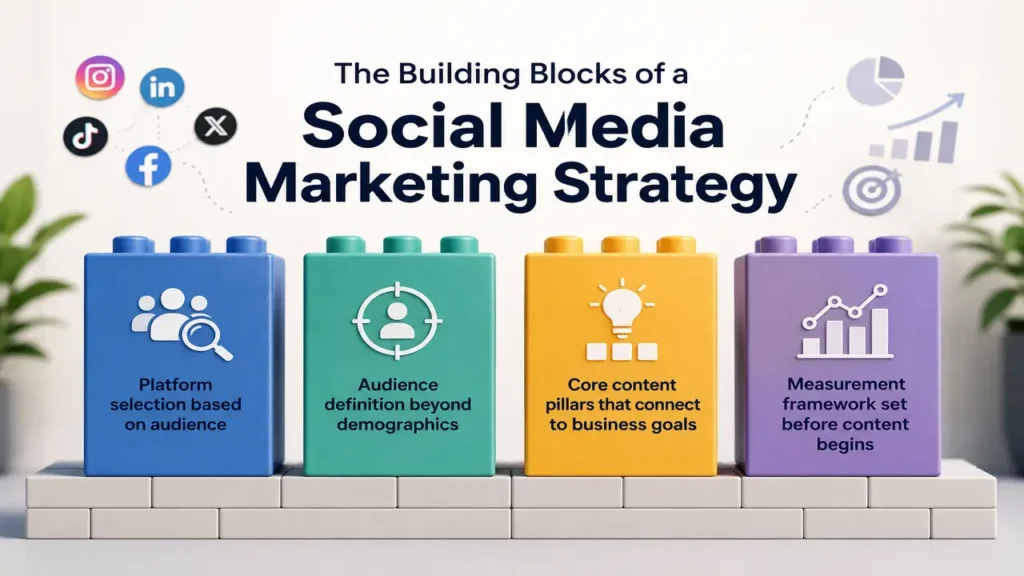
Before you open a content calendar or write a single caption, the foundational decisions of your social media marketing strategy need to be locked in. These are the choices that everything else sits on top of.
Platform selection based on audience, not assumption
The biggest waste in social media marketing is being present on every platform without a reason. A B2B SaaS brand has no business prioritising Instagram marketing over LinkedIn marketing. A D2C skincare brand targeting women aged 18 to 35 in India has no business prioritising Twitter over Instagram and YouTube. Platform selection should come from three inputs: where your audience actually spends time, where your category content performs well, and what your team can produce consistently.
In India specifically, Instagram and YouTube dominate consumer attention across most product categories, while LinkedIn is the primary channel for B2B brand awareness and thought leadership. WhatsApp and community management is increasingly used as a retention and re-engagement channel rather than a top-of-funnel one. Choosing two or three platforms and doing them well consistently outperforms spreading thin across six.
Audience definition beyond demographics
Every social media marketing strategy should include a defined audience profile that goes beyond age and gender. The most useful audience definitions include platform-specific behaviour (what they watch, save, share, and comment on), the content formats they respond to (short-form video versus long-form educational content versus memes), and their relationship with your category (are they already buyers, researchers, or passive browsers?).
Core content pillars that connect to business goals
Content pillars are the three to five recurring themes that all your social content falls under. They keep your social media marketing strategy consistent and give your audience a reason to follow you. Strong content pillars are specific: not “educational content” but “myth-busting common misconceptions about skincare ingredients.” Not “behind the scenes” but “showing the sourcing and craftsmanship behind each product.”
Good content pillars cover:
- Brand story and values content that builds emotional connection over time
- Product or service education that reduces purchase friction
- Social proof in the form of customer stories, reviews, and case study results
- Category expertise content that builds authority and organic reach
- Community content that invites engagement and conversation rather than passive consumption
Measurement framework set before content begins
A social media marketing strategy without a measurement framework is a creative exercise, not a business tool. Set your key metrics before the first post goes live. Brand awareness campaigns should track reach, impressions, and follower growth. Engagement rate measures how actively your audience interacts with content. Lead generation campaigns should track click-through rate, form fills, and cost per lead from social ads. Revenue-focused campaigns need conversion tracking connected to your CRM or e-commerce platform. Whamply’s social media audit service is a strong starting point for brands that want a data-driven baseline before committing to a platform strategy.
How to Build and Execute Your Social Media Marketing Strategy Step by Step
A documented social media marketing strategy removes the guesswork from daily execution and makes it possible to improve performance systematically over time. Here is the process that works across brand sizes and categories.
Step 1: Audit your current social presence before building anything new If you have existing social accounts, start with an audit. Review your last 90 days of content across every platform: what got the most reach, what drove the most engagement, what sent traffic to your website, and what generated leads or sales. Use native analytics on each platform alongside Google Analytics 4 to track what happened after the click. This audit tells you what to keep, what to cut, and where your current content is failing to connect. For brands starting from zero, this step becomes a competitor audit instead: review the top five accounts in your category and identify what content formats and posting frequencies are driving their engagement rate.
Step 2: Define platform-specific goals and content formats Each platform in your social media marketing strategy should have its own goal and its own content format. Instagram marketing might target brand awareness and community building through Reels and carousels. LinkedIn marketing might target B2B decision-maker reach through long-form posts and thought leadership articles. YouTube marketing might target search-driven discovery through educational videos optimised for YouTube SEO. Keeping these goals separate prevents you from posting the same content everywhere and expecting the same results.
Step 3: Build a content calendar that balances consistency with quality A content calendar is the operational backbone of your social media marketing strategy. It should specify posting frequency by platform, content format for each post, the content pillar it belongs to, the caption angle, and the visual or video brief. For most brands, two to four posts per week per platform is a sustainable starting point that maintains algorithmic visibility without sacrificing content quality. In India, posting windows between 12pm and 2pm and 7pm to 9pm IST consistently outperform morning slots across Instagram and Facebook for most consumer categories. Pairing your content calendar with an AI social media content workflow can significantly reduce production time without sacrificing quality or brand voice.
Step 4: Integrate paid social with your organic social media marketing strategy Organic reach alone cannot scale most brands in 2026. Social ads should be treated as an amplification layer on top of strong organic content, not a replacement for it. The most efficient approach is to identify which organic posts generate the highest engagement rate, then put paid budget behind those specific pieces to extend their reach to new audiences. This method, often called “boosting winners,” reduces creative risk and improves social ad performance because the content has already proven it resonates with your existing audience. For brands running Facebook advertising or Instagram advertising, a strong organic feed directly improves ad trust scores and reduces cost per result.
Step 5: Activate influencer marketing as a reach and trust channel Influencer marketing works best when it is integrated into your social media marketing strategy as a distinct channel with its own goals and measurement, not treated as a one-off brand awareness play. For Indian brands, micro-influencer campaigns with 10,000 to 100,000 followers in a specific niche consistently outperform celebrity endorsements on cost-per-engagement and purchase intent metrics. A creator with 30,000 highly engaged followers in the skincare or fitness category will drive more measurable results than a Bollywood endorsement at ten times the cost. Budget for influencer marketing in India typically starts at ₹15,000 to ₹50,000 per micro-influencer post depending on category and platform.
Step 6: Review, test, and iterate every 30 days A social media marketing strategy is not a document you write once. Every 30 days, review your platform analytics, compare performance against your goals, identify the top three performing content pieces, and use those insights to brief the next month’s content calendar. Test one new variable per cycle: a new content format, a new posting time, a new caption style, or a new content pillar. This systematic testing approach builds a compounding performance improvement over time rather than relying on guesswork or trend-chasing.
Common Mistakes to Avoid in Your Social Media Marketing Strategy
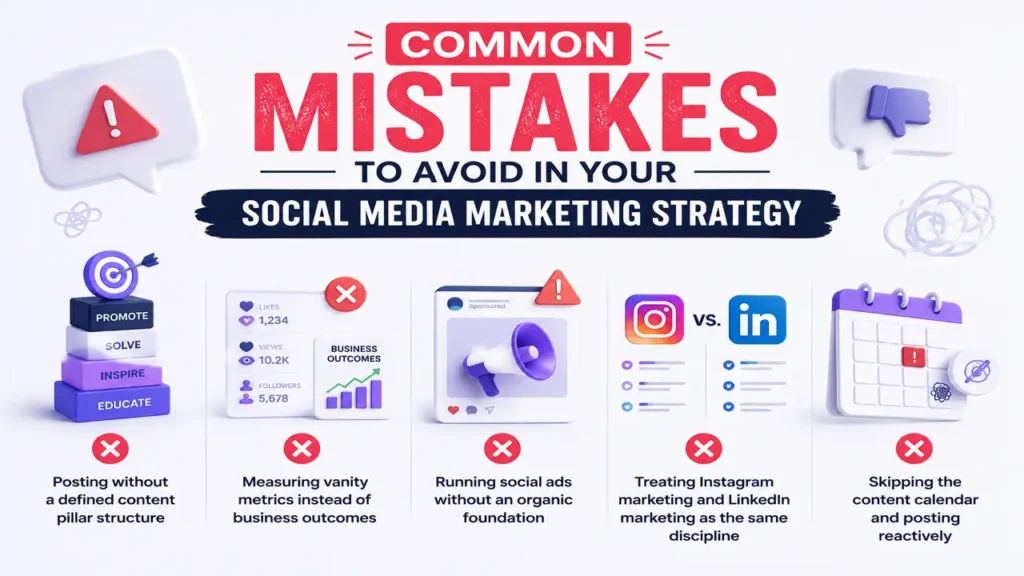
Posting without a defined content pillar structure
Brands that post whatever feels timely or relevant in the moment end up with a social feed that communicates nothing coherent to a new visitor. If someone lands on your Instagram profile and cannot tell within 10 seconds what you do, who you are for, and why they should follow you, your content pillar strategy has failed. Every post should belong to a defined theme that connects to a business goal.
Measuring vanity metrics instead of business outcomes
Follower count and likes are the most visible social metrics and the least useful for evaluating a social media marketing strategy. A brand with 50,000 followers and 0.3% engagement rate is performing worse than a brand with 8,000 followers and 4.2% engagement rate. The metrics that matter are engagement rate, click-through rate, cost per lead from social ads, and ultimately revenue or pipeline influenced by social. Build your reporting around those.
Running social ads without an organic foundation
Social ads work best when the user can click through to an active, credible social profile that reinforces what the ad said. Running social ads from a dormant or low-quality account undermines trust and increases cost per result. The organic social media marketing strategy and the paid social strategy need to be built together, not in separate silos managed by separate teams. For brands concerned about brand damage during campaigns, Whamply’s crisis management service provides a safeguard for social reputation alongside active ad campaigns.
Treating Instagram marketing and LinkedIn marketing as the same discipline
Each platform has its own content grammar, audience behaviour, and algorithmic preferences. The caption style, video length, posting frequency, and content angle that performs on Instagram will almost certainly underperform on LinkedIn. Brands that copy-paste content across platforms without adapting it are paying the cost in lower reach and lower engagement across both.
Skipping the content calendar and posting reactively
Reactive posting produces inconsistent frequency, inconsistent quality, and no strategic thread connecting posts to goals. A content calendar forces strategic thinking upfront and makes it possible to batch-create content efficiently, which consistently improves both quality and posting consistency. Brands that operate without a content calendar typically post twice a week for a month, go silent for three weeks, and then wonder why their organic reach has dropped.
Conclusion
The two decisions that will have the biggest impact on your social media marketing strategy in the next 90 days are defining your content pillars and building a consistent content calendar before publishing anything new. Without those two foundations, every post is a one-off guess rather than part of a compounding brand-building effort.
If you want Whamply’s social media team to audit your current presence and build a platform-specific strategy for your brand, book a free social media audit and receive a channel-by-channel action plan within 48 hours. For brands ready to run paid social alongside their organic strategy, our social media advertising team can get your first campaigns live within a week.
Frequently Asked Questions
What is a social media marketing strategy?
A social media marketing strategy is a plan that defines a brand’s goals on social media, which platforms it will use, who it is targeting, what content it will produce, and how it will measure results. It connects every social activity to a business outcome such as brand awareness, lead generation, or sales, and covers both organic and paid social channels.
How do I create a social media marketing strategy from scratch?
Start with a social media audit of your current accounts or a competitor audit if you are starting fresh. Define your target audience, select two to three platforms where they are most active, set platform-specific goals, build content pillars, create a content calendar, and establish your key metrics before publishing anything. Review performance monthly and adjust based on data.
How often should I post on social media?
For most brands, two to four times per week per platform is the sweet spot between consistency and quality. Posting daily with low-quality content is worse than posting three times a week with high-quality, well-considered posts. Consistency matters more than frequency: an audience that sees you regularly at a predictable rate grows faster than one exposed to an erratic posting schedule.
What is a content calendar and why does a social media marketing strategy need one?
A content calendar is a scheduled plan that maps out what content will be posted, on which platform, in which format, and on which date. It is essential to a social media marketing strategy because it forces upfront planning, enables batch content creation, maintains posting consistency, and creates a clear connection between individual posts and broader campaign goals.
What is engagement rate and why does it matter more than follower count?
Engagement rate is the percentage of your audience that actively interacts with your content through likes, comments, shares, and saves. It matters more than follower count because it measures actual audience connection rather than passive audience size. A high engagement rate signals to platform algorithms that your content is worth distributing further, which directly improves organic reach.
How does influencer marketing fit into a social media marketing strategy?
Influencer marketing works as a reach and trust channel within a broader social media marketing strategy. It is most effective when the creator’s audience matches your target customer, when the content format fits the platform natively, and when influencer activity is measured against specific goals like reach, traffic, or conversion. In India, micro-influencers in specific niches deliver the best cost-per-result for most brand categories.
What is the difference between organic reach and paid social?
Organic reach refers to how many people see your content without paid promotion, based on algorithm distribution and follower engagement. Paid social refers to advertising placements that extend your reach to audiences beyond your existing followers, using targeting parameters like demographics, interests, and behaviours. A strong social media marketing strategy uses both: organic content builds credibility and community, while social ads scale reach and drive direct conversion.
How much should I spend on social ads in India?
For Indian brands starting with social ads, a minimum test budget of ₹15,000 to ₹30,000 per month on Meta Ads (Facebook and Instagram combined) is enough to generate meaningful data across two to three ad sets. Below that, the algorithm does not have enough spend to exit the learning phase and optimise delivery. LinkedIn Ads in India require higher budgets, typically ₹40,000 or more per month, due to higher CPCs in B2B categories.
Which social media platforms should be part of my marketing strategy in India?
For consumer brands targeting Indian audiences, Instagram and YouTube are non-negotiable. Facebook remains relevant for older demographics and for running Meta Ads across both platforms simultaneously. LinkedIn is essential for B2B brands. WhatsApp Business is increasingly important as a retention and re-engagement channel. Pinterest and Twitter play smaller roles in most Indian social media marketing strategies unless the brand’s category has a strong presence there.
How do I measure the success of my social media marketing strategy?
Measure success against the goals you set at the strategy stage. Brand awareness campaigns should track reach, impressions, and follower growth. Engagement-focused campaigns should track engagement rate and saves. Lead generation campaigns should track click-through rate, cost per lead, and lead quality. Revenue campaigns should track conversion rate and revenue attributed to social. Vanity metrics like total likes or raw follower count should not be the primary success indicator.
How does Instagram marketing fit into a broader social media marketing strategy?
Instagram marketing typically serves brand awareness, community building, and product discovery goals within a broader social media marketing strategy. Reels drive organic reach to new audiences. Carousels perform well for educational and product content. Stories maintain daily touchpoints with existing followers. Instagram Shopping connects organic content directly to purchase. Each format serves a different role and should be planned separately within your content calendar.
What is the role of brand awareness in a social media marketing strategy?
Brand awareness is the top-of-funnel goal in most social media marketing strategies. It measures how many people in your target market recognise your brand, what it stands for, and what it offers. Social media builds brand awareness at scale and at lower cost than traditional advertising, particularly through consistent organic content and targeted social ads. Brand awareness investment shortens sales cycles by reducing the amount of education required when a user enters the consideration stage.
How do I build a content calendar for social media?
Start by listing your content pillars, then map each pillar to specific content formats and platforms. Decide on your posting frequency per platform, then fill in the calendar with specific post topics, captions, and visual briefs for the next 30 days. Use a spreadsheet, Notion, or a social media scheduling tool like Buffer or Hootsuite to manage the calendar. Review and refill it at the end of each month based on the previous month’s performance data.
Can small businesses benefit from a social media marketing strategy?
Yes, A documented social media marketing strategy benefits small businesses disproportionately because it prevents wasted effort on the wrong platforms and wrong content types. A small business with a clear two-platform strategy and a consistent content calendar will outperform a larger competitor posting randomly across five platforms. The discipline of strategy matters more when resources are limited, not less.
How does a social media marketing strategy connect to SEO and ?
Social media and SEO share an indirect relationship: social content drives traffic to your website, which generates behavioural signals that support SEO performance. More directly, social content extends the reach of your blog posts, videos, and other SEO-optimised content, compounding the return on each piece you produce. Brands that integrate their social media marketing strategy with a content marketing and SEO strategy get more reach from every piece of content without proportionally increasing production costs.