
How to Use LinkedIn Ads to Generate B2B Leads in 2026
On this page
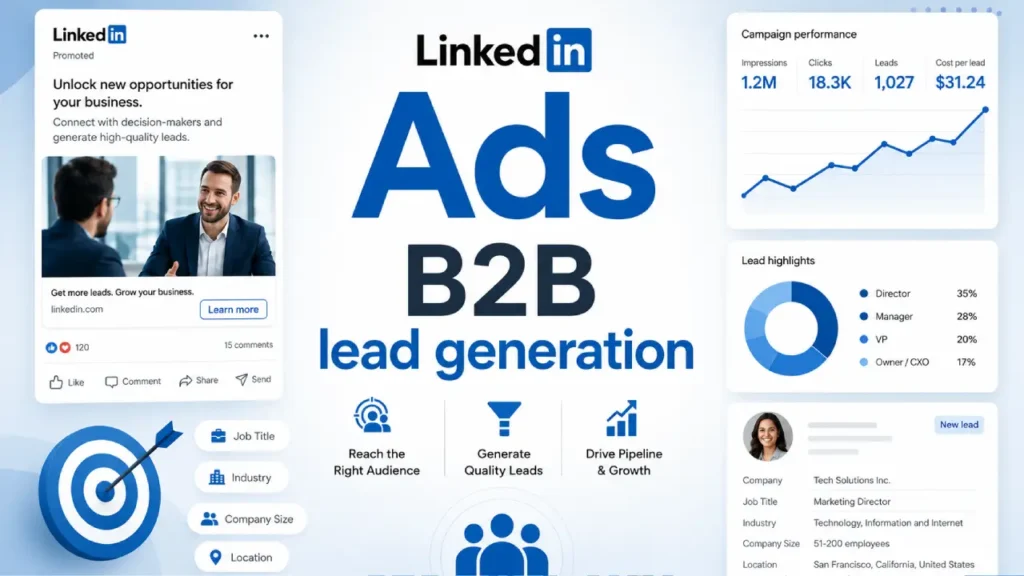
LinkedIn Ads B2B lead generation now costs an average of $5.26 per click globally, and yet companies using LinkedIn’s lead gen forms report conversion rates up to 3x higher than standard landing pages. If you are spending budget on LinkedIn without a structured campaign approach, you are almost certainly paying for traffic that never converts. This guide covers exactly what works in 2026, from targeting logic to ad format selection to budget allocation, based on what actually performs in real campaigns.
What Is LinkedIn Ads B2B Lead Generation?
LinkedIn Ads B2B lead generation is the practice of using LinkedIn’s paid advertising platform to attract, engage, and capture contact information from business decision-makers. It combines LinkedIn’s professional targeting capabilities, including job title, company size, seniority, and industry, with ad formats like sponsored content, InMail ads, and lead gen forms to move potential buyers from awareness to qualified lead status within the platform itself. Unlike broad digital advertising, LinkedIn Ads B2B lead generation targets professionals by their career identity rather than browsing behaviour, making it particularly effective for high-value B2B sales cycles.
Why LinkedIn Ads B2B Lead Generation Matters in 2026
LinkedIn now has over 1 billion members globally, with more than 130 million in India alone. The platform has become the primary channel for B2B advertising among mid-market and enterprise brands, especially as third-party cookie targeting on Google and Meta continues to erode.
According to HubSpot’s 2024 State of Marketing Report, LinkedIn generates 2x higher conversion rates for B2B marketers compared to other social platforms. That gap has widened into 2026 as LinkedIn has layered in AI-powered audience tools and enhanced its Predictive Audiences feature, which builds lookalike segments from your CRM data.
In India specifically, the rise of SaaS companies targeting global enterprise clients has made LinkedIn Ads B2B lead generation a near-essential channel. Indian B2B advertisers are seeing average CPLs (cost per lead) ranging from ₹1,200 to ₹4,500 depending on target audience seniority and industry vertical, which compares favourably to the cost of SDR outreach at scale. If you are running B2B lead generation campaigns in India or targeting global buyers from India, LinkedIn is consistently the most cost-efficient channel for enterprise-level deals.
Choosing the Right LinkedIn Ad Formats for B2B Lead Generation
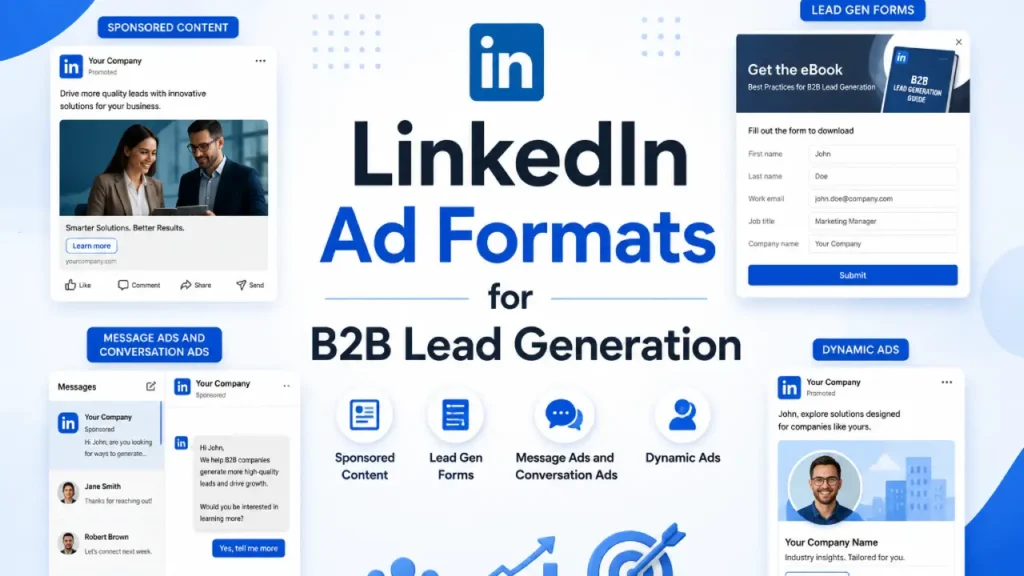
Not every LinkedIn ad format works equally well for LinkedIn Ads B2B lead generation. The format you choose should match where the buyer is in the funnel and how much information they need before they will hand over their details.
Sponsored Content is the workhorse of LinkedIn Ads B2B lead generation. These are native posts that appear in the feed, either as single image, carousel, or video. LinkedIn sponsored content works well for top-of-funnel awareness and middle-of-funnel content offers. A carousel showing five common mistakes a CFO makes when choosing ERP software, for example, tends to outperform a generic product ad.
Lead Gen Forms are LinkedIn’s own in-platform form format, pre-filled with a user’s profile data. Because the user does not need to leave LinkedIn, friction drops sharply. These forms work best when attached to a specific content offer: a whitepaper, a benchmark report, a free audit. They are particularly effective for LinkedIn Ads B2B lead generation campaigns targeting senior buyers who are unlikely to fill out a long external landing page form on mobile. If you are running a dedicated LinkedIn Ads campaign, lead gen forms should almost always be part of your format mix.
Message Ads and Conversation Ads (formerly InMail ads) go directly to a member’s LinkedIn inbox. They have open rates that typically sit between 30% and 50%, significantly higher than email. The catch is frequency caps: LinkedIn only allows a member to receive one sponsored message every 30 days from any given advertiser. Use InMail ads for high-intent moments: event invitations, demo requests, or time-sensitive offers.
Dynamic Ads personalise automatically using the viewer’s profile photo and name. They are best suited for retargeting and brand recall rather than cold lead generation. For more sophisticated retargeting flows, a dynamic remarketing strategy running in parallel with your LinkedIn campaigns keeps your brand visible across channels between touchpoints.
Here is a quick reference for format selection:
- Sponsored Content (Single Image): Top-of-funnel awareness, content promotion
- Sponsored Content (Video): Product explainers, case study highlights, thought leadership
- Carousel Ads: Educational content, step-by-step guides, multi-product features
- Lead Gen Forms: Mid-funnel content offers, webinar sign-ups, demo requests
- Message Ads / Conversation Ads (InMail ads): High-intent outreach, event invites, retargeting
- Dynamic Ads: Retargeting, follower campaigns, brand awareness at scale
How to Set Up a LinkedIn Ads B2B Lead Generation Campaign Step by Step
Setting up a LinkedIn campaign correctly from the start avoids wasted spend and gives your campaign the data it needs to optimise. Here is the exact process used in campaigns that generate consistent qualified pipeline.
Step 1: Define your ICP before you touch Campaign Manager Your ideal customer profile needs to be job title-specific, not just industry-broad. “Marketing professionals at tech companies” is too wide. “VP of Marketing at B2B SaaS companies with 200 to 1,000 employees in North America or UK” is workable. LinkedIn’s targeting allows you to layer job function, seniority, company size, and geography simultaneously. Be precise. For Saas lead generation in particular, ICP precision on LinkedIn is what separates campaigns that generate enterprise pipeline from those that fill a CRM with unqualified contacts.
Step 2: Choose your campaign objective LinkedIn Campaign Manager groups objectives into Awareness, Consideration, and Conversion. For LinkedIn Ads B2B lead generation, you will almost always use either Lead Generation (which enables lead gen forms natively) or Website Conversions (if you have a landing page with tracking set up). Avoid Engagement objectives for direct lead gen; they optimise for likes and comments, not form fills.
Step 3: Build your audience with Matched Audiences first Before using interest-based or attribute-based targeting, upload your CRM contact list or connect your CRM via LinkedIn’s integration. This creates a Matched Audience you can use for retargeting or exclusions. Then build a cold audience using the targeting attributes relevant to your ICP. LinkedIn’s B2B advertising audience tools now include Predictive Audiences, which is worth enabling once you have at least 300 leads in your CRM list for LinkedIn to model from. Pairing this with CRM automation ensures your matched audiences stay fresh and your lead data flows cleanly into your sales pipeline.
Step 4: Select your ad format and create your assets Match the format to the funnel stage. For cold audiences, lead gen forms attached to a content offer (report, checklist, webinar) consistently outperform ads asking for a demo directly. Save the direct demo request for retargeting audiences who have already engaged with your brand content.
Step 5: Set your bid strategy and budget Start with Maximum Delivery (automated bidding) for the first two to three weeks to gather cost data. LinkedIn’s minimum daily budget is $10 USD (approximately ₹830), but realistically you need at least $50 to $100 per day to generate meaningful volume in competitive B2B niches. Once you have enough conversion data (50+ leads), switch to Cost Cap bidding to control your CPL. For a clearer view of what paid B2B lead generation costs at different budget tiers, Whamply’s lead generation services page breaks down typical CPL benchmarks by channel and industry.
Step 6: Monitor, test, and iterate LinkedIn’s reporting dashboard shows impressions, clicks, click-through rate, leads, CPL, and lead form completion rate. Watch lead form completion rate closely. If it drops below 10%, your offer or the form questions may be misaligned with what the audience expects. A/B test one variable at a time: headline, creative, offer, or audience. Do not test multiple variables simultaneously or you will not know what drove the change.
Common Mistakes to Avoid in LinkedIn Ads B2B Lead Generation
Targeting too broadly to “see what works” LinkedIn’s CPCs are high precisely because the targeting is precise. Broad audiences like “all marketing professionals” or “anyone at a company with 50+ employees” will spend your budget fast and deliver low-quality leads. Start narrow with your highest-confidence ICP segment and expand only when you have proof it converts.
Sending cold traffic directly to a demo request Asking a cold prospect to book a sales call before they have any context about your product is one of the most common and expensive mistakes in LinkedIn Ads B2B lead generation. Cold audiences need a value exchange first: a report, a tool, a benchmark, something they want for their own reasons. Warm them up with LinkedIn sponsored content before asking for a meeting. Pairing this with a well-built landing page optimisation strategy further increases the chance that warm leads who do click through actually convert.
Using the same creative for more than six weeks LinkedIn ad frequency caps are softer than Meta’s, but creative fatigue still sets in. When your frequency per member climbs above 5 impressions in a 30-day window, CTR typically starts to fall. Rotate creative assets regularly and track frequency in Campaign Manager’s reporting columns.
Ignoring lead quality in favour of volume LinkedIn lead gen forms make it very easy to get a high volume of leads, especially with a low-friction offer. The problem is that not all leads are equal. If your sales team is complaining that LinkedIn leads never convert, the issue is usually audience targeting or offer mismatch, not the platform itself. Set up a lead quality feedback loop between marketing and sales from day one. Using lead automation tools to score and route leads the moment they come in prevents the common problem of high-volume, low-quality pipelines sitting untouched in a CRM.
Skipping the LinkedIn Insight Tag and post-lead nurturing The LinkedIn Insight Tag is a small piece of JavaScript that goes on your website. It enables website retargeting, conversion tracking, and demographic reporting on your site visitors. Running LinkedIn Ads B2B lead generation without it means you are flying blind on attribution. Install it before you launch any campaign. Equally important: once a lead comes in, do not let it go cold. Setting up an email automation services to nurture LinkedIn leads over 5 to 7 days dramatically improves the rate at which those leads convert to booked meetings.
Conclusion
The two things that move the needle most in LinkedIn Ads B2B lead generation are audience precision and offer relevance. Get your ICP targeting right and pair it with a genuinely useful content offer, and the economics of the platform become far more favourable. Everything else, bidding, format, creative, is optimisation on top of that foundation.
If your current LinkedIn campaigns are generating clicks but not qualified leads, the issue is almost always one of these two things. An independent audit of your targeting and offer strategy will surface the problem faster than any amount of bid adjustment.
Ready to get more from your LinkedIn Ads investment? Book a free 30-minute LinkedIn Ads campaign audit with our B2B paid media team. We will review your current campaign structure, targeting setup, and lead quality data and give you a prioritised action plan. Book your free audit today.
What is the average cost per lead for LinkedIn Ads B2B campaigns?
Average CPL on LinkedIn for B2B campaigns ranges from $40 to $200 USD depending on the industry, audience seniority, and offer type. In India, B2B advertisers typically see CPLs of ₹1,200 to ₹4,500. Technology and financial services tend to sit at the higher end due to audience competition.
Are LinkedIn lead gen forms better than sending traffic to a landing page?
LinkedIn lead gen forms generally produce higher conversion rates because they are pre-filled with the user’s profile data and require no page load. However, landing pages give you more control over messaging and allow for longer-form qualification. Use lead gen forms for top-of-funnel offers and landing pages when you need to qualify intent more carefully. Whamply’s landing page optimisation service can help you build pages specifically designed to convert LinkedIn traffic.
What budget do I need to start LinkedIn Ads B2B lead generation?
The minimum is $10/day, but this is not enough to gather actionable data. A realistic starting budget is $1,500 to $3,000 USD per month for meaningful testing. In Indian rupees, that is approximately ₹1.25 lakh to ₹2.5 lakh per month. Below this threshold, campaigns typically do not generate enough leads to optimise bid strategy or creative.
What LinkedIn ad format works best for B2B lead generation?
Lead gen forms attached to LinkedIn sponsored content consistently produce the best results for direct lead capture. For awareness and nurturing, video ads and carousel ads perform well. InMail ads (Message Ads) work best for retargeting and high-intent outreach rather than cold prospecting.
How do I target decision-makers on LinkedIn?
Use a combination of Job Title, Seniority Level, and Job Function targeting. For senior decision-makers, layer Seniority (VP, C-Level, Director) with Job Function rather than relying solely on job titles, since job titles vary widely between companies. You can also upload a list of target accounts for account-based marketing campaigns using LinkedIn’s Matched Audiences feature.
What is account-based marketing on LinkedIn and how does it work?
Account-based marketing (ABM) on LinkedIn involves targeting specific named companies rather than broad audience segments. You upload a list of target accounts to LinkedIn, which then shows your ads only to employees of those companies. It is particularly effective when your sales team is already engaged with certain accounts and you want to support outreach with B2B advertising at scale. Whamply’s LinkedIn advertising service includes full ABM setup and execution for B2B brands.
How long does it take to see results from LinkedIn Ads B2B lead generation?
Most campaigns need at least four to six weeks to exit the learning phase and produce stable CPL data. LinkedIn’s algorithm requires around 50 conversion events (leads) before it can optimise delivery effectively. Plan for a 60 to 90 day runway before judging campaign performance marketing or making major strategic changes.
What is the LinkedIn Insight Tag and why do I need it?
The LinkedIn Insight Tag is a tracking pixel that you install on your website. It powers conversion tracking for LinkedIn Ads, enables website retargeting audiences, and provides demographic data on your site visitors. Without it, you cannot run website retargeting campaigns or accurately measure ROI from your LinkedIn Ads B2B lead generation efforts.
How do I measure the ROI of LinkedIn Ads for B2B lead generation?
Track CPL, lead quality score (defined by your sales team), pipeline generated, and revenue attributed. Connect LinkedIn Campaign Manager data with your CRM using UTM parameters or LinkedIn’s native CRM integrations (Salesforce and HubSpot are both supported). Revenue-per-lead and pipeline-to-spend ratio are more meaningful metrics than CPL alone. Combining this with CRM automation makes attribution reporting far more accurate and keeps your pipeline data clean.
Can I use LinkedIn Ads for B2B lead generation in India targeting global clients?
Yes, Many Indian B2B SaaS and services companies run LinkedIn Ads targeting buyers in the US, UK, and Europe. LinkedIn’s targeting is geography-based, not account-location-based, so you can target decision-makers in any country regardless of where your business is headquartered. Ad creative and offers should reflect the target market’s context, not the advertiser’s location.
What is a good click-through rate for LinkedIn Ads?
The average CTR for LinkedIn sponsored content is around 0.44% to 0.65%. A CTR above 0.8% is considered strong. For InMail ads, average open rates sit between 30% and 50%, with click-to-open rates of 10% to 15% being healthy benchmarks for a well-targeted message.
Should I use LinkedIn Ads or Google Ads for B2B lead generation?
They serve different intent stages. LinkedIn Ads B2B lead generation works best for reaching buyers who are not yet actively searching but match your ICP by role and company type. Google Ads capture buyers who are already searching for solutions. The most effective performance strategies use both: LinkedIn for demand generation and Google for demand capture.
How many ad variations should I test in a LinkedIn campaign?
Start with two to three creative variations per ad set. LinkedIn recommends a minimum of two ads per campaign to enable A/B testing. Test one variable at a time: headline, image, CTA text, or offer. Avoid testing too many variables simultaneously, particularly in smaller-budget campaigns where data accumulates slowly.
What industries get the best results from LinkedIn Ads B2B lead generation?
B2B SaaS, IT services, consulting, financial services, HR technology, and manufacturing all see strong results. LinkedIn’s professional audience skews towards knowledge-economy sectors. Industries with long, relationship-driven sales cycles tend to benefit most because LinkedIn’s targeting precision helps reach the right people early in their buying process.
What is the difference between Sponsored Content and Sponsored InMail on LinkedIn?
LinkedIn sponsored content appears in the feed like a native post and is seen by a broad audience matching your targeting criteria. Sponsored InMail (now called Message Ads) is delivered directly to a member’s LinkedIn inbox and is seen only by the specific recipient. Sponsored content builds awareness at scale; InMail ads are more personal and better suited for high-value, one-to-one outreach moments. If you want to combine both as part of a full-funnel B2B lead generation strategy, sequencing them — awareness first, InMail second — consistently outperforms using either in isolation.